Showing posts with label Books. Show all posts

Saturday, 11 February 2012

Bookish

 An entry to Sepia Saturday, "Using old images as prompts for new reflections"

I have always loved books, perhaps too much
 because I obviously couldn't be without one on this day out on Hoad Hill, Ulverston.  I remember these little books, they were a set that fitted into a box sleeve. I have no idea who the legs with summer skirts belong to, one would have been my mother. I can remember as a child seeing pictures of people reading in different positions and experimented to see if one would replace curling up on a chair, such as lying on my stomach (too uncomfortable for long periods of time),  but never tried sitting on a branch
 which does look rather spiffing to use the word that could have been used in this book full of stories full of adventure such as "Betty's Besetment" "The Detectives" and "Out of the Storm.  Even if I did not know that this book was published in the 1930s I would know it was my mothers rather than mine because no book illustration would be left uncoloured in a book owned by me as a child.  I wonder which section I would have started on first, possibly the tree flowers, although the dress flowers would be tempting, then again the broad sweeps of the branch would be relaxing.  Although I have never sat on a high branch to read I did used to 
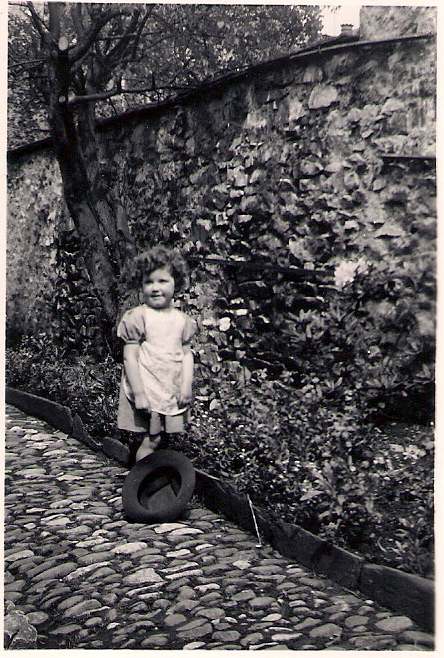
use the lilac tree in the background of this photo to gain access to the wall (not when this picture was taken, those 3 year old legs would never have made it).   On the other side of the wall was a builders yard, which had interesting stacks of wood, copper tubes for plumbing and the coming and goings of the builders. On warm summer days it was my favourite place to sit drying my hair after having it washed.   We left this house when I was 12 years old but I think I gained my love of walled gardens from this time, not to mention hats. But here is a much more elaborate hat

 From the North Yorkshire Library Collection
in an idyllic spot for a quiet moment with a book on the River Greta at Ingleton in 1912, (woman and photographer unknown).

Sunday, 29 May 2011

Green Lanes

I have a few old nature books which I love for their illustration. This is the frontispiece of one of them. The swallow in pursuit of another hunter, the dragonfly.  The sight of swallows as they first arrive and when they swoop through the air in summer is one of the joys of the natural year.  The book does not credit its illustrators but their names are on the drawings, this one is in the bottom right corner, Whymper.  I think this may be Edward Whymper mountaineer and explorer, who is probably most famous for the first ascent of the Matterhorn. When he was not climbing he was an engraver of illustrations for books and magazines.

The book has a slightly battered cover
which I like to think is from being in a pocket while wandering those green lanes, maybe getting a bit damp when observing life in a tarn.  This book is a seventh edition published in 1890. Its author John Taylor was curator of the Ipswich Museum and both a geologist and a naturalist, writing about his specialist subjects in an entertaining way.  In his preface to this edition he ends by saying if the reader "has developed a love for the multitudinous natural objects which surround us, his pleasant labours have not been in vain".

 An entry to Sunday Scans.  A weekly meme dedicated to anything scanned.

Monday, 26 July 2010

English Journeys

Nathan Burton has designed the covers for the new Penguin 'English Journeys' series. After seeing some of the covers on Caustic Cover Critics blog I wanted to rush out and buy them all immediately however  I managed to resist the urge and just got The Clouded Mirror, Rolt's meditation on canals, the English landscape and "endless summer days of childhood", together with

Henry James's travels around the corners of England.  This series of 20 little books each of which consist of  about 100 pages, cover poetry, gardens, walks, nature, the countryside, the perfect companions to take on a journey around England, even if you just wanted to gaze at the covers.

Friday, 29 January 2010

The Visitor by Maeve Brennan

This novella has been called a "jewelled miniature" and it is certainly full of iridescent sentences, portraying a world of insularity like a piece of amber with the characters trapped inside.

The story is the return of Anastasia King from Paris (where she has been living with her, now dead, mother), to her grandmother's house in Dublin.

"All the houses in the square were tall, with heavy stone steps going up to the front doors. They were occupied by old people, who had grown old in their houses and their accustomed ways. They disregarded the inconveniences of the square houses, their dark basements and draughty landings, and lived on, going tremulously from one wrinkled day to the next, with an occasional walk between the high stone walls of their gardens".

There is no enthusiastic welcome as she enters in the house in fact it is implied that this is only to be a temporary visit, which is not what Anastasia wants to hear.

"Home is a place in the mind. When it is empty, it frets. It is fretful with memory, faces and places and time gone by. Beloved images rise up in disobedience and make a mirror for emptiness".

The domineering grandmother that wants to be left alone with the grief for her dead son, and Anastasia the granddaughter who wants to be loved. At first the reader's sympathies are with this lost young girl surrounded by elderly women but as the story moves on irritation starts to build and I felt like shouting, get a grip and stop moping around, but self absorption prevents Anastasia from doing this.

Brennan's characters unfold as the novella advances and a sense of unease builds through the pages. With the introduction of Miss Kilbride, a friend of Anastasia's mother, it seems as though this might be the answer to Anastasia's isolation, but this leads to a shocking incident that shows another aspect of her character.

Verdict - A short book that packs a punch and I could read time and again just for the beautiful prose.

Maeve Brennan died in obscurity in 1993 but her posthumously published books have attracted many admirers. Born in Ireland (1917) she emigrated, with her parents to America in 1934 and went on to write a column and short stories for the New Yorker, but the latter part of her life disintegrated into mental instability.

The Irish author Roddy Doyle was distantly related to Maeve and met her, but at the time much to his regret, he did not know she was a writer and describes her as "small and exotic". When asked if she would be considered an American or Irish writer hes says that with the discovery of her writing in the latter part of the century she was perceived as a new Irish writer who had been discovered 8 years after she died.

In the following audio he briefly discusses her with Deborah Freisman of the New Yoker, and then reads a short story called 'Christmas Eve' which is written in a much simpler style than 'The Visitor' but in its domesticity tells a powerful story. Doyle thinks, that although "he might be biased", her Dublin set stories are her best.


Saturday, 16 January 2010

The Birds & Other Stories


by Daphne Du Maurier (1907-89). A prolific author who I have never read but whose stores have seeped into my consciousness through films. Giles Coren, journalist, novelist and food critic, participating in a book quiz did not know her work and said he thought she was a sort of "chick lit" author. The master of cinema Alfred Hitchcock did not seem to think so (not that that term existed back then; I wonder what other dismissive term was used) and certainly appreciated her imagination, and made a trio of films from her books - Jamaica Inn (1939), Rebecca (1940) and The Birds (1963). They all have one thing in common, threat and peril.

When this collection of six stories was first published The Birds was not the original story headlined, but a quieter but equally spooky tale, The Apple Tree. The publisher Virago no doubt thought the more familiar story would be a better selling point, and it worked because that is what made me pick it up.

Hitchcock only read The Birds once and said to Francois Truffaut "What I do is to read a story only once, and if I like the basic idea, I just forget about the book and start to create cinema" so none of Hitchcock's ice cold blondes appear, or the American locale of California. Du Maurier sets her story in the place that inspired her, Cornwall, and it is probably a more ominous tale not just an apocalyptic allegory, and prescient of the destruction of ecosystems in which a collective consciousness of nature might turn and confront humankind. The story start in an unusually bleak and cold winter, one man tries to protect his family but how successful will he be. There may be no escape in this tale.

All but one of the stories has an element of the supernatural but there is also a sense of the natural world ever present. Here are some one liners of the stories, so as not to give too much away -

Monte Verita; set somewhere in the alpine regions "in the mountains we come closest to whatever Being it is that rules our destiny" and "They have the secret of life in Monte Verita", about a community in the mountains of which the locals are afraid. The narrator tells the story of his friend Victor's marriage to a Welsh girl called Anna which is a happy one, but she is lost to him in the mountains and our narrator tries to find her.

The Apple Tree; may be about madness or a haunting.

The Little Photographer; a story of a bored self centred young woman and an infatuated photographer and a betrayal.

Kiss Me Again Stranger; be careful of who you pick up

The Old Man; who are the strange, isolated family who fascinate our narrator? This is the shortest story in the collection but a quite perfect vignette, with a surprise ending.

Verdict: Great short stories that tell more in 30 pages than perhaps some 300 page books.

Friday, 8 January 2010

Discovery of Heaven by Harry Mulisch

First published in Dutch as 'De ontdekking van de hemel' in 1992 and translated by Paul Vincent in 1996.

A 700 page chunkster of a book (although the original Dutch was even chunkier) that roams through philosophy, architecture, linguistics and theology. In other words this is probably a great book for cold winter days and dark nights when you have time on hand.

page 4 -"That's right, They have discovered our profoundest concept - namely, that life is ultimately reading. They themselves are the Book of Books. In the year 1869 the wretched creatures discovered the DNA in the cell nucleus, and at the time we kidded ourselves that it was of no great significance, because they would never have the bright idea that the acid contained a code - and in any case would never be able to break it - but a hundred human years later they had deciphered the genetic code down to its subtlest details. We made them too clever, using the very same code.

The premise of the book is that the covenant has been broken between The Chief and mankind beginning in the 17th century with Francis Bacon's* pact with Lucifer. Rationalism and the Age of Reason follow as mankind gain more knowledge. The book stats as a conversation between tow inhabitants of another sphere, which one presumes to be some sort of heaven, discussing how they have to do something to prevent the human race discovering heaven by putting on earth a 'spark', a human deus ex machina. A lot of things have to be contrived before that happens, which include two world wars and much death and destruction heading for one point, where the book begins. A meeting in the 1960s between Onno Quist, black sheep of a powerful political Dutch Calvinist family and Max Delius, son of a Jewish mother and a German Nazi father. The two intellectuals become bosom friends.

The first chapters are very slow, after a racy prologue, but I guess if you are manipulating fate it takes time; which moves much faster for immortals than for mere humans. It ticks along quite nicely when the wheels of destiny start to turn.

Max meets Ada Brons and they become lovers but she discovers that the bond between him and Otto is greater than his love for her so she finishes the affair, but moves in with Otto. The three friends travel to post revolutionary Cuba where a baby is conceived, but Ada does not know who the father is, Onno or Max. She marries Onno and Max attends the wedding.

Page 242 - "There was a rather charged atmosphere. The Amsterdam style with which everything was being done here - the bride and groom on a bike, the reception in a pub, artists everywhere, freethinkers and Reds, no sign of clergyman; instead, a revolutionary document from the Napoleonic period - and now they were saddled with a war criminal from the German occupation: their dismay was not entirely incomprehensible. Such things did not happen in The Hague. Of course everyone at this table knew who his father was, but hence who his mother had been. People here knew everything - except who he was. Onno's brother... offered him a chair with a friendly smile , and when he sat down amongst them he felt the weight of the family"

Ada's father has a heart attack while she and Otto are visiting Max's workplace and they set off in a storm to the hospital, but a tree falls on the car, and although they all survive, Ada is in a coma. The baby is born some months later by cesarean section, Ada is still unconscious. Everyone loves this beautiful baby that never cries and has mesmeric eyes. But who is going to look after him? Various members of Otto's family offer but Max suggest that he and Ada's mother act as foster parents and this is what happens. This new family move in together as Max takes up an astronomy position outside Amsterdam. where a great radio telescope is being built. and with Otto's connections take residence in part of a castle occupied by artists and intellectuals who will, as fate planned, educate the young Quinten for his ultimate purpose and destiny.

The telescope is positioned on land where there was once a camp during the war for Jews, like Max's mother, before being sent to concentration camps. All traces of that previous purpose are being eliminated. This is really the core of Mulisch's exploration of 20th century Dutch history and psyche, but through the prism of Greco-Roman philosophy and the place of man in the universe as well as the Judea-Christian ideas driving the plot as time moves through the second half the the century and the world changes.

The novel is divided into four sections from "the beginning of the beginning" through to "the end of the end" and the 65 chapter headings each contain an idea, which is a wonderful construct.

This is a bumper book of ideas and a tour de force of writing but essentially I found it a rather cold book. I did not really care about any of the people and their concerns and felt they were essentially just devices to move the plot along. Maybe Mulisch was behaving as capriciously as the gods with his characters.

People love 'Discovery of Heaven' and seem to read it more than one, it certainly has enough ideas in it to stand more readings and maybe also lead to exploring the subjects he discusses.

The book has excited enough interest for a film to be made, with Stephen Fry taking the part of polymath Otto, on the insistence of Harry Mulisch, a choice which I think would work very well. How much of the book would transpose to film I'm not sure.

Verdict - An interesting book makes me want to have a look at others he has written. The Complete Review have a overview of his work here

Quote by Harry Mulisch in an interview I rather like "I have a theory that everybody has an absolute age which he will always have. My absolute age is 17"

*Footnote on Francis Bacon

I studied the Renaissance as part of a course many moons ago so those concepts in the book were familiar to me but I knew very little about Francis Bacon and had to look him up in the Oxford Companion to English Literature.

He started off his career as a barrister and then was elected to parliament in 1584, but had a driven ambition. He was taken up and helped by Queen Elizabeth's favourite, Essex, who he was later to prosecute and convict of treason. Off came Essex's head. He rapidly progressed after Elizabeth's death and was created Viscount St Albans but was convicted of taking bribes and his public life was over in disgrace. His writings were very influential and these are the ones that concern Mulisch, as Bacon contributed to the division between art and science in contemporary, although not his own, time.

In one of those strange coincidence that often happen in life I read the following reprinted in, I think, the Independent newspaper as :

Best interview question

"Rudolf Freiburg: Are you familiar with...Bacon's doctrine of the faculties of the mind, ratio, memoria and imaginatio?

Julian Barnes: Francis Bacon?

Freibur: Yes, Sir Francis Bacon. He sees parallels between faculties of the mind and fields of human knowledge. So memoria corresponds to history, ratio to philosophy, and imaginatio to poetry or literature. And then he says 'Get rid of imagination as it doesn't serve a purpose.' Could one say that treating the world as you sometimes do in your books, one can observe an infiltration of memory by imagination, and will this lead to - I hope the question isn't getting too complicated - would this also lead to the infiltration of history by imagination?"

Julian Barnes: Gosh! 'I don't know' is the answer"

From Do You Consider Yourself a Postmodern Author?, reprinted in Conversations with Julian Barnes

First book read towards the 2010 New Authors, New Worlds, New Cultures Challenge hosted by Literary Escapism and also incidentally to the Everlasting Europe Challenge on Library Thing.

Wednesday, 30 December 2009

Favourite 2009 Reads

The last days of December mean looking back at my reading year. What have been the standout books for me.

Number One picks itself. The Outlander by Gil Adamson was one of Canada Reads choices but it does not seem to have made a big impact here, yet, but the paperback is not released until January.

The story grips from the start as you travel with The Widow being chased by revenging brothers across the Rocky Mountains in 1903. This first novel by Gil Adamson, it is full of adventure, history, characters and vivid descriptions. Happening on some photographs of this part of Alberta after reading this book it was as though I had seen it already. The book was nearly not published as it was pushed away in a drawer for some time (article and profile here). Go read it you won't be disappointed. I blogged it here
Number Two is Haruki Murakami's 'Hard-boiled Wonderland and the End of the World', another adventure but one of the mind. Set in both an alternative Tokyo and a place called The End of the World. It is both a 'noir' mystery, fantasy and philosophical riff on the nature of self. I blogged it here Everybody raves about Murakami and this was my first experience of his work so I have lots more to discover.

Both these books were early year reads so I'm hoping that next year will be as lucky. Now for my two non fiction reads which were read at the end of this year which is a neat coincidence.
Number One.
I bought 'Miracles of Life' by JG Ballard when trying to add another book to complete the trio necessary to bag a book bargain in The Works. Like I have not enough books waiting for me on my To Read shelf/s. This is a fascinating short memoir of growing up in China and internment by the Japanese in Shanghai during the war, an experience he used as a basis for his novel 'Empire of the Sun' . He arrives back in a grey post war England and then writes about his life from then on and his reason for writing. The book illuminates the reading of Ballard's novels and makes me want to return to some of his work. I think I remember reading he knew he was dying when writing this autobiography and here he seems to be leaving us some of his memories.

Number Two is an old book but one I read after seeing a few of I've Been Reading Lately's musings. 'The Proud Tower. A portrait of the world before the war 1896-1914' by Barabara Tuchman is great and entertaining exploration of the shifts in power and society that led to the First World War, explored through various themed chapters. This is a page turning book about an age that was looked back on, after the carnage of WW1, as a golden era, this shows us with humour and learning how wrong this view was.

The only quibble I have is about the anarchists chapter which only concerns itself with the tabloid view of bomb throwers, but would guess this was an editorial decision to make a point about the violence and paranoia of the era. For a more rounded view of the anarchists George Woodcock's 'Anarchism' is a better starting point.

Series I've Only Read One of So Must Read the Rest

Fred Vargas's Adamsberg series. I read 'Wash This Blood Clean from My Hand' , set in both France and Canada, and thought this was a fresh take on the detective genre. I blogged it here and have another on my shelves waiting to go.

Like it seems the rest of the world I've read the first of Steig Larsson's Millennium trilogy 'The Girl with the Dragon Tattoo' and have been bought the second one so I've cracked that open today.

Happy reading.

Saturday, 28 November 2009

Twenty Ten Book Challenge


This is an interesting book challenge for 2010. I took part in my first book challenge over at Dolce Bellezza's place this year (I'm just about to open my next book for that one) and found that it focused my reading, rather than the freewheeling way it usually takes place.

So here is the challenge hosted by Bart's Bookshelf:-

The aim is to read twenty books over ten categories, in 2010 (Was this challenge based solely around the name? You decide!)

Rules
  • Read two books from each of the categories
  • The categories are intended as loose guidelines only, if you decide it fits, then it fits. (Apart from those marked with **)
  • Categories marked with a** have tighter rules, and these must be followed.
  • Each book can only qualify for one category
  • Crossovers with other challenges are allowed
  • Books read from 1/1/2010 to 31/12/2010 are eligible
So, here are the categories
  1. Young Adult. Any book classified as YA or featuring a teenage protagonist.
  2. TBR**. Intended to reduce that tottering TBR pile. Books in this category must be already residents of your bookshelves as of 1/11/09. No problem there. I'm running out of room on my TBR shelf.
  3. Shiny & New. Bought a book NEW during 2010 from a bookstore, online or supermarket? Then it counts for this category. Oh pretty new books I cannot resist you.
  4. Bad Bloggers***. Books in this category should be ones you've picked up purely on the recommendations of another blogger (any reviews posted should link to the post that convinced you to give the book a go). Bad Bloggers*** is hosted by Chris at Stuff as Dreams are Made on
  5. Charity. Support your local charity shop with this category, by picking up books from one of their shops. Lots of them to choose from, the best is the Oxfam shop which has a whole floor of interesting books.
  6. New in 2010. This category is for books newly published in 2010 (whether it is the first time it has been released, or you had to wait for it to be published in your country, it counts for this one!).
  7. Older than You. Read two books that were published before you were born, whether that be the day before, or 100 years prior!
  8. Win Win. Have a couple of books you need to read for another challenge? Then this is the one to use, as long as you do not break the rules of the other challenge by doing so.
  9. Who Are You Again? This one is not for authors you have never read before, this is for authors you have never even heard of before! This was the category that sold this challenge to me, I love discovering new writers.
  10. Up to You! The requirements are up to you. Want to challenge yourself to read some graphic novels? A genre outside your comfort zone? Something wild and wacky? Then this is the category for you. The only requirement is you state it on your sign up post. Someone once said that genres are walls that keep people out so I try and read across them all, however there are a few that I do not read, and one of them is fantasy, so that is the one I'm going with. It will be outside my comfort zone, but I like wild and wacky so hopefully I will be able to find something left field. Any suggestions?

Saturday, 14 November 2009

The Coroner's Lunch by Colin Cotterill


The year is 1976, the place Laos and Dr Siri Paiboun is the only coroner in the country. He was looking forward to an easy retirement in Vientianne, after "reassembling broken soldiers and avoiding bombs" in the jungles of Laos and Vietnam for 35 years but the Lao People's Revolutionary Party have other ideas.

"We've decided to make you the Republic's chief police coroner" He looked into Siri's green eyes for a hint of pride, but only saw bewilderment. He might as well have told him he was to be the Republic's new balloon bender or unicyclist"
"I've never done an autopsy in my life"
"Ah. Its all the same. Putting them together; taking them apart"

He inherits a team of two, Nurse Dtui and mortuary assistant Mr Geung and settles into a routine, until Comrade Kham's wife dies unexpectedly. Cause of death is elusive, have her tablets been spiked with poison? Khan wants her cremated as soon as possible, and the body is taken out of the morgue. Dr Siri goes in search of answers and finds he is enjoying the investigation and the "cloak and daggery" of it all. But this is just the start, tortured Vietnamese bodies bob up to the surface in a lake, mysterious deaths occur in the provinces.

"Whats happening to this job? For nine months we plod along nicely: a couple of old ladies, the odd electric shock and a bicycle fatality. No murders, mysteries, or mayhem. Then, all of a sudden, the body business explodes like an atomic bomb."

Someone does not want any of these mysteries to be solved, reports disappear, investigations are hampered. But Siri Paiboun has another resource, he sees the dead in his dreams which encourages him to "show respect to cadavers, once he knew the former owners would be back", and maybe they will give hims some clues to find answers, but his main resource will be his scientific mind and resourcefulness.

The historical setting as the communist government overthrows the royal family and takes charge, the shortages of every type of equipment, the power struggles and beginnings of corruption, together with the uneasy relationships with Vietnam and the politics make this interesting but unfamiliar territory for a crime novel.

The book has a real sense of place and community in urban Vientianne and to a lesser extent the border territory of Kumsing, where Dr Siri will find more than he bargained for.

There is an interesting cast of characters and as this book is the first in a series I would hope that this element would be developed further. Dr Siri is a charismatic figure and we learn more about him throughout the book.

An entertaining book with dry wit which could be described as a cozy crime, apart from the body dissections, prophetic dreams and a hint of shamanism. I am certainly going to search out the next in the series 'Thirty-Three Teeth'.

Verdict: Rattling Yarn

Colin Cotterill lives in Thailand and his website contains both his writing and cartooning skills. Another interesting project he is involved with is the blog of the International Crime Authors , a collection of writers whose detectives ply their skills in Turkey, Thailand, Palestine and of course Laos.

Monday, 26 October 2009

Strangers by Taichi Yamada


Hideo Harada is recently divorced, never sees his son, and his TV script writing partner is avoiding him. He is retreating from the world and living in a building that although located in a busy part of Tokyo, is almost deserted, apart from the other inhabitant, a mysterious young woman.

Buying his own birthday present on his 48th birthday (after his writing partner breaks the news that he wants to marry Harada’s ex wife) he convinces himself he has a new independence, and with little else to do decides to travel on the Ginza subway to visit Asukusa, the part of Tokyo where he grew up. His last childhood memory of the area was the blood stained pavement where his parents were killed in a hit and run accident.

Visiting the area temple and then wandering down various streets eventually leads to visiting the Variety Hall where he meets a man, who looks exactly like his father, and is invited back to this familiar faced strangers home where there is a woman waiting who resembles his dead mother.

We are not sure at the beginning of the novel if Harada’s parents’ appearance is just wish fulfilment, ghosts or he is having a mental breakdown. The couple look the same, are at the same age as at their deaths but live with modern possessions. Harada finds emotions to be troublesome so always tries to separate himself from them. Losing his parents at the age of 12 and then his grandfather not long after has given him certain emotional scars.

The first chapters of the book are very slow but as Harada returns to visit his parents the story gathers pace; his emotions vary between terror and yearning when taking the train to Asukusa to visit the couple. He forms an attachment with Kei, the young woman in his apartment building, but she has her own secret.

I would classify this book as a novella and rather like a MR James short ghost story when everyday events, only seem slightly strange at first, gain momentum and turn into something more chilling. Can the dead harm the living? Maybe like the eel meals that are consumed ,the truth is more slippery than that. Enjoyable as a quick read.


(Participating in Dolce Bellezza's Japanese Literature Challenge 3)

Monday, 18 May 2009

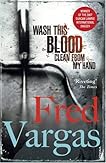
Wash This Blood Clean From My Hand by Fred Vargas

Murders from 1943 to 2003 that all have murder wounds in common, three punctures like a trident. Commissair Jean Baptiste Adamsberg thinks it is the same killer, Judge Fulgence, but he has been dead for over 15 years. Whoever he tries to convince tells him to stop wasting their time. Each murder has been solved and someone has been convicted, despite the accused not remembering anything. Commissaire Adamsberg has a personal interest - his brother's girlfriend was killed, and his brother would have been convicted, if Adamsberg had not got rid of some of the evidence.

The first few chapters are rather contrived, as Vargas sets up the characters and a fresh murder, but once we fly from Paris and arrive in Canada the plot and prose start to flow. Before long Adamsburg is on the run, accused of a murder with three puncture wounds! He cannot bear to think he has committed this crime, but there are hours he cannot remember after a drinking binge, and he found blood on his hands. The key is to return to France and solve the murder of The Trident.

Commissair Adamsberg is a detective who relies on intuition and imagination whereas his subordinate, and friend, Captaine Danglard is intellectual and logical. A nice yin/yang balance in a detective novel. As a man on the run he is help in his quest by a handful of people and a different type of computer hacker.

Vargas's characterisation of the main and secondary characters is deft and she can capture the essence of a place in a few sentences. An enjoyable, lyrical and page turning read, admirably translated by Sian Reynolds. I look forward to reading more Vargas. Apparently this is number five in the Adamsberg series but the first I have read.

Additional Info

The book won the Duncan Lawrie International Dagger Award.

The French title is 'Sous Les Vents De Neptune' (Under Neptune's Winds) and the origin of the English title is from Macbeth "Will all great Neptune's ocean wash this blood from my hands". Love whoever came up with that.

The book has recently been made into a film "Sous Les Vents De Neptune" which I think is a made for TV movie. It has an interesting cast...


more

Monday, 11 May 2009

Miss Pettigrew Lives for a Day by Winifred Watson

Downtrodden and penniless Miss Pettigrew has reached middle age and thinks her next governess job will be her last chance. She is sent by her employment agency, in mistake, to the household of Miss LaFosse, a nightclub singer.

Thrown into an exotic world she has never experienced before, treated with kindness and as an equal. Looked to for help Miss Pettigrew draws on resources she never knew processed. As Miss LaFosse's complicated life and loves spin out of control Miss Pettigrew's common sense and experience of past employees and film plots (she is an avid movie goer) guides them through the day.

This is a delightful novel first published in 1938 and set in that period , a modern Cinderella story written in a lively and humorous style not dissimilar to Noel Coward. It is also one of the "1001 Books to Read Before You Die" so this would be a nice quick read to tick off if you are a list addict.

Persephone Books have published it with the original charming drawings and a rather attractive flapped cover. I love a pretty book.

Saturday, 2 May 2009

Back When We Were Grownups by Anne Tyler

In the middle of a boisterous extended family Rebecca, in her 50s, wonders how she got to this part of her life and wonders who she really is and is this really the life she expected. Anne Tyler opens the novel with the sentence "Once upon a time, there was a woman who discovered she had turned into the wrong person"

Growing up as an only child in a small town it was assumed that Rebecca would marry her childhood sweetheart but she meets and marries, in a heartbeat, Joe Davitch, a divorcee with three children. A few years later she is widowed when he dies in a car accident and now with four young children she takes charge of the family business. The years roll by and now a grandmother she is still at the centre of the family and its party function business. She wonders what happened to Will, her old college boyfriend and how her life might have been had she made different choices so she decides to contact him. While this inner turmoil is going on the house is in need of continual repair, her stepdaughter's third child to her third husband is due and Uncle Poppy's hundredth birthday party has to be arranged.

This is an effortless Anne Tyler page turner she does so well. Nothing much appears to happen and yet lives, emotions and the nature of identity are examined.

Verdict: Good Read

Monday, 27 April 2009

Jack Maggs by Peter Carey

Jack Maggs returns to London in secret from Australia where he has been deported but made his fortune. He is searching for the occupier of a house in Great Queen Street but while he knocks on number 27 he is spotted by Mercy Larkin who thinks he is at the wrong house and has come for the interview for a butlers appointment at her employers house. Jack falls in with this for his own reasons and is employed to be butler to Percy Buckle. One of Buckle's visitors is the famous author Tobias Oates who is skilled in mesmerism. He promises to cure Jack of a muscle spasm by hypnosis but unlocks secrets that would be dangerous to be known abut Jack and which will impact upon all the lives of those present at the mesmerism, including the servant who listens at the door.

London's murky underbelly is laid bare as Jack Magg's life story gradually unfolds from his orphan upbringing, the reason for his deportation to the colonies and his dangerous return.

Carey has taken the character of the title from Dicken's 'Great Expectations' but apart from that very little remains of the original novel. Perhaps the character of Tobias Oates is supposed to represent Dickens who, in this story, is obsessed with Maggs because he is in search of a idea for his next novel.

This is a dark story full of secrets and damaged people, all in fear of poverty or position, nearly all willing to exploit others.

Peter Carey cranks up the level of trepidation as he plunges you into the Victorian world and the quest of his anti-hero Jack Maggs to find Henry Phipps which entangles everyone around him and no one escapes from the consequences of their actions for good or ill.

I recommend this book but if you have not read any Peter Carey before then I would suggest starting with 'Oscar and Lucinda' which is set in the same century.

Monday, 16 March 2009

Q & A by Vikas Swarup

A darker story than its film spin off 'Slumdog Millionaire' but with a similar structure of the question asked and then the story. The experiences Ram Mohammad Thomas has had in life enables him to be able to answer the questions as he takes part in the Indian version of Who Wants to be a Millionaire. Arrested by the police he has to prove he is innocent of cheating by recounting how he knows the answers to the questions because, as an orphan slum dweller, how could he know. As he says "The brain is not an organ we are authorised to use. We are supposed to use only our hands and legs"

Modern India as experienced from he bottom of the pile travelling from Mumbai, Delhi and Agra backwards and forwards in Ram's life. (differing from the film which is a linear story). Confronted by dacoits, employed by aging Bollywood stars, exploited, shown kindness and friendship, discovering love and tragedy. All these things make Ram the person he becomes, an extraordinary everyman.

This is a pacey book with a compelling narrative looking at the underside of society but ultimately it is that old fashioned thing a fable of good triumphing over evil.

Verdict - Good read

Friday, 27 February 2009

The Outlander by Gil Adamson

"At nineteen Mary Boulton has just become a widow and her husbands killer" so says the blurb on the jacket of this book. The year is 1903 and Mary flees from the Alberta prairies towards the Rockie mountains pursued by her two avenging brothers-in-law. She runs, escaping with no plan or direction in mind. Her very survival in the wilderness is in question but at each point when either hunger or disaster threatens she is helped on her way by the people she meets. Things happen to Mary rather than her influencing them as we start out, but her story gradually filters through as she journeys and we realise that she has had little love and affection in her young life but in this escape she may have found both but her life is still in jeopardy.

This is a great adventure story with luminescent prose bringing both the wild country and the people that inhabited these regions vividly to life. A tough heroine who can battle winter weather, illness and injury but whose character unfolds and develops in this page turning book.

I think the quote from Ann Patchett sums this book up "The Outlander deserves to be read twice, first for the plot and the complex characters, which make this a page-turner of the highest order, and then a second time, slowly, to savor the marvel of Gil Adamson's writing. The novel is a true wonder"

This is Gil Adamson's first novel. I hope she writes more.

Verdict: Highly Recommended

Monday, 16 February 2009

The Oxford Murders by Guillermo Martinez

A South American student of mathematics arrives in Oxford and boards with a Mrs Eagleton but he does not get to know her well she is soon murdered. He discovers the body in company with Arthur Seldom a professor of logic who tells the police that a piece of paper was left in his pigeonhole at the college with a symbol and the message "The first of the Series" and the time 3:00pm.

We do not have long to wait for the next mysterious death with also a note and symbol posted on the college door. The problem of solving the next in sequence is that according to the Austrian logician Godel not every statement can be proved true.

The start of the book is OK but I found the expositions rather clunky and slowed down the narrative. Once we got rid of those the plot rolls on quite nicely. The descriptions of Oxford from an outsiders point of view are quite well done but the problem is it reads rather like a film exposition rather than a fully fledged novel. It has recently been turned into a film with Elijah Woods (as the student) and John Hurt as the professor but I have not seen it on general release.

The book won the Spanish Planeta Prize so maybe they saw something in it that I did not.

Verdict - A short quick read.

Tuesday, 27 January 2009

Hard-boild Wonderland & The End of the World

Hard-boiled Wonderland and the End of the World by Haruki Murakami

Quotes from the book:=
"Stealing memories is stealing time"
"But on the phenomenological level, this world is only one out of countless possibilities. As you create memories you're creatin' a parallel world"

We are in a future Japan where information is a commodity highly prized and the Calculecs work for The System whose competitors are the Semiotecs of The Factory but maybe these two organisations are one and the same or maybe not.

Two parallel story lines start with our narrator travelling in a hermetically sealed lift which he is not sure if it is going up or down. To calm himself he counts his loose change in both pockets simultaneously. A neat trick but simple for a Calcutec whose core consciousness has been altered so he can run information through one hemisphere of his brain, encrypt and scramble it.

He is met by a "chubby girl" in pink who leads him through labyrinthine passages to meet her grandfather, an eccentric professor who, amongst other things, can turn off sound. He is given information to scramble and told that the world depends on him carrying out his task.

The concurrent storyline is 'The End of the World" which is a walled town with few inhabitants and a herd of golden unicorns. Our narrator has just arrived but he has no memory of how he got there or memory of his past life. On entering the town he has to give up his shadow and becomes the towns dream reader. The shadow will not last long without him so they make a pact that he will map out the town for escape and they will leave. (This map appears in the frontispiece of the book).

Tokyo is the setting of the "Hard boiled Wonderland" which is full of hazard with a nod to Raymond Chandler we have two heavies in pursuit of our hero. There are strange watery underground places where dangerous creatures called INKlings roam. The End of the World is full of warnings, whirlpools and dark forests.

We inhabit both these strange places through Murakami's vivid descriptions and journey with our hero and supporting characters as the plot unfolds.

Murakami has a light touch and the theme of memory, consciousness and self is explored in an imaginative and entertaining way with a touch of dry wit.

Verdict - Recommended Read

Thursday, 22 January 2009

The Edgars & In Bruges

The Mystery Writers of America's Edgar Award Nominees have been announced in this year of the 200th anniversary of Edgar Alan Poe's birth.

I love a list but with this on top of the Guardian's "1000 novels everyone must read" series also coming out this week, I suspect, I may be tempted into more book buying.

What I like about the Edgars is the all encompassing nature of the awards within the genre. As the name mimics it is indeed like the Oscars although I don't know if they have a red carpet, maybe just a Masque of the Red Death with dripping blood.

I must admit that I have not read any of the books mentioned, yet, but Book Club Buzz has the full list and some links to his reviews.

I have seen one of the films that is up for Best Motion Picture Screenplay which is 'In Bruges' written and directed by the Irish playwright Martin McDonagh. It is the story of two Irish hit men who have been sent away to a wintry Bruges at Christmas after one of their jobs goes wrong. Ray (Colin Farrell) hates Bruges and is haunted by the fact that he killed a little boy by mistake on this last assignment but Ken (Brendan Gleeson) loves the city and tries to enthuse Ray about medieval sites. The plot is clever and the dialog sparkles, there's a girl, a dwarf, Bruges itself and some black comedy plus a cameo appearance by Ralph Fiennes as the cockney boss. The two leads inhabit the parts and are wonderfully acted. A marvelous two hander as Brendan Gleeson's world weary part allows Colin Farrell to really shine on screen.

Verdict - Unpredictable Thriller. Recommended

Sunday, 18 January 2009

Kate Atkinson

'When Will There Be Good News' by Kate Atkinson

Quotes from the Book:- "A coincidence is just an explanation just waiting to happen" Jackson Brodie
"The best days of her life had been when she was pregnant and the baby was still safe inside her. Once you were out in the world, then the rain fell on your face and the wind lifted your hair and the sun beat down on you and the path stretched ahead of you and evil walked on it" Joanna Hunter

'When Will There Be Good News' opens with a slaying of a family by a stranger but the 6 year old Joanna runs and hides in the long grass. This section is marked 'In the Past'

We then move to 'Today' which is 30 years later and now Joanna is a GP in Edinburgh with a baby and married to Neil , a businessman who may be a bit dodgy. Her nanny is a precocious 16 year old called Reggie whose mother has drowned on holiday.

Other characters are introduced, Jackson Brodie, an ex army and police, currently a private detective, is in Yorkshire stealing hair from a boy who may be his son. DCI Louise Monroe, who is not sure where her own life is going, is about to alert Dr Hunter that her family's murdered has been released from prison.

Reaching one of the sections marked 'Tomorrow' (and there is more than one):

Suddenly Joanne Hunter disappears but DCI Munroe does not believe Reggie when she says something is wrong and has not, as Neil Hunter says, gone to visit her sick aunt. Brodie meanwhile is boarding a train he thinks is going to London, but he is wrong and it is heading in the opposite direction, to Edinburgh but he will not quite make it to the station as the train crashes.

Our protagonists are hurtling towards each other and now everybody believes that Joanna is missing. The plot gallops away taking more twists and turns to its eventual end.

This is a beautifully constructed novel, as you would expect from the author of 'Behind the Scenes of the Museum', although of a very different genre, but still full of dry wit, full drawn characters and a pacey plot.

Verdict: Rattling Good Read

Kate Atkinson's website here