Showing posts with label France. Show all posts

Wednesday, 7 January 2015

Greetings

I inherited a bound set of The War Illustrated from my paternal grandparents. One hundred years after publication I'm exploring its pages to discover the people and their times.
"Thoughts of 'Noel' - The French Soldier Sends a Greeting from the Battlefield"
I was looking for something connected with the 1915 New Year in the War Illustrated but couldn't find anything however coinciding with my love of all things postal I thought this illustration of a French soldier sending Christmas greetings home was an appropriate one.  I have two of my  maternal Grandmother's first husband's Christmas messages to her, he never made it home.   If someone was killed or missing the letter were returned to the sender with a message on them to that fact.  The French on the other hand put a rather poignant message on their mail returned to sender "  le destinataire n’a pu être touché à temps" (the recipient could not be reached in time).

I know little about the French postal system during WW1 beyond the fact that it was sorted in the National Music Conservatory in Paris. The UK postal service of the first world war was an amazing piece of organisation delivering 12 million letter a week. At first the post was sorted by the army units in France, but it soon became apparent that it would be better to do it in the UK so they built the Home Depot sorting office in Regent's Park, London.  When completed it was the largest wooden building in the world.  The average time for a letter to be delivered to the western front was 2 days, if it did not have to be censored.  Letters were censored at the port of Le Harve and then later in Boulogne so the enemy could not learn any information from the letters, but they also had a great deal of success in catching spies this way.  Both countries of course censored mail and also provided postcards to the troops, some where there was a list of messages like this where the appropriate one was chosen


 This French card is interesting with the various theatres of war in Europe on one side:


where I suppose one indicated by number where your unit was.

Saturday, 29 November 2014

Champagne

I inherited a bound set of The War Illustrated from my paternal grandparents. One hundred years after publication I'm exploring its pages to discover the people and their times.
 "The average man soon grows accustomed to a strange environment.  This picture was taken in a vineyard of the Champagne region of France.  A few miles off, the heavy artillery of the contending armies was sending out thunder and death, and the air was reverberating with the din of war.  At the same time troops were marching past to the battle-lines, yet these peasants working in the vineyard pay little heed to the  world-shaking events close by.  Some of them do not even interrupt their work to look at what is going on around them" War Illustrated , 7th November 1914

The champagne produced in 1914 is considered the greatest vintage of the 20th Century.  Maurice Pol Roger famously said it was "harvested to the sound of gunfire but to be drunk to the sound of trumpets".  The weather that year had been perfect and by September 12th the grapes were ready to be harvested but with the men away fighting it fell to women, children and older people to harvest the vines (as can be seen in the photograph).  The schools even closed so that the children could be in the fields.  By October 11th the last accessible grapes had been picked but not without the cost of life (twenty children were killed by sniper fire or shelling).

Amazingly champagne was produced in every year of the war despite 40% of the vineyards being destroyed and fighting continuing in the area but it was 1914 that produced the once in a lifetime vintage.  Reims was also under continual bombarded and shelling so the Champagne houses opened their cellars as a refuge to the local population and also continued operating their businesses from the underground limestone crayères.

Recently one of the bottles produced in 1914 was taken from the Pol Roger cellars and has been auctioned for £5640, the proceeds will go to support the new World War One galleries at the Imperial War Museum.  The unusual longevity of the wine is attributed to the early picking of the grapes which initially gave it acidity but as it matured the flavour blossomed, just like the indomitable spirit of the French wine pickers and producers.     

Additional (with pictures)
1914:  Champagne's Violent Vintage by Tom Stevenson - Wine Searcher

Tuesday, 19 February 2013

In the Frame


The National Trust used a popular part of the Lake District and one of Tarn Hows favoured aspects for their "Framing the View" initiative to encourage people to take one of their Great British Walks and discover wildlife, hidden heritage and of course the views of the area. It also proved popular with families and friends to have their photograph taken in the frame.  It was only a temporary installation from September to November (this photo was taken in October) and provided much fun.  Not too far away there is another frame
near the Grizedale Forest.  I think the idea behind this is probably better than the actuality as it looks rather inelegant in reality but the autumn colour of the tree in the distance improves and boosts it no end
Tree and frame (on the right) are located  by what was Grizedale Hall.. This terrace is all that remains of a 40 room country mansion built in 1903 and sold to the Forestry Commission who demolished iit n 1957 for unknown reasons.  Its claim to fame is that it was a German prisoner of war camp during WW2 and was the setting for the POW film "The One That Got Away" starring Hardy Kruger playing the part of the Luftwaffe pilot and POW escapee Franz von Werra
What was a window in the romantic ruin of Frith Hall frames one of the surrounding views from its hillock in the Duddon Valley,
you could still light a fire in its fireplace and watch the stars.  

Lastly here is a frame in France located in the grounds of the Poète ferrailleur a museum recreating the "wonder of childhood" which I have shown before  in a previous ABC round, but not this frame.

An entry to ABC Wednesday, a journey through the alphabet.


Tuesday, 15 November 2011

ABC Wednesday - Roche Bernard

La Roche Bernard is a small harbour town on the River La Vilaine, with a popular marina and Michelin starred restaurants. Its origins date back to the 9th Century with stories of Vikings but today it is a popular tourist destination.
Designated a "Petites cités de caractère" it has a historic centre but here we are walking down to the harbour.
The boat that takes trips up and down the river in Summer was about to leave but my attention was taken with
the numerous photos in the water by the yachts.
which were blown up postcards of the building of the bridge across the Vilaine. I collect old postcards so a lot of camera clicking went on at this point, this one is my favourite, all the town's population in those past times seems to be gathered on one side of the river.  I guess the reason these photos were here was that there was a celebration of photography and an exhibition in La Roche Bernard and
large pictures were posted throughout the town. No time to be recumbent here, lots to see and do, not to mention canoes
to be hired and paddled.

An entry to ABC Wednesday a journey from A to B stopping at R this week

Tuesday, 18 October 2011

ABC Wednesday - Etang Moulin Neuf

A peaceful lake near Rochfort en Terre in France.  This is the Etang du Moulin-Neuf, I did not spot any trace of the nine windmills but this 40 hectare stretch of water now attracts runners, walkers (with and without dogs) and fishermen. The wily pike and perch may even lurk beneath these water lilies.  No French leisure destination would be complete without a restaurant and that is the building in the distance. A path runs all the the way round and nature surrounds,  the only swan I saw was this one -
  but there were many birds
I think I know where this artist of nature lives because by all these little touches of art was a painted sign
advertising the walk from the lake to the village of Pluherlin which seems to have everything to keep body and soul together.

The letter of N is this week's stop on the ABC Wednesday journey of  the alphabet.

Tuesday, 20 September 2011

ABC Wednesday - Journey

To journey by bike is the best way to see a country, faster than walking yet slow enough see the sights and meet the people.  This bike was outside the port office in La Roche Bernard so perhaps the owner had another mode of transport for his journey in mind such as
this one which would take the three sailors out into the Atlantic. If a little more comfort is required maybe something bigger would take one to another country
 such as this ferry leaving Portsmouth bound for St Malo. Or maybe journey across continents by train
although you would have to pick the right day with my local line up the coast. This photo was taken on Sunday and no trains ever run on that day.   So maybe it would be better to jump on
a motor bike like this one.

The ABC Wednesday journey from A to Z has reached the letter J

Wednesday, 3 August 2011

Easely Seen

This artist's workshop was closed when we passed through Rochefort-en-Terre, a shame because the sign was so inviting.

An entry to Signs, Signs

Wednesday, 27 July 2011

How Green Is The Sea

A glazed tile on a house wall in the village of Coet-Bugat, France.  The language is Breton (Breizh) and the lettering and design attracted me. I liked it even more when I looked up the words.  It says "How green is the sea".

An entry to Signs, Signs

Tuesday, 26 July 2011

ABC Wednesday - Break

How nice to get away and take a break, relax. We arrived in France on the 9th July driving down to the rented Gite. All discoveries in front of us. Unpacked and later that evening up the stairs to bed. If only I had not decided to come down the stairs again in the moonlight. They turned at the bottom, but I did not my feet scrambling on air. Bump, my hip hit the tiled floor. Argh. My partner, when I could not move, ever the optimist said, maybe it is a muscle injury. No signal on the mobiles so off he went into the night and returned with 2 French men who by chance had been returning home from a night out. One was a paramedic who looked after me until the Pompiers arrive. In France it is the Firemen who run the emergency services, and one of the reasons they are held in such affection by country and get to lead the parades.
In the rural part of France where we were staying they were volunteers so they were called from their homes to look after me. They made me comfortable placing me on the air stretcher, the  leader, a small, but strong, woman lifting me on.  Off we went with flashing lights and arrived at the hospital in Vannes half an hour, a fast trip. We shook hands and thank them as they left, a trio of kind strangers. Taken to X-Ray or Radio it was discovered I had broken the top of my femur. The surgeon asked if I wanted to be repatriated or have the operation there the next day. It took a heartbeat to say here. After a painful (douleur) night the next day I was operated on and returned to the hospital room. I now had an prosthesis (a new ball joint and a spike down my femur).  Returned to one of the two bedded rooms, I was lucky enough to have the one by the window. The rooms were light and airy. I gazed out of the window on to the tree lined car park. The days passed with  pain killers and  wonderful medical care.  How to learn French with total immersion. Well actually how to learn medical French.  My little French/English dictionary came into its own as I and the nurses flicked through it. What wonderful cheerful, professional care I received from the nurses. Eventually I arose from my bed to be taught by the physiotherapist how to use cannes (canes) or as we would call them walking sticks.  The surgeon had said I would be in for 5 days and then walk out. Behold I did. What else can I say. Well the hospital meals were restaurant quality. Apart from breakfast, well I'm English so missed a gentle cereal rather than a strong bowl of coffee and a bun.

At first I shared a room with a very sick and elderly woman who had a superb appetite, I though it was me who could not manage the full array until I shared the room with a woman who had broken her arm in 3 places in the shower. We both agreed these were big meals as we swapped holiday destinations in France and England.

Better medical care could not have been given in such a caring way. So I raise my glass to French hospitals, in particular the Centre Hospitalier Bretagne Atlantique,  their staff and the kindness of strangers.
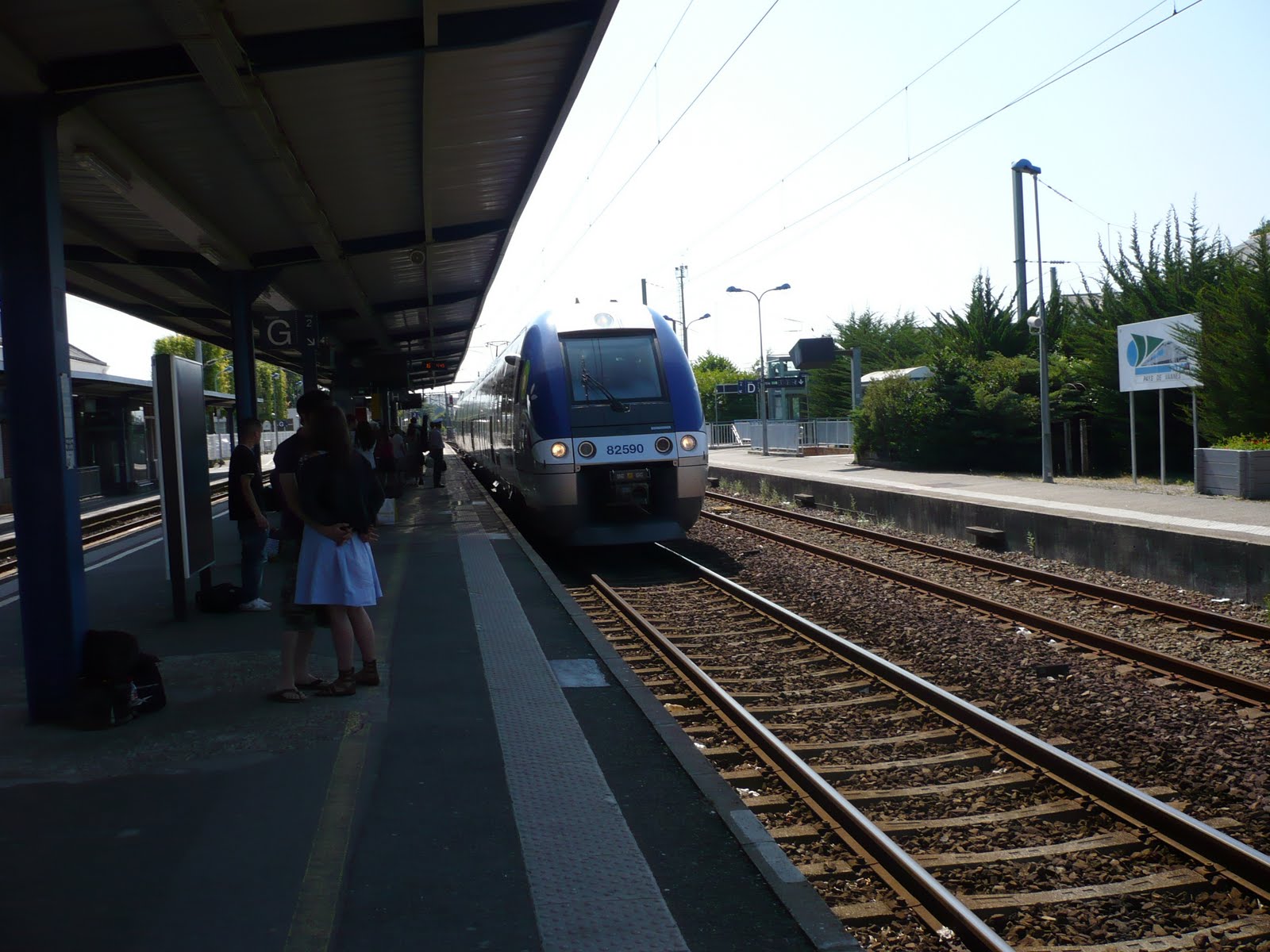
The pictures are courtesy of my partner who travelled on the train each day to see me in hospital with news of the outside world. He thought this kissing couple were about to be parted but no, they were just waiting for the train together.

Bob over to ABC Wednesday to see more words starting with the letter B

Tuesday, 3 May 2011

ABC Wednesday - Poètes Ferrailleur

On holiday near Lizio in Morbihan area of France we kept passing a tower on a hill in the distance, it looked from another world.  When on a showery day we fetched up at he Musée de Poètes Ferrailleur we discovered what it was.
It was part of the whimsy of Robert Coudray, the Poètes Ferrailleur in the title. A ferrailleur is a scrap iron merchant but Coudray has turned the scrap iron into whirling motion (this one wind powered), and to works of imagination, he is the iron poet.
 Perhaps this sail plane is about to take off
the boat-car set sail
The entrance looks as though it is about to be towed into the air. Inside there are automata, a mechanical theatre of fey creatures, rolling balls and lots of kinetic energy. I didn't take any photos inside, how could they capture the motion, so here is a short taste.  


Pop over to ABC Wednesday to see other words starting with P

Wednesday, 23 February 2011

Take A Break

The sign is a bit faded by the sun but it is in an ideal position, at the midpoint of the rows and rows of the 3,000 Neolithic megaliths at Carnac in northern France.  Just about the time one may be flagging  and ready for pancakes, drinks and ice cream. Chez Céline was a small hut with outdoor seating. Order at the window, the staff were a full pelt over hot stoves. We had ice cream. Delicious, definitely home made by an artisan.

The drawing recreates the old pictures of the 19th century when the locals liked to have their photograph taken sat on top of the larger stones.

An entry for the meme Signs, Signs

Tuesday, 1 February 2011

ABC Wednesday - Caen

Early morning in the coastal town of Caen, with the rising sun shining on the roofs and spires.  We had stopped briefly after arriving by ferry and as the town was quiet thought it would be nice to have a quick browse around. Thereby hangs a tale. Driving into the town from the port of course the first thing to look for was a car park. "Look there" I shouted, as we swung left and then left again through an entrance.  Only it wasn't an entrance, it was a gap, as we realised after bouncing down the  high curb on the other side. Which would have been fine if it was not one of those car parks where you get a parking ticket when the barrier opens to let cars in. How to get out?  Too tricky to get out the way we had come in.  We had a look at the instructions. Do you know there wasn't anything about accidentally coming into the car park over a pavement,  but there was one if a ticket was lost.  Well it would have to do, oops, it was going to cost 8 Euros.  I always have some small change (sometimes I think its magnetically attracted)  but could only copper up 2 Euro.  We would have to buy something; never a problem to me. We wandered into town.
and admired the rather elegant town hall, its
formal gardens and the Abbaye aux Hommes built by William the Conqueror in the 11th Century, as a penance to the Pope for marrying his cousin Matilda of Flanders, she built a twin church, the Abbaye aux Dames.  William was buried here but the tomb was destroyed by the Huguenots in 1562 during the Wars of Religion. Some of the bones remained but the last of William was scattered in the French Revolution.

Well apart from that gory tale, it was all very pleasant, the streets were being washed but nothing was open. So where was this change going to come from?  Then we turned a corner to a square and there in rows were the stalls of the food market with their produce stacked high, glowing in the sunshine.  After oohing and ahhing at the pile of produce (France is food central) visiting various stalls, stocking up with kilos of juicy tomatoes, fruit, vegetables (I'm putting tomatoes in a special category because I'm never sure what they are) and cheese, we had all the change we needed, and as a bonus almost everything required to arrive at our holiday cottage.  Which we reached after a short diversion to the coast (I thought I would try for a hat-trick of navigation errors) 
where as we saw the signs took a look at Omaha Beach and as I stood on the cliffs looking down, wondered how the troops of the bloodiest battle of the D Day landings in 1944 ever made it off the beach.  The Battle of Normandy apart from the tragedy of loss of life also destroyed much of the centre of Caen.


Catch up with what the other participants in ABC Wednesday are talking about beginning with C