Showing posts with label Morecambe Bay. Show all posts

Tuesday, 7 February 2017

Exposed

The sands of Morecambe Bay came into view as on Saturday I gained modest height on Hampsfell by the lone exposed tree and if on cue the sky darkened
with just some shafts of light tracing the the winding tidal gullies. The sharp wind blew and then the hail shower started so I tucked my camera away and continued on thankful that I was well wrapped up against the elements.

The hardy snowdrops seem enured to the elements and have started to flower like a signpost

to more gentle seasons to come.
  
A warm summer's day on the footpath that links the villages of Foxfield and Broughton which at this point crosses the Eccle Rigg's nine hole golf course but something had changed nearby when I walked this way at the end of 2016 for the small indistinct pond that lies at the bottom
had been cleaned out and grown a bit bigger and deeper.  The notice asks everyone to stay away from the now exposed edges until it settles and regrows.   I think they are trying to improve the drainage but in the meantime
I look forward to some reflection opportunities when I might improve on this photograph.

An entry to ABC Wednesday, a journey through the alphabet, this week sojourning at E here

Tuesday, 22 March 2016

River Kent

The River Kent starts its life in the Kentmere valley, here it is weaving its way through the town of Kendal, about nine miles away, in benign manner.  Not so recently, the winter storms saw the water level rise, and keep rising, eventually flooding the riverside walk and the houses alongside it.  The many bridges that cross the Kent
had to be checked for safety, one closed,
This footbridge is the most modern of the bridges.  The Kent is a short river (20 miles) but one of the fastest flowing in the spring wending its way over weirs and waterfalls and through villages
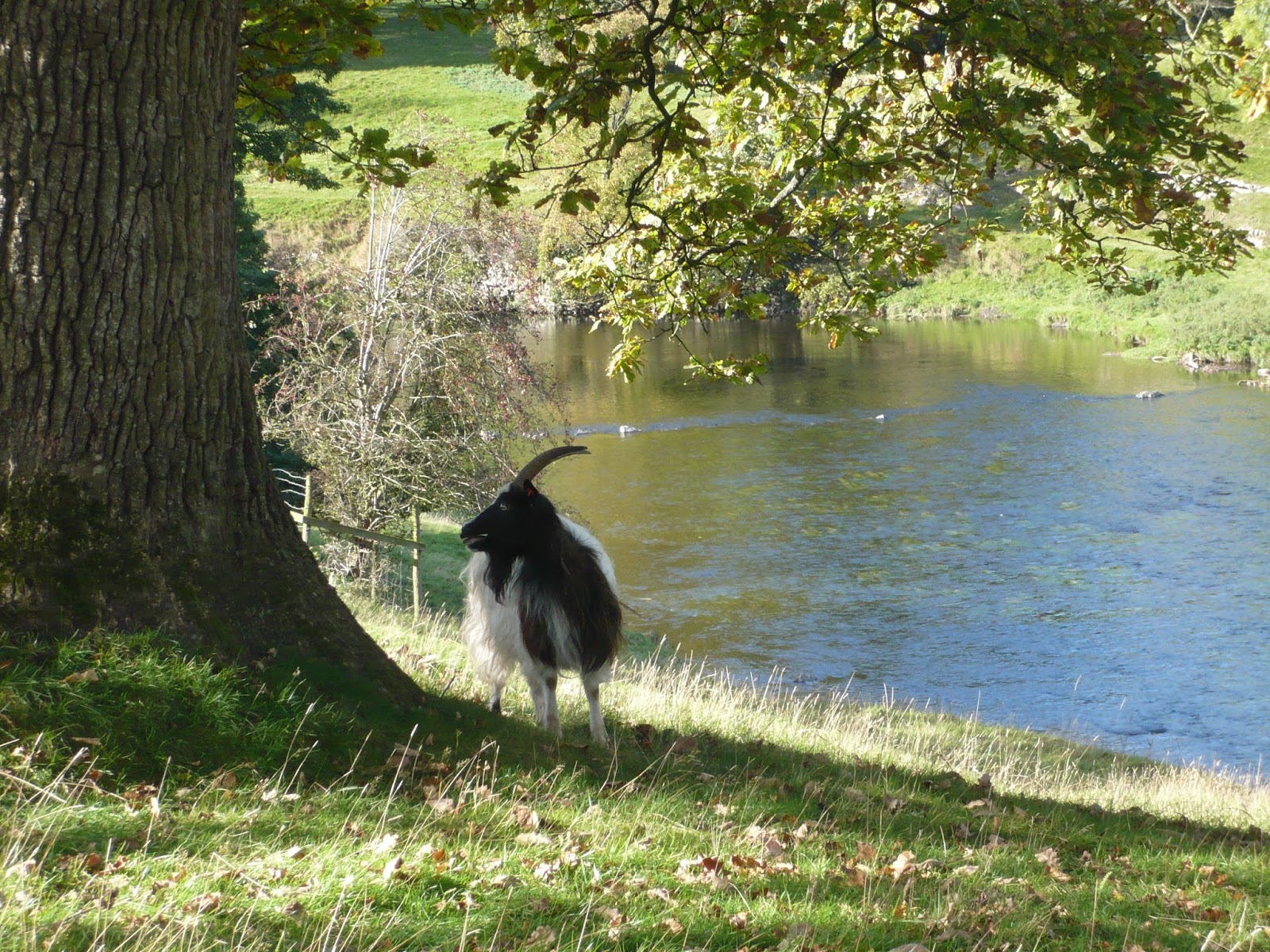
but here it is on a still autumnal day placid in the sunlight passing through the Levens valley while
sheep graze
and goats keep a curious eye open.
Kent Viaduct at Arnside
Eventually it will reaches Morecambe Bay, mingle with the salt water 

 and head out with the tide into the Irish Sea.

 "You could not step twice into the same river" (Heraclitus)

An entry to ABC Wednesday, a journey through the alphabet, this week sojourning at K here
 

Tuesday, 14 January 2014

Arnside on the Rails


Built in the mid 19th Century I think the view has altered little on Arnside Station since then, apart from the station furniture.  All is quiet until

a bust of activity as passenger arrive at Arnside Station, crossing over the bridge and heading for the way out on a summer's late afternoon.  I was waiting for the train going in the other direction.  When I do board the train just a short distance west over the blue sea in the distance

is the Arnside viaduct.  The signal is up and the Barrow to Manchester Airport train, a distinctive Desiro DMU is taking them home.    
The 50 span and 1,558 ft Arnside Viaduct crosses the Kent estuary (low tide when this photo was taken).  The viaduct, built in 1857, was repaired and refurbished in 2011.
Low Tide Channels, Arnside Viaduct, Morecambe Bay

 An entry to ABC Wednesday, starting a new journey through the alphabet and a new logo, its Round 14


Tuesday, 30 July 2013

The Case of the Curious Chimney

Chimney and Quicksand Pool
The chimney on Jenny Brown's Point is a local landmark and can be seen some distance away whether seaward from this south side of Morecambe Bay or when walking on the surrounding hills. 
Its size can be judged by my companion making his way around the point at low tide.  It is often referred to as being as a copper smelter from 1790 (in the past small mining companies operated in the area) but there is no evidence such as the copper slag that would have be left behind from this process.
Another idea was it was a ventilation shaft for a mine but there is no trace of a mine, perhaps it was a lime kiln was another suggestion, but they did not have chimneys plus there is no discolouration inside as evidence of chimney use.  So is the curious chimney, despite always being called a chimney, ever been used for that purpose? Nobody really knows when it was built . John Bolton in a "From Keer to Kent:" journal item comes up with a possible explanation when he found an article from 1945 by E Cuthbert Woods* who made mention of a very early guide (1796) to the Lakes by Father West (author of Antiquities of Furness) complete with map of the route across the sands from Hest Bank to Ulverston. On the position of what is now called Jenny Brown's Point is shown a tower with flames and smoke issuing from the top and identified with the word - "beacon".
I
It is possible it was a guide to ships bringing ore to the furnaces of  Leighton Beck which operated from 1713 to 1806.  The sea at this time flowed further inland and there would have been a good channel half a mile to the landward side of the chimney (shown on the charts of 1736), smoke signals would have provided navigation assistance.  An additional benefit would be to provided guidance to those people crossing the sands from Hest Bank to Silverdale.
Over recent decades the changing sands have revealed the timber of the old jetty at this point.  I believe that in front of nearby Brown's

cottages it used to be sand and grass but with the higher tides and the shift of the River Kent bed  in its hundred year cycle from one side of the estuary to the other this has been scoured off. Perhaps in decades to come the water will lap once more at the protective wall and there will be a point once more for a jetty but in the days of electronic charts and echo sounders not chimney beacons .


*"Some History of the Coastwise Lights of Lancashire and Cheshire" by E Cuthbert Woods. Transactions of the Historical Society of Lancashire and Cheshire, Volume 97, 1945

An entry to ABC Wednesday - join the journey through the alphabet


Tuesday, 23 July 2013

Round the Bend

Parton from Redness Point
Bit by Bit I am knocking off the various sections of the Cumbria Coastal Way and this bend of the railway line follows part of it. I'm walking on the the old tram road above (it is now a cycle path) that used to connect to the Parton Brickworks before the railway arrived. One of the ironies is that in 1840 the first locomotive for the Maryport to Carlisle railway was built further up the coast at Lowca but it had to be transported down to Parton to be sent by seagoing barge up to Maryport as this line did not exist.  This section of the Coastal Way from Whitehaven to Workington could be described as a walk through Britain's industrial past of ironworks, mines and engineering.
If you are having problems with bends this is the person to solve your problems, Bull Dog Drainage, making a house call at the aforementioned Lowca, we spotted his van again later in the day when we arrived in Workington picking up parts at the Plumb Centre. Problem solved.   As it was one of the hottest days of the year we were just looking a shop selling ice cream.
The Beachcomber, Parton
 No Beachcoming on this trip and no refreshing drinks at the Beachcomber pub, it closed in 2009.  There were plans for four houses to be built on the site but nothing seems to be happening, they would have great Irish Sea views.
Next week I will be on home ground in Morecambe Bay and just around the bend from this little bay.  It is unusual for me to know what I'm doing for a next weeks ABC but the reason is the object has both a B and a C in its name.

An entry to ABC Wednesday - a journey though the alphabet

Tuesday, 22 January 2013

Boats and Barriers on the Bay

A boat on Morecambe Bay. What a convenient place to park ones boat just on the promenade no chance of it breaking away. I wonder if those cross-hatchings mean no stopping - unless you are a boat.
Morecambe
In the middle this weeks snow how nice to think back to a summer when just chilling out on a beach is possible without being chilly. Last week's tides were high so those large chunks of stone that form a barrier will take the sting out of the waves.
A more substantial barrier by the coast road on the opposite side of the bay to the previous photos and on my side of the bay.  Possibly one could  peek  through the holes from the other side while keeping dry in high tides with the wind behind them.. Although this year it has been remarkably still, possibly because of the billows of clouds coming across the Atlantic. But even a sunny winter day like this it was calm.
So  peaceful, and a bundle of seaweed waiting to be taken out to sea again.
Meanwhile on a tidal creek for these boys there is some exploring to be done and with a  bit of  imagination some great adventures to begin,  while never setting sail.

An entry to ABCWednesday. The start of the  journey through the alphabet, our second port of call - B


Friday, 2 November 2012

Tidal Reflections

Morecambe Bay looking south
The tide has just retreated, the day is still and the clouds reflect on the damp sand.  Where the clouds gather two shapes are just visible, zoom in 12 miles across the bay to the large buildings,
 
.
and the sun, as it descends, glows on the side of Heysham Nuclear Power Station.  We don't want anything glowing from the inside!  The little white dots on the sand are the seagulls enjoying a damp buffet.

An entry to SkyWatch Friday


Saturday, 15 August 2009

Fantasy, Wolves and Art

I love books but I also love the whole tactile and visual book experience, so a local exhibition of the book cover artist Geoff Taylor's work was of interest. This was a display covering 30 years of his work and also cases of the books, a considerable number of which had the original, acrylic paintings on display. He specialises in fantasy and science fiction and has designed for some of the big names in this genre. It was interesting compare the two mediums and to appreciate how the artist works within the restrictions. The huge paintings and the small covers. Taylor trained as a graphic designer but midway through his degree course realised that he might have preferred fine art but by that time it was too late to change. (By such decisions sometimes the courses of lives are made).

The amount of detail in the original paintings was phenomenal, but he also has the imagination to create and bring the author's other worlds into reality. Fantasy art can all too easily be cliched and flat but Taylor's seem to really live and have texture and movement. To see examples of his work go to his website here

Browsing the books I realised that I had one of his first commissions which he was given in 1976 which was Philip K Dick's 'Counter-Clock World'

As was the case in those days the cover was uncredited. Its years since I read this book but basically it is about a society experiencing something called the Hobart Phase where people age backwards (the old born) gradually getting younger and entering the womb. A dead religious leader about to be reborn, hence the cover design, and throw in an evil Library and away goes the plot. That's all I can hazily remember.

Coming out of the exhibition, apart from the prints, they also had some signed bookmarks for sale, and I do like a bookmark. While I was trying to decide which to get I noticed there were also postcards. Geoff Taylor also paints animals, and it would appear from the exhibition these are generally of those types beloved by myth makers as symbols - the deer, wolves and owls. One of the cards was 'The Last Wolf'.

This is the local legend that the last wolf in England was killed in the Middle Ages on Humphrey Head, a promontory on the north shores of Morecambe Bay. My grandmother's family farmed in the area, so maybe this is why she owned the book I inherited called 'The Last Wolf', published, and written, in the Victorian times by Mrs Jerome Mercier. It has some nice black and white plates and sketches of the area.

It is written as a medieval romance with a poem at the back which describes the legend in verse form. The chase of the wolf, which must have had superhuman, or should I say, super wolf, stamina, covers a huge area, but it all ends badly for the wolf, however true love is found by the human protagonists. For a description of the full story, and other wolves go here

So now my Grandmother's book has a picture it was lacking, a wolf against the backdrop of Morecambe Bay.

Thusslow they strain o'er Humphrey's Height,
When low! a chasm appears,
That dips in darkness to the sight,
And fills the heart with fears.

Begirt with rock on every side,
It slopes in shade away:
But at its base may be espied
Against the light of day

To this black hole the quarry draws,
Now racked with sore distress,
While hard behind, with out-stretched jaws
The yelling bloodhounds press

Tuesday, 12 May 2009

ABC Wednesday - Q

Q is for Quicksand

This is the Leven Estuary where the River Crake feeds into Morecambe Bay, a 120 square mile intertidal area. Five rivers in total run into the bay creating shifting channels and water logged sand. It is also rich in wading birds who also use it as a wintering and passage area.
The point which is on the far side near hear was one of the places we used to go to the beach. It was reached via a railway viaduct. One of my vivid memories is of the heat of the wooden planks on our feet as we walked by the railway line which we took us over the channel and from where we would walk on the sea turf and round to the point. Each summer the area would be different, sometimes flat, sometimes with channels but quite magical. The viaduct has long gone now, no more trains, and has been replaced by a footbridge.

But back to the quicksand
One of the things to do as a child was to stamp up and down on the spot to make the sand go all wobbly, great fun. Some of the areas further out in the bay are far more dangerous.
In past times the stage coaches would come across the sands because this saved miles and miles of travel going round the bay, however, not all made it some sinking or being overtaken by tides when stuck. Legend has it that part of the Roman Army crossed the sands, never to be seen again. My grandmother told the story, to all her grandchildren, of standing as a young girl on Arnside Knot and seeing a horse and cart coming back from gathering cockles and then the man, horse and cart disappear within minutes.
There was such loss of life in earlier times that a guide was employed by the Duchy of Lancaster in 1536 to take people across the bay and the latest in this long line is Cedric Robinson who still guides groups of people across, but just for fun nowadays. The times of the crossing depend on the tide because as it says on the above notice they are fast rising and come in, as the local expression goes, "faster than a horse can run".

For lots more Qs go to Mrs Nesbitt's ABC Wednesday