Showing posts with label Ships. Show all posts

Tuesday, 8 August 2017

Elbfeeder

I always love sailing into ports and harbours. The romance of arriving into a small island harbour or the bustle of a large port both have their charms for me.  Here I am camera clicking away on the Stena Adventurer ferry deck as we sailed into Dublin port in June. Container ship loading was in full swing as the ferry slowly entered the dock system.  This is the Elbfeeder, one of three ships, bought a couple of year's ago by the Irish Continental Group from the German shipping company Elbdeich Reederei.  Unfortunately I didn't get a photograph of the crane swinging a container into place
but just managed to capture this stevedore directing operations from the deck before he disappeared from view.  I wonder what are in all those containers and where their journey will eventually end?  The Elbfeeder can carry 974 containers and it and its sister ships, Elbcarrier and Elbtrader ply their trade between the ports of Dublin, Cork, Belfast, Rotterdam and Antwerp.  Here is a 51 second time lapse You Tube video of the ship leaving port -  'Farewell to Antwerp' complete with rowing boats sculling past at high speed. 

An entry to ABC Wednesday, a journey through the alphabet, this week docked at E here


Tuesday, 11 July 2017

Tootling Along the Anglesey Coast

We were travelling to Ireland last month but took the opportunity to stay overnight on the Welsh island of Anglesey at a hotel on Bull Bay on the north coast. Our hotel window looked over the bay and as we were in the middle of a heatwave the waters glistened in the sunlight.
The coast weaves and crimkles in a mixture of bays, inlets and caves.  It is a popular destination for geology field trips because of the complexity and age of the rocks.
They can share their enthusiasm with those who prefer flora and fauna

and who walk along the coastal path.

The next day we took a leisurely drive along the coast road
Standing Stone and Wylfa Nuclear Power Station, near Cemaes Bay
and admired some of the standing stones we passed along the way. The area is rich in megalithic monuments.
Trefadog
We were nearing our destination of Holyhead whose hill can be seen in the distance when we stopped at this little shingle and sand bay.
and my little Lumix zoomed to its limit to catch the high speed ferry making its way into port.
The Dublin Swift catamaran  twin hulls lowered now makes a leisurely entrance. Although the name suggests speed it is actually named after the Irish poet, satirist and political pamphleteer Jonathan Swift (1667-1745)
Later in the day I'm standing on the deck of rather rather more sedate transport while trying to get a framed picture of a passing ship as the vessel sways and we are on our way from Anglesey across the Irish Sea to Dublin. 


An entry to ABC Wednesday, a journey through the alphabet, now in its new home with Melody at the helm.  The 21st round starts here


Tuesday, 21 June 2016

X Sign

An X in the sky meant when I took this photo one of ABC Wednesday's tricky letters was sorted.  The crossing here is of road, rail and cycle path and the only steam train ever seen is the one painted on the sign as the line is for freight
to the docks. I didn't take any photos of the railway lines because I thought I had some already, which was true, but they are inaccessible at the moment and in the depths of my very poorly old laptop although I do have my memory cards,  which I haven't labeled, xxxx!  
International Nuclear Services Terminal
The rail tracks can just be seen in this photo.  We have had some strange weather patterns this year and the day in May these photos were taken was no exception, sultry, with complete hazy cloud cover,
the lines between sky and water only distinguished by their texture.  The ship is the Oceanic Pintail which makes it sound quite benign but in actual fact it is a carrier of high level radioactive waste so you could say it is x rated.  On its journeys around the world they will turn off the AIS (Automatic Identification System) and if returning via the Suez Canal the canal cameras will be turned off to keep secret its course. The Global Threat Reduction Initiative means that the Plutonium it carries will end up somewhere near the Savannah River in the US. 

'Normal' nuclear waste will trundle up and down the coast to and from the port but on the occasions more exotic nuclear materials are transported then the level of police buzzing up and down the road is usually a pointer to transportation of something potentially more dangerous.   
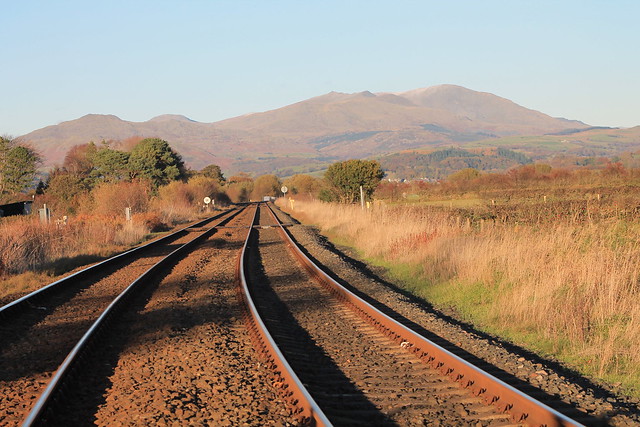
On the Line
but not on a quiet November day when the even the rails on this coastal railway seemed autumnal.  

An entry to ABC Wednesday, a journey through the alphabet, this week sojourning at X here  
    

Tuesday, 3 November 2015

The Queens

A liner floats in the sky above a building in Birkenhead which stands on the junction of two roads
and is named after the Queens who are the Cunard liners.  These are not their modern cruise ships whose design looks like a human container ship but the iconic lines of the Queens from the 1930s who vied with other vessels to make the fastest crossing of the Atlantic from Southampton to New York.
The building is a pub and hotel owned by Admiral Taverns (continuing the nautical theme).  I'm assuming the name is related to the fact that Cunard headquarters were originally in Liverpool and their beautiful old building forms one of the 'Three Graces' on the city's waterfront.  The Queens however is tucked away on the other side of the Mersey by Birkenhead Park. In the early afternoon on an April day the area seemed quite deserted, maybe the chill and grey skies had something to do with it.

To make up for the lack of activity on the photograph here is an interior shot of the Queen Mary (the first of the Queens), being fitted out on Clydeside in Art Deco style in about 1935.  (The photographer is Yevonde Middleton (Madam Yevonde) a pioneer of colour photographer)
The joiners are busy behind the bar.  The two 'customers' may have a long wait for any liquid refreshment.

An entry to ABC Wednesday, a journey through the alphabet, this week sojourning at Q here
  

Tuesday, 4 August 2015

Razzle Dazzle

Dazzle Ship
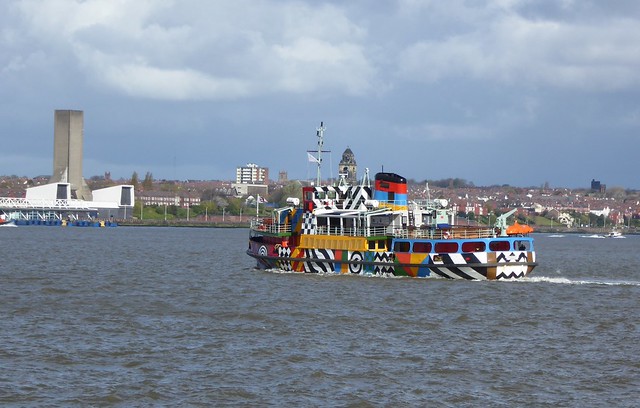
Here is the Mersey ferry 'Snowdrop' crossing the river heading for Seacombe and decked out in Dazzle, or to be more precise it is called "Everybody Razzle Dazzle" and the design is by Sir Peter Blake, a pioneer of pop art with a impish sense of humour.  I imagine he enjoyed this project.  I'm rather fond of his collages, of which the most famous is the cover of the Beatle's Sergeant Peppers Lonely Heart Club Band album.

The Dazzle project was part of the Liverpool biennial but also to mark World War One which was when the artist Norman Wilkinson (1878-1971) came up with this idea to protect naval ships. Unlike normal camouflage whose objective is to hide,  this camouflage's idea was to mislead by making it difficult to estimate speed and bearing.  Every ship design was different, for the full dazzling differences feast your eyes here  (HMS Argus is confusing enough on a photo goodness only knows what it looked like on the high seas).  The connection with Liverpool is that the Dazzle ships of WW1 were mostly painted there.  When not serving in the navy and inventing Dazzle Norman Wilkinson was a fine maritime painter.  My first introduction to his work was the LMS railways travel posters of the 1920s and 1930s, today highly collectable items but for those without deep pockets available on postcards. I could have gone with a Liverpool view but as a contrast show a scene nearer in distance to where I live,  a dazzling day of
gentle sailing on Windermere.
Dazzle Ship
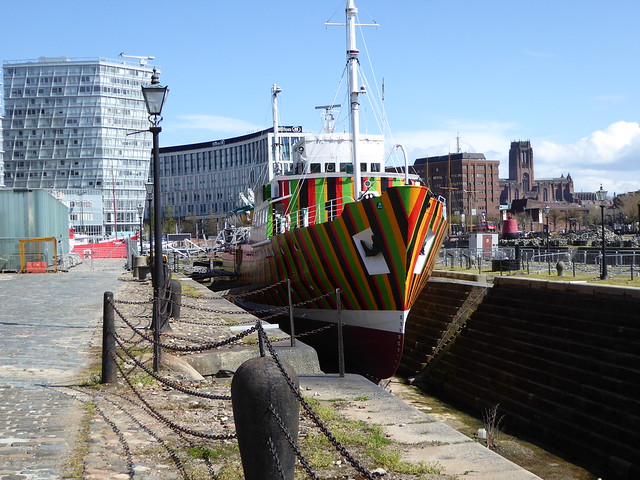
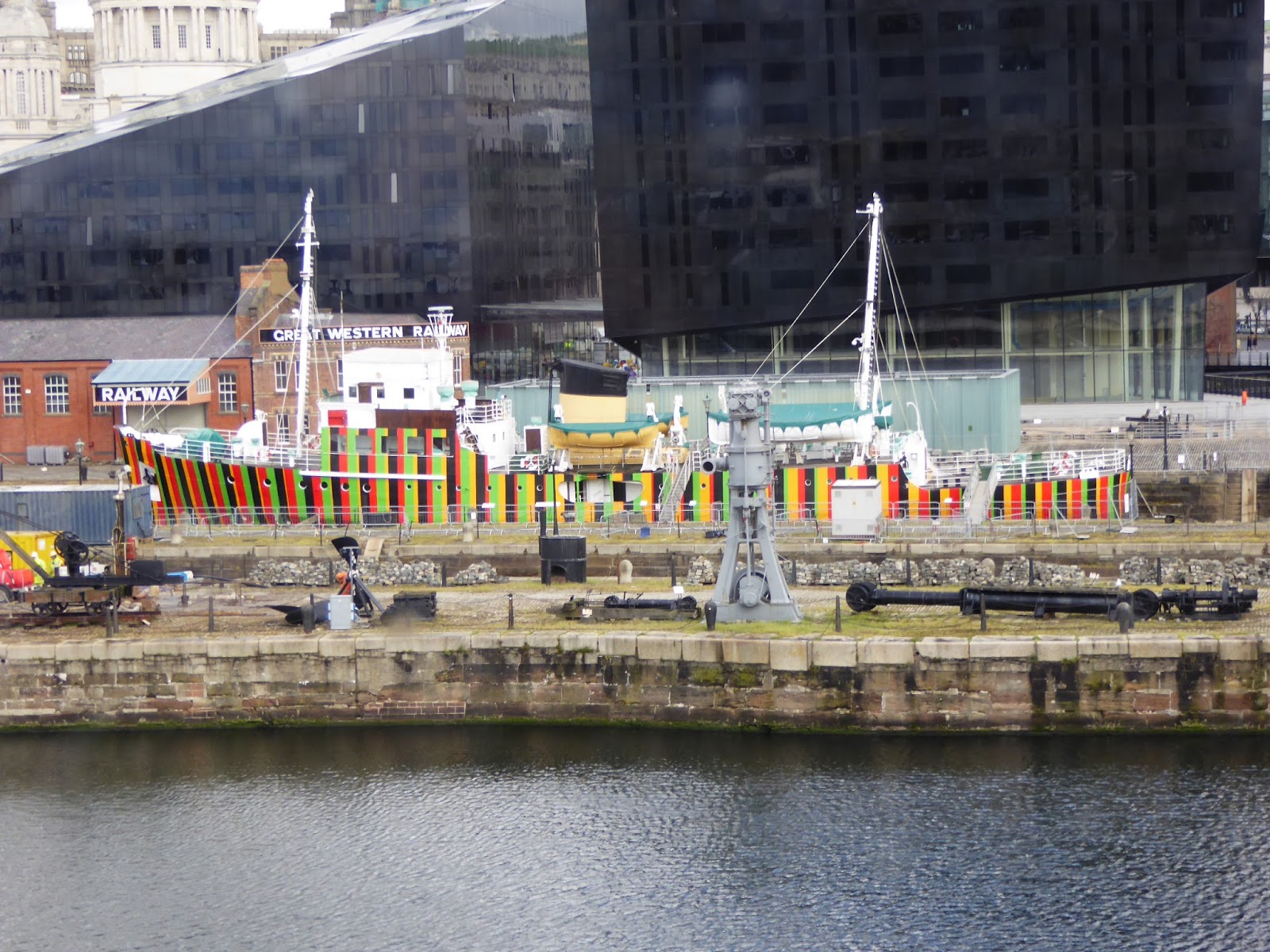
Time to return to the Liverpool waterfront and the pilot ship Edmund Gardner in Canning Dry Dock with its Dazzle stripes.  Unfortunately all the area was padlocked and barricaded off so this was the best angle I could get, although the following day I did take some pictures from the rain splattered windows of the Maritime Museum, none of them very good, but the next photo at least shows more of the stripes
The Dazzle is by the artist Carlos Cruz-Diez (Induction Chromatique à Double Fréquence pour l'Edmund Gardner Ship, Liverpool, Paris 2014).

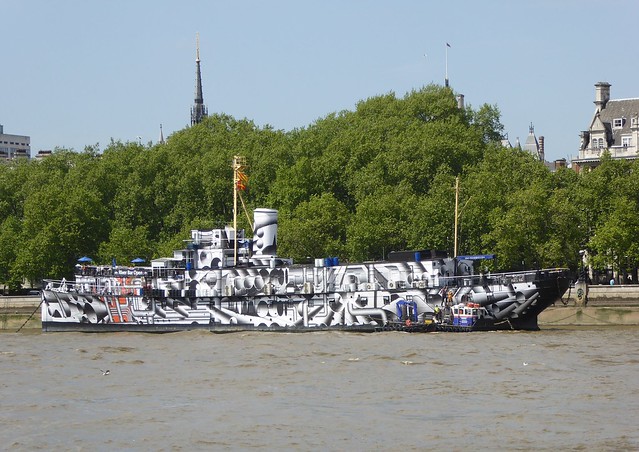
Lastly to complete the trio of Dazzle ships here is one I had no difficulty photographing from every angle because it was moored near Blackfriars Bridge in London and I merrily clicked my way along both banks of the Thames.
Dazzle Ship
This is HMS President one of the three present day surviving Royal Naval ships of World War One (its date of 1918 may be a clue to one of the reasons it survived). This time the artist is Tobias Rehberger. When I took this photograph in May it was due to be officially 'launched ' in June so I wonder if the men at the front by the tug were putting some finishing touches or cleaning it.
Here is the ship's stern giving a closer view of the design and taken from the Victoria Embankment where she is moored.

All three ships were part of the  "14-18-NOW" WW1 Centenary Arts Commission.

An entry to ABC Wednesday, a journey through the alphabet, this week moored at D here
 

Tuesday, 21 July 2015

Buccleuch Dock

Living on a peninsula surrounded by sea there is usually a breeze or wind  coming from some direction of the compass. Unusually the photograph shows a sultry still day on the 1st July when it was just like walking into an overheated room, the cloud strata adding to the effect. This is Buccleuch Dock which is part of a small dock complex.  Another exceptional aspect is that there was not one ship or boat in sight, although there was one behind me. For the past ten years you could guarantee at least one in the dock
which was the Princess Selandia, once a nightclub and restaurant until it closed in 2010 due to a fire, since then it has been gently rusting by the dockside. 

Princess Selandia berthed in Buccleuch Dock, Barrow-in-Furness
Here it is in lit up for the revellers in 2007 when you could dance the night away on the freight deck which had been converted into "The Blue Lagoon"  After the fire this Danish passenger vessel's next destination had been due to be part of a dockland attraction at Korsør but the scheme collapsed.  The project has now been revived and on 14th July she set off for Danish shores to be a museum.  Once owned by the Danish State Railroad I believe she is the last ship of its type.  I wonder if she will be promoted and go back to her old name of Queen Ingrid?   You can see there is a walkway next to the ship which can be accessed by a gate from the supermarket car park and I like to keep an eye and a camera ready for any visiting ships as I load my shopping into the car boot.  Today the gate was locked so I was thwarted in having a nosey at a Swedish yacht on the other side.  The pathway can be accessed further down but I'm temporarily not very mobile at the moment so I gave it a miss,
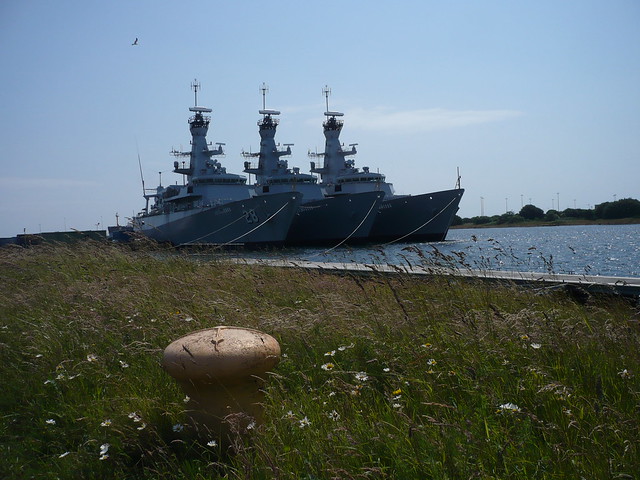
although once you are on the pathway there are plenty of seats.  This photo of  Buccleuch Dock is with a ripple of a slight breeze but as you can see I can never resist a reflection.  The dock opened in 1873 and is named after one of the original investors of the port and docks.  The picture was taken in late afternoon light, November 2012, and in the distance can be seen three corvettes which also, like the Princess Selandia,  became local landmarks after the Brunei Navy refused to take delivery of them. The dispute eventually went to arbitration in 2007 and BAE Systems won the case, resulting in Brunei eventually finding another buyer for them in 2012, the Indonesian Navy.   I've been trying to remember when they eventually sailed away
Jebat Frigates
 and think it must have been last year as I took this photo in July 2013 plus some of these corvettes were involved in the search for the Indonesia Air Asia plane which went missing at sea.

An entry to ABC Wednesday, a journey through the alphabet, this week sojourning at B here


Sunday, 3 August 2014

At the Seaside

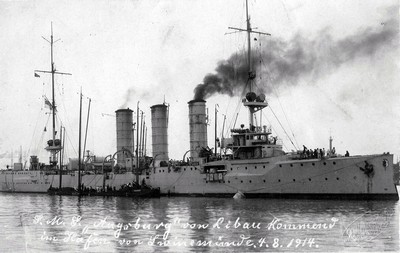
3rd August 1914 - "Germany declares war against France.  German cruiser bombards Libau..."
SMS Augsberg (photo from Europeana)
The cruiser conserned was the SMS Augsberg and the photo shows it after its return to the German Baltic
Swinemünde a
Swinemünde a
port of  Swinemude on 4th August 1914.  The picture is from "War Memories" by Lieutenant Max Kranz.  The port of Swinemude became the Polish city of Świnoujście after World War 2 and the Augsberg's target of Libau is now in Latvia and called Liepāja.  The boundaries of Europe for ever shifting throughout history and no doubt will continue to do so into our unknown future.  Liepāja is known in Latvia as "the city where the wind is born" because of the continuous sea breezes and as an ice free port on the Baltic has been a been a prized possession for military empires. Happily there are only sea festivals and walks on wide sandy beaches today.  The tourist site says it is best enjoyed slowly.
But let me return to the winds of war of this day in 1914

"In reply to a 12 hours ultimatum from Germany (expiring at 7 am), Belgium refuses to allow passage of German troops through her territory and King Albert sends "supreme appeal" to Kind George.  German troops envelope Visé (which was afterwards burnt).  General Joffre, French Commander-in-Chief, leaves Paris for the French frontier.  Grand Duke Nicholas appointed Generalissimo of Russian Army.  Australia offers 20,000 men.  Sir Edward Grey's speech in the House of Commons.  British naval mobilisation complete.  Moratorium Bill passed.  Bank holiday extended to August 7th". 'Our Diary of the War' War Illustrated.

On the actual Bank Holiday Monday of August of 3rd August people were enjoying the sunshine while reading newspaper headlines such as "Europe Drifting to Disaster" and nobody was sure whether Britain was yet definitely engaged in the war. That evening a boat from the Hook of Holland arrived at Harwich carrying 780 passengers instead of the expected 100. Among them were tourists who had been turned back at the French-German frontiers and told to get back home as quickly as possible.

The author WJ Makin wrote
"At Scarborough and Whitby crowds idled beside the sunlit waters of the North Sea, little dreaming that German battle cruisers were already contemplating bombardment of that particular coast-line.  And on the other side of the North Sea the same scenes were to be witnessed.  At Ostend, gay Continental crowds lounged along the plage. The Casinos were full, dance halls were crowded, orchestral concerts were drawing their huge crowds.  Europe, generally, was prosperous and happy. It had been a good year for the crops, and everyone from Calais to Constantinople was looking forward to a bumper harvest....Life at that time for the common people of the Continent was simple and pleasant.  Never again while they lived would they ever feel as secure"


Saturday, 2 August 2014

From Kiel to Kerry

2nd August 1914 "British ships seized at Kiel. German troops invade Luxembourg and enter Ciréy. Russian forces cross German frontier at Schwidden.  Romania declares neutrality". War Illustrated 'Our Diary of the War'

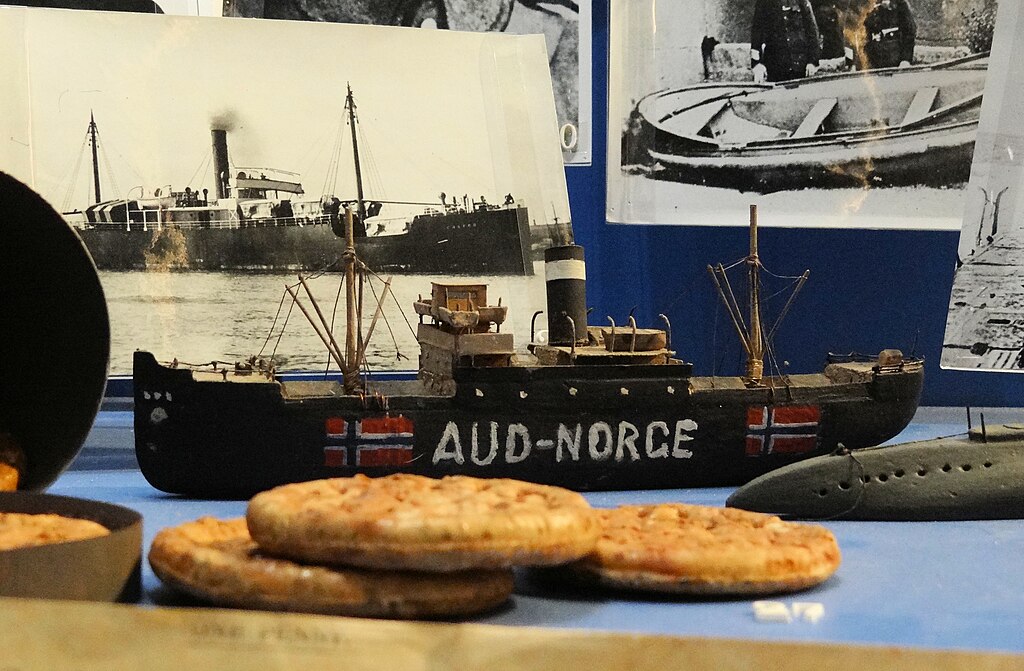
I idly wondered when reading this entry what the ships were seized at Kiel and found it was a liner called 'Castro' and a collier  The coal carrier was unnamed but when I went looking for the 'Castro' what a story I found. Built by Earls Shipbuilding in Hull (1911) it was the second of three ships named 'Castro' which would be owned by Wilson and Son (later to be taken over by the more famous Ellerman Lines).  On capture the Castro was used by the German Navy and renamed the Libau  in 1915 only to take on another identity in 1916 being disguised as the Norwegian steamer Aud. Loaded with weapons it set sail for the Kerry coast in Ireland and the Irish Republicans planning the Easter Rising in Dublin.  Despite wonderful attention to detail such as even having buttons on the crews uniforms imprinted with a Norwegian company name it failed to rendezvous with the U.19 which was carrying Sir Roger Casement returning from Germany (where he had been trying to form an Irish Brigade from Irish prisoners of war for the uprising against the British).  The 'Aud' failed to land the arms and in April 1916 was intercepted and ordered to Queenstown Harbour (now called Cobh) for examination. If it had landed they would have found  20,000 rifles, machine guns, giant "clockwork" bombs and one million rounds of ammunition but it was scuttled by its captain, Karl Spindler while under the Royal Navy escort of the ships Bluebell and Zinnia (its crew surrender when they were in the lifeboats).  A description of the Aud operation is found in an article about Karl Spindler here Casement eventually landed in a collapsible boat on Irish soil but was soon captured by the British.

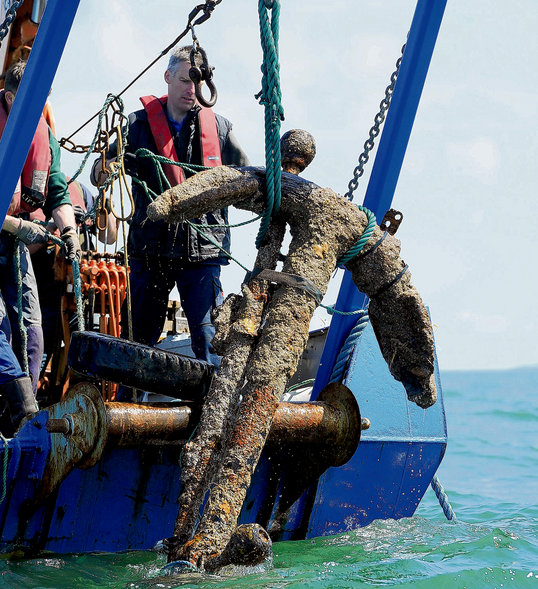
The anchors of the Aud were recovered in 2012 from the seabed and it is anticipated that they will be displayed in the centenary commemoration of the 1916 Irish uprising.
A model of the Aud at the Cork Museum with a photo of it in the background of when it was sailing as the Castro (photo taken by Bjørn Christian Tørrissen on Wikimedia Commons)

'Aud' Anchor recovery (photo from Sea Hunter)

Tuesday, 3 June 2014

Unseaworthy

In last week's ABC Wednesday I showed a pool on the Cumbrian coast teeming with tadpole life so this week I would like to take you from that pool at Haverigg out on to the sands and the flotsam and jetsam that finds itself there.  This is the Duddon Estuary which opens out into the Irish Sea.
There is a great tidal range and the tide can go out up to two miles uncovering a vast stretch of sand.  In 2011 one of the channels moved and uncovered a wreck that had been there for over a hundred years and now can be seen at very low tide.  I'd just walked out, curious to see what the solid block on the horizon was, but as it was not an extremely low tide so this is as far as I could get.  Lets zoom in
This was the 'Ariel' built in 1887 which sprang a leak and foundered here in 1904 on Duddon Bar, drifted and eventually settled on this spot half a mile away and is now unseaworthy but still hangs on to its ship shape, despite being covered by sea life over that century underwater .  Known locally as McNally's Wreck it shows how oral history can capture the essence but not always the truth as the captain at the time of its sinking was called McNish.  Steve of the Cumbrian Sea Sports Association has a fascination with the wreck and has pictures at a very low tide which shows more of the 'Ariel' and more history he has uncovered here    
Duddon Estuary and Black Combe
Well time to turn back and head towards land before the tide comes in.
Passing by this lone jellyfish left behind from the last tide whose gelatinous form is 98% water and of course famously the painful sting of jellyfish can be treated by urine, I think on balance I might prefer the other alternative of vinegar.

An entry to ABC Wednesday, a journey through the alphabet, this week drifting by U here

Tuesday, 11 June 2013

Veteran Victory

To continue my nautical theme from last weeks ABC entry here is HMS Victory, the oldest naval ship still in commission.   Launched in 1765 it is both flagship of the First Sea Lord and a living museum to the Georgian navy.  The statue in the foreground is of a sailor carrying part of a field gun. Today this is a competition between teams to transport a field gun over obstacles in the shortest time, dismantling, reassembling and firing.  The origins date from the Siege of Ladysmith (1899/1900) when naval guns were taken off ships and transported overland to help relieve the siege. The current record (set in 2010) is 1 minute and 17.78 seconds and the team holding the record, HMS Naval Base Portsmouth,  is located not too far away from  the Victory.  HMS Victory was moved to Portsmouth in 1922 is crewed by a mix of Royal Navy sailors and staff from the National Museum of the Royal Naval.
You will notice that the ship  has rather a lot of guns, 104 to be precise, but all is not what it seems. Only one of them is real all the rest are made of fibreglass.  If they were the original cast iron cannons the weight would damage the ship without the support of seawater as Victory sits in a dry dock
Although HMS Victory was present at a number of battles it is most famously remembered for the 1805 Battle of Trafalgar in the Napoleonic Wars and the  tactical imagination of the commander Admiral Lord Nelson
who was always loosing bits himself in naval battles and in this ship he met his end.   There are disputes to whereabouts on board he died but
not as to where his cabin was, here astern. I don't know if the windows were smashed in battle to the extent that is always dramatically shown in nautical and pirate films, but apart from that  the cabins always looked the perfect way to travel.  With a crew of 850 other accommodation would not be as convivial.
At the moment this and the first photo is not the present view as the topmasts and rigging have been struck, that is taken down.  They have been dismantled as part of the ships restoration.  Wooden ships need constant repair but this is the first time they have been taken down since 1944.
Time to be piped on board? No this is as far as I got   Despite having mooched around Portsmouth Historic Dockyard on numerous occasions over the years I have never gone on any of the vessels. The reason being that we are usually don't have enough time as are about to sail on a more prosaic ferry to continental Europe. This may also be the reason I don't seem to have taken a photo of Victory's bow or  figurehead or maybe it was the overcast day.

So this photo of a poster produced for the 200th anniversary of Trafalgar which was on the wall in one of the dockyard buildings will have to do for the moment.

An entry to ABC Wednesday - a sail through the alphabet