Showing posts with label church. Show all posts

Sunday, 28 March 2021

St Cuthbert Church


St Cuthbert's church was carpeted with the gold of daffodils as I came through the Lynch gate.  I had come here for solace as my dear Ron died suddenly on Monday 22 March and while many of the churches in the area had closed because of Covid I thought this one was open.
The church is Norman in origin
and this is the front entrance surrounded by Yew trees.  Although the porch was open the door was not so in the Spring sunshine I wandered around to the right side away from the sharp wind.  I have never though about why country churches have a low sloping sort of concrete attachment on the bottom of the church wall but as I sat down realised why, most comfortable.  I sat and contemplated and was joined by a robin who sat nearby on a gravestone and kept me company for some time. I rose and wandered off
spotting a group of these bell like plants. They are a little like lungwort but not quite.
There is pretty gravestone for the Postlethwaite family and a more austere but attractive
grave marker for Dr James Menzies 1853-1941 and his wife Elizabeth Ellen 1863-1937. He was the Kirkby in Furness doctor and must have been admired because the stone reads - "The skill of the physician/ shall lift up his head and/in the sight of great men/he shall be in admiration".
I left by the war memorial with its white and yellow daffodils.  For the history buff there are little biographies of the men by the gate but on this day of sadness it was not for me.
I admired the detail of the cross and went on my way home


.

Wednesday, 20 November 2019

Museum of the Moon

A clear November day when some trees still retain their autumnal colour . Here we are on Castle Hill about to enter Lancaster Priory to see a moon.
The view on entering of our time worn natural satellite - a recreation of the surface by Luke Jerram which he calls the 'Museum of the Moon'.
Walking down the aisle to enter the chancel and look back from the 14th Century choir stalls.
which are intricately carved. It is appropriate that these wonders of woodwork by unknown medieval craftsmen have
 
an embroidered cushion celebrating the furniture making of Robert Gillow and the company he founded in the 19th Century - Gillows of Lancaster and London.  The medieval misericord of the folding seat can be seen above it.
The moon is 7 metres in diameter and there were both spiritual and cultural references to the moon scattered around in the Priory as well as an information sheet with prayers, stories and the dates of the moon's cycle through the month.  I love a pun and the leaflet uses Lancaster's river as one as it is called - By the Light of the Silvery Lune.  Moonlight on water is of course always magical.
Going up the stairs to the gallery a different perspective of the moon can be seen.
There has been a church on Castle Hill since Saxon times however Lancaster Priory dates from the 14th Century but apart from the rich medieval heritage changes have been made throughout time . The bell tower (10 bells inside) is is dated 1759 but it needs some repair and there is a sponsor a brick scheme running inside the church.

The Museum of the Moon like its celestial template is always on the move and the Light Up Lancaster festival, which it was part of, ends today so it will travel south to the Wales Millennium Centre in Cardiff for December and the new year. (Museum of the Moon website) 


Wednesday, 31 October 2018

Heysham Spirit

The Spirit of Heysham sculpture by Michael Edwards on the wall of Heysham's Jubilee Institute depicts many of the historical buildings and artifacts to be seen in this ancient space and led us to the small but interesting Heritage Centre where the Duddon Valley History Group learnt about the area and indulged in a small bit of retail therapy and then moved on
to one of those buildings on the sculpture, St Peter's Church, a sturdy squat building whose churchyard slopes down to the sea and the buildings rear windows look out over the expanse of Morecambe Bay.  Two of the remains of crosses can be seen either side of the path in the photo above.  The core of the church is Anglo Saxon (mid 8th Century or before) and the door with a wooden bar and niches speaks across the centuries of times when refuge was taken from those with ill intent coming from the sea or land. Over the centuries the interior has been expanded from its Anglo-Saxon origin and altered with each era, Norman to Victorian.  One of the church's great treasures is the Hogback Stone, a Viking grave cover, and the story it contains of the Legends of Sigmund and Sigurd the Dragon Slayer are told and can be seen here .   Our church guide Richard Martin had a wealth of knowledge of the church and its history and has a handy guide available in the church for self tours.  

The church was consecrated in 967 and as part of its millennium celebrations the parishioners in 1966 made kneelers and cushions portraying the area's industry and occupations.  The four evangelists have pride of place
by the wooden screen in the chancel.  This is St Mathew and St John (the eagle)
St Mark (the winged lion) and St Luke (the winged ox).  The Cross with the crosses at the end is a Crosslet which also represents the four evangelists and the spreading of the gospel to the four corners of the earth.  Moving outside towards St Patrick's Chapel
a different type of cross can be see, a Pommée, the apple shapes at the end represent the fruits of the Christian life and it is thought that
St Patrick's Chapel's Anglo Saxon Doorway
St Patrick's Chapel on top of the headland was a place of retreat. It would have been a great place for contemplation with its views over Morecambe Bay and the hills of the Lake District.  Another of Heysham's treasures are the six rock-cut graves -
Nobody knows their origin but they are certainly unique and, as demonstrated, it looks a cosy place to end ones days under ever changing skies. Perhaps there were sky burials here although the less romantic archaeological explanation is that they were probably reliquaries for bones and other materials as they were not big enough for bodies but I observe they appear to big enough for female bodies.  The holes at the head were for crosses.  We took our leave of the Anglo-Saxon chapel and returned to the church
another stone coffin but of one which at one time contained the body of a past rector of the church (the crumbled remains of his chalice can be seen in the church).  We headed away
Remains of Anglo-Saxon Cross
to the nearby St Peter's cafe, a converted stables, which was a nice warming retreat to take the chill off the biting wind of the day.

 
The Heysham Timeline can be seen on Heysham Heritage Association website here.


Tuesday, 14 March 2017

A trio of Js

I am sure these telegraph poles would be raised in a jiffy with the help of the JCB digger.  There was a strong smell of creosote on the air when I came close to take this photograph one Sunday when the workers were enjoying a justifiable rest.
Maybe they were enjoying their leisure in a garden although this photo of a jug on garden steps was taken in December, more the time of year to browse the seed catalogues.
Perhaps they walked to church in the spring sunshine, going through a door created by a joiner.  

An entry to ABC Wednesday, a journey through the alphabet, this week sojourning at J here

Tuesday, 13 December 2016

Windows on Life

A beautiful aspect of the of hills and woodland is glanced through the window's of St Bega's Church in Eskdale Green. Originally built as a chapel of ease in the 19th Century generations will have gazed on the seasons changing from the church seats.
At Colton Church (Holy Trinity) the words of the Psalm 150 greet one coming though the door, which urges the congregation to praise God with singing and dancing.
Windows of a more practical nature in a Signal Box when alert eyes are needed to keep the trains safe and I'm taking the picture through the train window as it slowed down.

Even more windows at the Bluecoat Art Centre, originally built as a school in 1717.

I've got a double here as there are not only window but also a yellow poster advert for WT Windowstore in one of them. I think they were doing some renovation at the this, the old British and Foreign Marine Insurance building in Liverpool. To be honest I was more interested in the building's mosaics which can be seen in more detail here 

An entry to ABC Wednesday, a journey through the alphabet, this week sojourning at W here

Tuesday, 26 July 2016

Clock This

One clock tower and two times but both correct.  One is reading the sun and the actual time, the other having done its 'spring forward' an hour is showing Summer Time.  The clock dates from 1856 and was made by one of the great clock makers of England, Potts of Leeds. The mechanism was designed by Edmund Beckett (later Lord Grimthorpe) who was also responsible for the rather more famous mechanism that chimes Big Ben in London.
But this particular clock is on the All Saints Church in the market town of Bingley, West Yorkshire. It is thought that a church has stood on this spot since Saxon times but the present gritstone building dates from the Tudor period (15th/16th Century). The tower was added later but then heightened with a new belfry in 1739.  The interior has also been altered through the years but other alterations are going to happen outside in the near future. 
The memorial stones that make up the path to the church (the inscriptions don't show up well in my photograph) are due to go because of health and safety concerns as they get very slippy in wet weather and there have been a number of falls.  I wondered why they were there and discovered that their original place was in the churchyard which was closed in 1904 when a main road was built through it to the east of the church.  There are 145 stones, some on this path 
others surround the church and the steps to the left of this photograph form a layered patio area.
Photo from: All Saints Bingley website
which the church's website shows in appropriately wet weather.  It has not been decided where the old gravestones are going, one idea was to put some in the nearby rose garden which needs some TLC and the rest to be relocated to the municipal cemetery.  In the meantime when work does eventually start they will be put into storage until their ultimate destination is decided but the question is are there really only 145 slabs or as the lawyer that was dealing with the planning application mentioned they may be layered.  A plan of the 145 stones and those inscriptions that could be read have been transcribed and the information put on the church's  website. for the growing number of genealogists.

Here is the Bingley clock mechanism in motion.  Beware for the gentle and mesmerising ticking will change into a startling cacophony as the clock strikes or maybe it was because I had my computer sound on maximum by mistake. I love a chiming clock.


An entry to ABC Wednesday, a journey through the alphabet, this week sojourning at C here      

Tuesday, 24 May 2016

Church Tower

A carpet of crocus and a scattering of daffodils surround the tombs of St Mary Magdalene churchyard.  Here I stand on the west side of the church looking towards the tower. A church has stood here since the 12th century, although little remains of it after an extension in the 16th century, alterations in the 18th century and lastly a rebuilding in 1873.  The squat saddleback tower we see today is by Austin and Paley, a duo of much loved local architects, and replaced the old one in 1900-1.
It is difficult to get a photograph of the whole church as it is surrounded by trees and from this angle the tower saddleback cannot be seen but lets head out towards the gate for another angle, look up to check the time
and see a homily on the tower "Watch for ye know not the hour",  perhaps something to meditate on as I take a turn around the tombstones
while enjoying a day of spring sunshine and flowers.
Here can be seen how well the sturdy tower sits with the church as they nestle in the hollow of the valley south of the village of Broughton in Furness.

An entry to ABC Wednesday, a journey through the alphabet, this week sojourning at T here


Tuesday, 17 May 2016

Saltaire

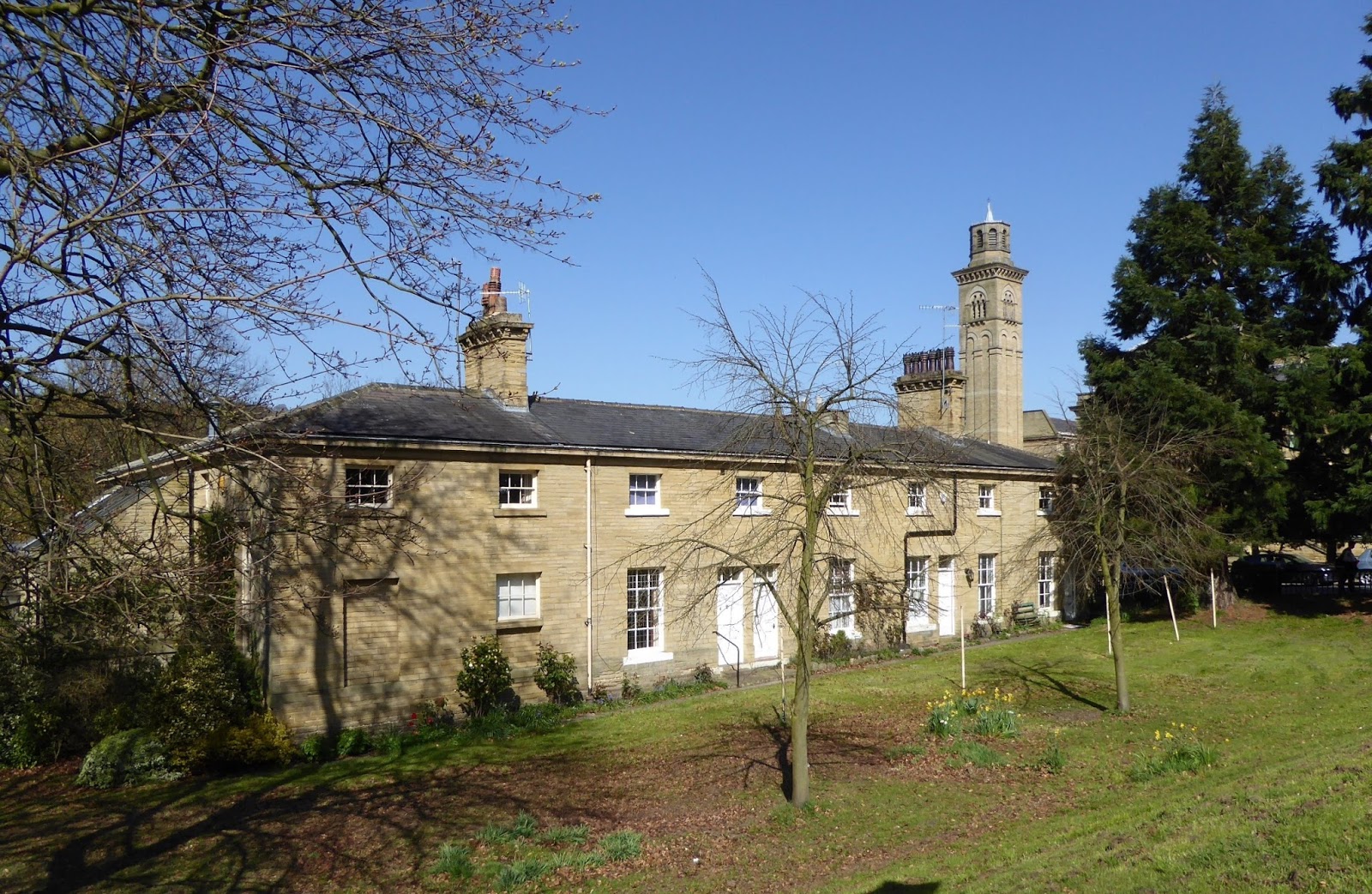
Walk along the towpath of the Leeds-Liverpool Canal (celebrating its 200th birthday in 2016) from Shipley in Yorkshire this marvelous edifice comes into view around a bend at Saltaire.  It is New Mill or the North Block of Salts Mill and built in an Italianate style; the chimney is based on the Campanile of Santa Maria Gloriosa dei Frari in Venice. Once a wool mill today it houses the National Health Trust who must have lovely window views of canal
and to the side, the River Aire.  Built by Titus Salt as a wool mill when be bought farm land here because of the ideal transport links of both canal and railway but also because he had a vision of building a model village for his workers.  A man of great religious faith he also built
the Congregationalist Church directly opposite the mills. The conditions in the slums of Bradford were dire at this time with high infant mortality and even an outbreak of cholera so when the workers came here to neat housing and open green spaces it must have been a revelation.  The village, by combining his name and river name, became Saltaire. 

No wonder when in 1876 Titus Salt died 100,000 people lined the street for his funeral cortege. The Salt family mausoleum is at the rear of the church on the right. 
In the grounds by the entrance are also what was the office house and stables.  Titus Salt had made the bulk of his fortune by the chance of finding Alpaca wool in a Liverpool docks warehouse which was being used as  packing material in imported goods.  He discovered that by combining it with Angora sheep wool it made a fine and desirable material.  When in recent times ideas for a sculptures alongside the River Aire were imagined and drawn by the local school

it is no surprise one of them was of an Alpaca.
As well as housing, schools and churches Salt also built Saltaire Institute as a 'centre for recreation, culture and learning’ consisting of  library, gymnasium and rifle drill-room, fencing room, armoury, chess room, laboratory and lecture theatre, bagatelle and billiards room, a school of art, and a large dance hall with a fully sprung floor.  Wow there was a whole lot going on in there.  Today owned by the Salt Foundation charity trust and renamed Victoria Hall it is still a centre for recreational use with the addition of weddings and film locations.

Saltaire was designated a UNESCO World Heritage Site as an "exceptionally well preserved industrial village that had a profound influence" on similar model villages built as a result of philanthropic paternalism (such as Port Sunlight which I pictured in a previous round of ABC Wednesday here) 

Although I am quite fond of taking photographs of vernacular housing my brief time in Saltaire meant I couldn't didn't get to amble along it planned streets and parks but by chance I did take a photo of one of the lions outside Victoria Hall
which were designed by sculptor Thomas Milnes and originally destined for the bottom of Nelson’s column in Trafalgar Square in London.  Guess the capital decided they wanted something a whole lot bigger.  Of course the housing is evident in the background and what is even better is that the road sign says Lockwood Street.  Titus Salt's architects who designed the whole village and mills were Lockwood and Mawson and this is one of the streets, as thanks, he named after them.

An entry to ABC Wednesday, a journey through the alphabet, this week sojourning at S here