An entry to Signs, Signs
Showing posts with label Britanny. Show all posts
Wednesday, 27 July 2011
How Green Is The Sea
A glazed tile on a house wall in the village of Coet-Bugat, France. The language is Breton (Breizh) and the lettering and design attracted me. I liked it even more when I looked up the words. It says "How green is the sea".
Location:
Coët Bugat, 56120 Guégon, France
Tuesday, 26 July 2011
ABC Wednesday - Break
How nice to get away and take a break, relax. We arrived in France on the 9th July driving down to the rented Gite. All discoveries in front of us. Unpacked and later that evening up the stairs to bed. If only I had not decided to come down the stairs again in the moonlight. They turned at the bottom, but I did not my feet scrambling on air. Bump, my hip hit the tiled floor. Argh. My partner, when I could not move, ever the optimist said, maybe it is a muscle injury. No signal on the mobiles so off he went into the night and returned with 2 French men who by chance had been returning home from a night out. One was a paramedic who looked after me until the Pompiers arrive. In France it is the Firemen who run the emergency services, and one of the reasons they are held in such affection by country and get to lead the parades.
In the rural part of France where we were staying they were volunteers so they were called from their homes to look after me. They made me comfortable placing me on the air stretcher, the leader, a small, but strong, woman lifting me on. Off we went with flashing lights and arrived at the hospital in Vannes half an hour, a fast trip. We shook hands and thank them as they left, a trio of kind strangers. Taken to X-Ray or Radio it was discovered I had broken the top of my femur. The surgeon asked if I wanted to be repatriated or have the operation there the next day. It took a heartbeat to say here. After a painful (douleur) night the next day I was operated on and returned to the hospital room. I now had an prosthesis (a new ball joint and a spike down my femur). Returned to one of the two bedded rooms, I was lucky enough to have the one by the window. The rooms were light and airy. I gazed out of the window on to the tree lined car park. The days passed with pain killers and wonderful medical care. How to learn French with total immersion. Well actually how to learn medical French. My little French/English dictionary came into its own as I and the nurses flicked through it. What wonderful cheerful, professional care I received from the nurses. Eventually I arose from my bed to be taught by the physiotherapist how to use cannes (canes) or as we would call them walking sticks. The surgeon had said I would be in for 5 days and then walk out. Behold I did. What else can I say. Well the hospital meals were restaurant quality. Apart from breakfast, well I'm English so missed a gentle cereal rather than a strong bowl of coffee and a bun.
At first I shared a room with a very sick and elderly woman who had a superb appetite, I though it was me who could not manage the full array until I shared the room with a woman who had broken her arm in 3 places in the shower. We both agreed these were big meals as we swapped holiday destinations in France and England.
Better medical care could not have been given in such a caring way. So I raise my glass to French hospitals, in particular the Centre Hospitalier Bretagne Atlantique, their staff and the kindness of strangers.
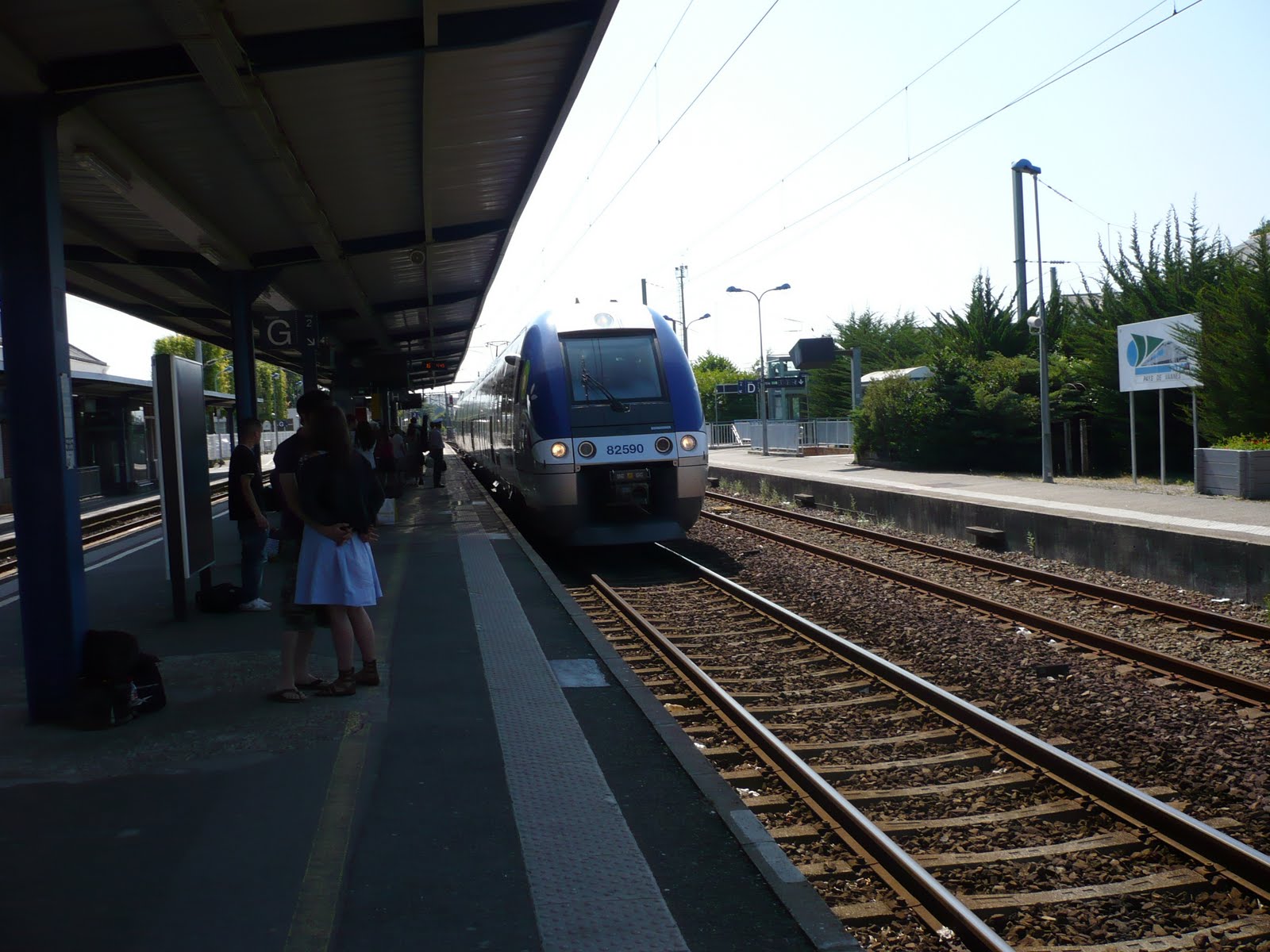
The pictures are courtesy of my partner who travelled on the train each day to see me in hospital with news of the outside world. He thought this kissing couple were about to be parted but no, they were just waiting for the train together.
In the rural part of France where we were staying they were volunteers so they were called from their homes to look after me. They made me comfortable placing me on the air stretcher, the leader, a small, but strong, woman lifting me on. Off we went with flashing lights and arrived at the hospital in Vannes half an hour, a fast trip. We shook hands and thank them as they left, a trio of kind strangers. Taken to X-Ray or Radio it was discovered I had broken the top of my femur. The surgeon asked if I wanted to be repatriated or have the operation there the next day. It took a heartbeat to say here. After a painful (douleur) night the next day I was operated on and returned to the hospital room. I now had an prosthesis (a new ball joint and a spike down my femur). Returned to one of the two bedded rooms, I was lucky enough to have the one by the window. The rooms were light and airy. I gazed out of the window on to the tree lined car park. The days passed with pain killers and wonderful medical care. How to learn French with total immersion. Well actually how to learn medical French. My little French/English dictionary came into its own as I and the nurses flicked through it. What wonderful cheerful, professional care I received from the nurses. Eventually I arose from my bed to be taught by the physiotherapist how to use cannes (canes) or as we would call them walking sticks. The surgeon had said I would be in for 5 days and then walk out. Behold I did. What else can I say. Well the hospital meals were restaurant quality. Apart from breakfast, well I'm English so missed a gentle cereal rather than a strong bowl of coffee and a bun.
At first I shared a room with a very sick and elderly woman who had a superb appetite, I though it was me who could not manage the full array until I shared the room with a woman who had broken her arm in 3 places in the shower. We both agreed these were big meals as we swapped holiday destinations in France and England.
Better medical care could not have been given in such a caring way. So I raise my glass to French hospitals, in particular the Centre Hospitalier Bretagne Atlantique, their staff and the kindness of strangers.
The pictures are courtesy of my partner who travelled on the train each day to see me in hospital with news of the outside world. He thought this kissing couple were about to be parted but no, they were just waiting for the train together.
Bob over to ABC Wednesday to see more words starting with the letter B
Labels:
ABC Wednesday,
Britanny,
France,
Hospital
Location:
Vannes, France
Tuesday, 21 June 2011
ABC Wednesday - Weirs
The River Leven drains from Windermere but when it reaches Backbarrow the terrain gives it a steep fall so the weirs perform their task well at this point of altering a rivers flow and preventing flooding. In the past this water flow allowed industrial use of the river for mills and ironworks. Nowadays the water just gives its name to a hotel, The Whitewater.
A gentler flow in a tributary of the River Kent which has a weir mechanism on one of the flows, the people in the camp site lower down can rest easy at night. Some weir mechanisms are more elaborate
although this one on the River Findhorn as it flows through the town of Forres in Scotland is so much better to launch your boat down or test your fishing net.
A gentler flow in a tributary of the River Kent which has a weir mechanism on one of the flows, the people in the camp site lower down can rest easy at night. Some weir mechanisms are more elaborate
although this one in France did not seem to have a lot of water coming down it, and was very still
on the other side. I think the metal work would be tempting for a small boy to walk acrossalthough this one on the River Findhorn as it flows through the town of Forres in Scotland is so much better to launch your boat down or test your fishing net.
An entry for ABC Wednesday, a journey from A to Z
Whiz over to ABC Wednesday to see more words beginning with W
Tuesday, 3 May 2011
ABC Wednesday - Poètes Ferrailleur
On holiday near Lizio in Morbihan area of France we kept passing a tower on a hill in the distance, it looked from another world. When on a showery day we fetched up at he Musée de Poètes Ferrailleur we discovered what it was.
It was part of the whimsy of Robert Coudray, the Poètes Ferrailleur in the title. A ferrailleur is a scrap iron merchant but Coudray has turned the scrap iron into whirling motion (this one wind powered), and to works of imagination, he is the iron poet.
Perhaps this sail plane is about to take off
the boat-car set sail
The entrance looks as though it is about to be towed into the air. Inside there are automata, a mechanical theatre of fey creatures, rolling balls and lots of kinetic energy. I didn't take any photos inside, how could they capture the motion, so here is a short taste. Wednesday, 23 February 2011
Take A Break
The sign is a bit faded by the sun but it is in an ideal position, at the midpoint of the rows and rows of the 3,000 Neolithic megaliths at Carnac in northern France. Just about the time one may be flagging and ready for pancakes, drinks and ice cream. Chez Céline was a small hut with outdoor seating. Order at the window, the staff were a full pelt over hot stoves. We had ice cream. Delicious, definitely home made by an artisan.
The drawing recreates the old pictures of the 19th century when the locals liked to have their photograph taken sat on top of the larger stones.
An entry for the meme Signs, Signs
Tuesday, 2 November 2010
ABC Wednesday - Ploërmel
For this weeks ABC its a short trip to Ploërmel, a small town near the Paimpont Forest in France under whose trees, says the legend, lived Merlin the Magician, sorcerer to King Arthur. The Citroen car has a little bit of magic, it is dressed up for someone's special day. I always think of the French Police detective Maigret who in the television series seemed to spend a lot of time driving around Paris in this type of Citroen, when he was not smoking his pipe .
in the Place d'Armi on an overcast day, the main entrance is round the cover to the left so no peeking at the wedding while dining at the Cafe de la Tour in the square, you have to wait for them to pass when driving away.
Taking a short promenade to a hidden corner of Ploërmel through a narrow passage arriving at
the courtyard of what used to be the Community of Brothers building is a French treasure in a glass case
the astronomical clock and orrery showing the movement of the planets. You can just make out the orrery in this picture inside the little building on the right with all the different sized planets, slowly turning. Built by Brother Bernardin (Gabriel Morin) who made it to help in his lessons. He was not a clockmaker but made the 197 parts, cut the cog teeth by hand and most importantly worked out the long calculations needed to accurately measure the movements of the planets. He constructed the clock and orrery between 1850-1855 and it functioned inside the building until it was dismantled in 1874 and packed away in boxes, Brother Bernardin would not see it working again in his lifetime. At one point it was nearly sold for the scrap value of the metal but happily it was eventually refurbished and installed in this little building.
The clock chimes
on the quarter hour, the 10 dials show the position of the sun, stars, phases of the moon and signs of the zodiac. There is a steady stream of a mini united nations of people coming to look as this wonder of invention, press the button for your language of choice and all is explained.
Ploërmel is a pleasant place for a perambulation with interesting
First Day Cover from the 6 Heroes of French Detective Fiction series of stamps
Georges Simenon wrote many novels and short stories about Commissaire Maigret which are an established part of the French detective genre the 'Policier'. I appear to be getting off the point, so lets return to the churchin the Place d'Armi on an overcast day, the main entrance is round the cover to the left so no peeking at the wedding while dining at the Cafe de la Tour in the square, you have to wait for them to pass when driving away.
Taking a short promenade to a hidden corner of Ploërmel through a narrow passage arriving at
the courtyard of what used to be the Community of Brothers building is a French treasure in a glass case
the astronomical clock and orrery showing the movement of the planets. You can just make out the orrery in this picture inside the little building on the right with all the different sized planets, slowly turning. Built by Brother Bernardin (Gabriel Morin) who made it to help in his lessons. He was not a clockmaker but made the 197 parts, cut the cog teeth by hand and most importantly worked out the long calculations needed to accurately measure the movements of the planets. He constructed the clock and orrery between 1850-1855 and it functioned inside the building until it was dismantled in 1874 and packed away in boxes, Brother Bernardin would not see it working again in his lifetime. At one point it was nearly sold for the scrap value of the metal but happily it was eventually refurbished and installed in this little building.
The clock chimes
on the quarter hour, the 10 dials show the position of the sun, stars, phases of the moon and signs of the zodiac. There is a steady stream of a mini united nations of people coming to look as this wonder of invention, press the button for your language of choice and all is explained.
Ploërmel is a pleasant place for a perambulation with interesting
buildings, streets and shops
although I have a penchant for taking the back routes.
Time for a sit down in the Salon de Thé, write the postcards home and pop them in the
post box.
Wednesday, 20 October 2010
Church in Northern France
Walking through the small village of Coet-Bugat in France we came across a little Gothic style church. I like a wander round a church, but it was locked, so we never got to see the intriguing stained glass windows from the inside. What else is a person with a camera to do but look for something interesting outside.
An entry in the mid-week meme "Window Views....and doors too"
Tuesday, 28 September 2010
ABC Wednesday - Kerguéhennec
The beautiful château Kerguéhennec built in 1710 with different owners either side of the French Revolution, lies 20 miles north of Vannes in the department of Morbihan. It is open in the Summer, the ground floor and kitchens show it as it would have been at its height, I especially liked the three bell pushes on the snooker table. On the top floor is a changing contemporary art exhibition. It is set in hundreds of acres of countryside laid out like a British Country House (jardin anglais) with two large lakes, woodland walks, bike tracks and an arboretum. So lots to see and do, or you could just lie down and relax, no entrance fee,
Perhaps take a stroll round the lake where apart from grebe and dragonflies you might find unexpected things
Mimi by Markus Raetz
put your hands behind the head and gaze into the deep blue sky
Perhaps take a stroll round the lake where apart from grebe and dragonflies you might find unexpected things
floating in the middle like Marta Pan's Parcours flottant Number 2.
But one of the things that mesmerised me was my countryman Richard Long, famous for his walking or landscape art who here has 'A Circle in Brittany'( Un Cercle en Bretagne).
A close up view. The rock is schiste, slate like but with high mineral content formed originally from clays and muds and become a crystalline foliated metamorphic rock. This rock was used in Brittany 6000 years ago for the many structures of prehistory that fill every corner of this part of the country, it looks marvellous in a barrow grave. It is the intensity of colour that Richard Long has managed to find. How did he do that? I was looking on the ground when I holidayed there for two weeks and never saw anything this rich a colour, my little pieces I brought back pale in comparison. It has the dates 1986-2007 by the title, some obtained from the area of St Just, which also has some other rather unusual rocks and ancient structures, a labour of love judging by those dates.
The grounds of the château contain many other pieces of contemporary art, it is the biggest sculpture park in France.
This we could not quite make out as it was at the end of an avenue of trees but became clearer as we approached. It is called The Seven Colums of Mallarmé (Sept Colonnes a Mallarmé). I will admit my ignorance, I have never read any of his poems or works so I have not a clue what this means. The columns all look similar but when you look closer they are all different.
As we looked back to the house along the long colonnade of trees. I wondered the significance. Any answers or clues from the well read and knowledgeable out there?
1000 Pots bétonnés une serre ancienne by Jean-Pierre Raynaud
(1000 Cemented Pots in an old greenhouse)
At least you know where you are with pots the colour of earth in a greenhouse, there are a few clues and it is a rather beautiful old structure.
A wonderful place to spend the day, a hidden gem of paths, trees, lakes and art, but under threat, and in danger of going kaput, one of the three partners does not want to fund any longer. There is a petition against closure but in these strange times who knows what will happen to the Domain Kerguéhennec, I hope it is still there next time I go to France.
Sunday, 5 September 2010
Champ-Dolent Menhir
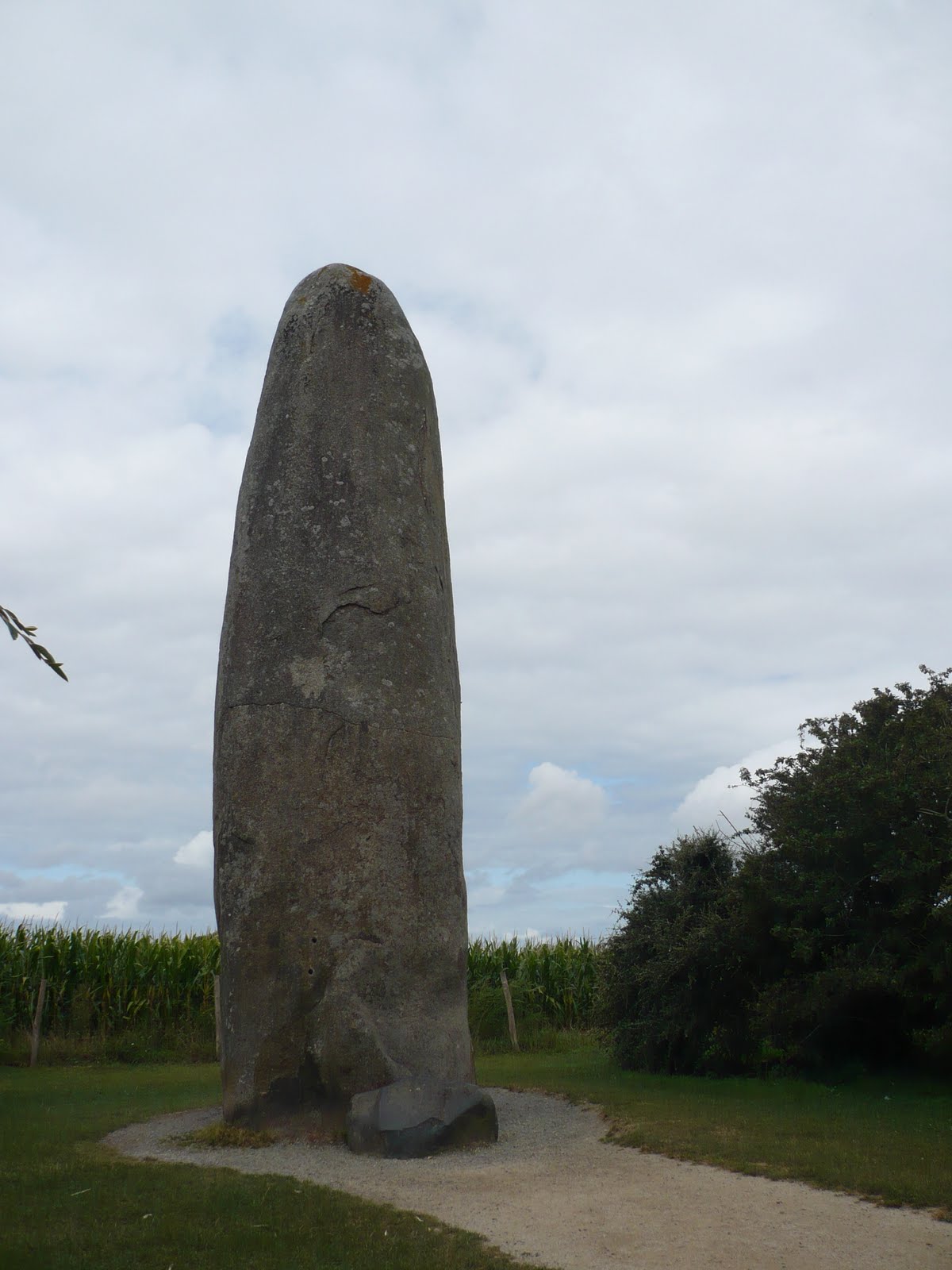
Back from France, so what picture would sum up my holiday. Brittany has greatest concentration of megalithic stones in the world. Wherever you go there will be one of a variety of structures within walking distance to gaze at and wonder about the people that constructed them 6000 years ago. Despite a visit to the thousands of stones at Carnac, this single stone near Dol-de-Bretagne is my favourite. Standing nearly 32 feet (10m) high it is an impressive sight on the flat plain. This family group sitting on the small, polished stone at its base gives it scale in this photo. The "sitting" stone of bluish granite is not the same material as the tall menhir and has been its companion for as long as anyone can remember.
It is a popular picnic spot as well as a photo opportunity, the area around it has been cleared since last I was here
when there was a corn field and big bushes. There are many legends surrounding the stone. One tells how a battle was once fought between two feuding brothers. When the fighting was at its hight, and the field was running with blood, the menhir sprang up between the two sides, amazed by the miracle, the armies ceased fighting and made peace. This legend gave the place its name, Field of Woe.
I like the other legend that that a piece of it is eaten by the moon every night, or that it is slowly sinking into the ground and when it disappears the world will end. It looks as though it is going to be there for a few more thousand years so I'm not too worried yet.
View Larger Map
It is a popular picnic spot as well as a photo opportunity, the area around it has been cleared since last I was here
when there was a corn field and big bushes. There are many legends surrounding the stone. One tells how a battle was once fought between two feuding brothers. When the fighting was at its hight, and the field was running with blood, the menhir sprang up between the two sides, amazed by the miracle, the armies ceased fighting and made peace. This legend gave the place its name, Field of Woe.
I like the other legend that that a piece of it is eaten by the moon every night, or that it is slowly sinking into the ground and when it disappears the world will end. It looks as though it is going to be there for a few more thousand years so I'm not too worried yet.
View Larger Map
Tuesday, 4 May 2010
ABC Wednesday - Point
It is that time of year in the northern hemisphere when the relief at the passing of a long cold winter and the enjoyment of sunny days turns to impatience and the longing to throw off the layers of clothing and feel the warmth of summer. So let me take you on a late summer walk along the coast of France from the Pointe du Nid to the Port de Mar, Cancale in Brittany. The first picture is looking west from the Pointe du Nid towards the Baie de Guiselin but this stroll is heading east. The coast used to be called the Cote Du Nord but there has been a bit of a re-branding exercise and now it is the Emerald Coast
but this time the marketing men have got it right. Here are red granite rocks but in the morning the sea was not the azure blue it can be for earlier it had rained, and we had been treated to a rainbow as the sun came out. The day was windy and warm
so when walking from point to point you may need sleeves and if I had been a bit quicker with my camera you would have a clearer view of the stripy blue hat. The path runs along cliff tops but descends to numerous
sandy beaches. Fishermen long lining from the beach but also from the
rocky points as the waves crash over them. There are notices warning of Peril in stormy weather soperhaps this is why the inflatables are are not bouncing on the waves and no-one is descending the steps near Port de Mer.
In the sheltered bay by the Pointe de la Mouliniere the waves wash onto the warm sand.
and amongst the sand dunes and sea grass an unexpected flowering of sweet peas
The sea and sky are now clear blue as we head from Pointe de la Mouliniere to Pointe du Grouin and the signals post in the far distance
And so to the end of a perfect perambulation by the sea.
Pop over to ABC Wednesday meme to see more words beginning with the letter P
Subscribe to:
Posts (Atom)