Showing posts with label History. Show all posts

Monday, 15 September 2014

Red Cross Volunteers

This recent Red Cross newsletter reminded me that before I went on holiday I was delving into my inherited War Illustrated magazines.  The Red Cross are also remembering the outbreak of World War 1 and their volunteers and staff who "did everything from nursing to air raid duty to searching for missing people and transporting the wounded" and of course the Red Cross work did not end in 1918 (or indeed ever) and by 1919 the numbers of volunteers had reached 90,000.  The majority of female VADs (Volunteer Aid Detachments) were nurses who organised and managed  the 3000 local axillary hospitals throughout Britain which were set up in a variety of buildings and places but many were also deployed abroad to help in field hospitals. From 20th October the records of the VADs will be available to browse at -  redcross.org.uk/ww1
World War 1 VAD Recruitment Poster

But lets return to August 1914 when the British Red Cross formed the Joint War Committee with the Order of St John and the War Illustrated edition of 22nd August devoted a page to "Woman's Healing Work Amongst the Wounded"
"Group of Red Cross nurses at Newport in the Isle of Wight"
 which gives the impression that the whole of womankind were on the march, setting sail or boarding trains:

Apart from those marching red cross volunteers the other thing that attracted my attention on this page was the ocean going steam yacht

which took me on a fascinating journey through the Internet where I discovered the story of the ship 'Liberty' and the eccentric Tredegar family but more of this later.

 Related Information:-
1. List of Auxiliary Hospitals in the UK During the First World War 

Sunday, 3 August 2014

At the Seaside

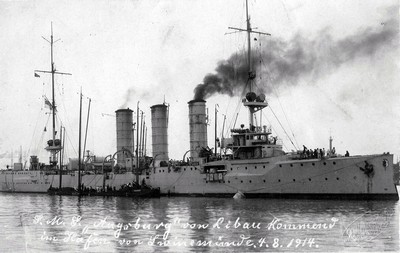
3rd August 1914 - "Germany declares war against France.  German cruiser bombards Libau..."
SMS Augsberg (photo from Europeana)
The cruiser conserned was the SMS Augsberg and the photo shows it after its return to the German Baltic
Swinemünde a
Swinemünde a
port of  Swinemude on 4th August 1914.  The picture is from "War Memories" by Lieutenant Max Kranz.  The port of Swinemude became the Polish city of Świnoujście after World War 2 and the Augsberg's target of Libau is now in Latvia and called Liepāja.  The boundaries of Europe for ever shifting throughout history and no doubt will continue to do so into our unknown future.  Liepāja is known in Latvia as "the city where the wind is born" because of the continuous sea breezes and as an ice free port on the Baltic has been a been a prized possession for military empires. Happily there are only sea festivals and walks on wide sandy beaches today.  The tourist site says it is best enjoyed slowly.

But let me return to the winds of war of this day in 1914

"In reply to a 12 hours ultimatum from Germany (expiring at 7 am), Belgium refuses to allow passage of German troops through her territory and King Albert sends "supreme appeal" to Kind George.  German troops envelope Visé (which was afterwards burnt).  General Joffre, French Commander-in-Chief, leaves Paris for the French frontier.  Grand Duke Nicholas appointed Generalissimo of Russian Army.  Australia offers 20,000 men.  Sir Edward Grey's speech in the House of Commons.  British naval mobilisation complete.  Moratorium Bill passed.  Bank holiday extended to August 7th". 'Our Diary of the War' War Illustrated.

On the actual Bank Holiday Monday of August of 3rd August people were enjoying the sunshine while reading newspaper headlines such as "Europe Drifting to Disaster" and nobody was sure whether Britain was yet definitely engaged in the war. That evening a boat from the Hook of Holland arrived at Harwich carrying 780 passengers instead of the expected 100. Among them were tourists who had been turned back at the French-German frontiers and told to get back home as quickly as possible.

The author WJ Makin wrote
"At Scarborough and Whitby crowds idled beside the sunlit waters of the North Sea, little dreaming that German battle cruisers were already contemplating bombardment of that particular coast-line.  And on the other side of the North Sea the same scenes were to be witnessed.  At Ostend, gay Continental crowds lounged along the plage. The Casinos were full, dance halls were crowded, orchestral concerts were drawing their huge crowds.  Europe, generally, was prosperous and happy. It had been a good year for the crops, and everyone from Calais to Constantinople was looking forward to a bumper harvest....Life at that time for the common people of the Continent was simple and pleasant.  Never again while they lived would they ever feel as secure"


Saturday, 2 August 2014

From Kiel to Kerry

2nd August 1914 "British ships seized at Kiel. German troops invade Luxembourg and enter Ciréy. Russian forces cross German frontier at Schwidden.  Romania declares neutrality". War Illustrated 'Our Diary of the War'

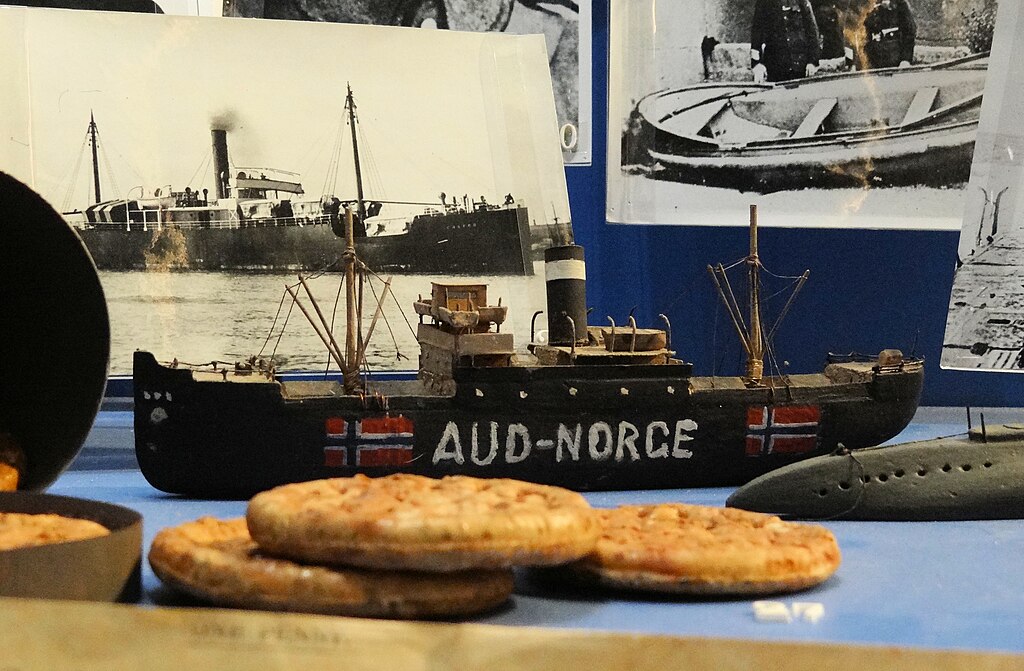
I idly wondered when reading this entry what the ships were seized at Kiel and found it was a liner called 'Castro' and a collier  The coal carrier was unnamed but when I went looking for the 'Castro' what a story I found. Built by Earls Shipbuilding in Hull (1911) it was the second of three ships named 'Castro' which would be owned by Wilson and Son (later to be taken over by the more famous Ellerman Lines).  On capture the Castro was used by the German Navy and renamed the Libau  in 1915 only to take on another identity in 1916 being disguised as the Norwegian steamer Aud. Loaded with weapons it set sail for the Kerry coast in Ireland and the Irish Republicans planning the Easter Rising in Dublin.  Despite wonderful attention to detail such as even having buttons on the crews uniforms imprinted with a Norwegian company name it failed to rendezvous with the U.19 which was carrying Sir Roger Casement returning from Germany (where he had been trying to form an Irish Brigade from Irish prisoners of war for the uprising against the British).  The 'Aud' failed to land the arms and in April 1916 was intercepted and ordered to Queenstown Harbour (now called Cobh) for examination. If it had landed they would have found  20,000 rifles, machine guns, giant "clockwork" bombs and one million rounds of ammunition but it was scuttled by its captain, Karl Spindler while under the Royal Navy escort of the ships Bluebell and Zinnia (its crew surrender when they were in the lifeboats).  A description of the Aud operation is found in an article about Karl Spindler here Casement eventually landed in a collapsible boat on Irish soil but was soon captured by the British.

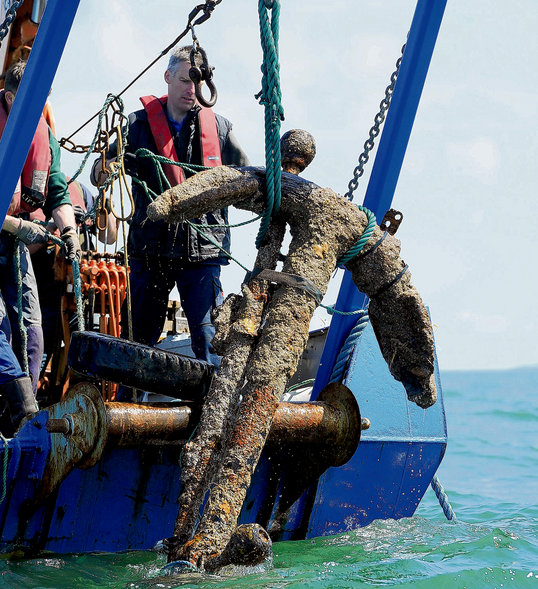
The anchors of the Aud were recovered in 2012 from the seabed and it is anticipated that they will be displayed in the centenary commemoration of the 1916 Irish uprising.
A model of the Aud at the Cork Museum with a photo of it in the background of when it was sailing as the Castro (photo taken by Bjørn Christian Tørrissen on Wikimedia Commons)

'Aud' Anchor recovery (photo from Sea Hunter)

Friday, 1 August 2014

War Ilustrated

I inherited a box of bound volumes of The War Illustrated which once belonged to my paternal grandparents. This was a collection of the weekly magazine issued throughout World War One being mostly photographs and drawings with the occasional articles and news items, notably the first issue (published for the week ending 22nd August 1914) had an article by the author HG Wells.  As a child that latter fact went over my head as it was the drawings and photographs that fascinated me. As you would expect the journals took on a patriotic tone with sensationalist headlines but this would alter from 1916 onwards as the weariness of a interminable war dragged on.

The binding of the volume calls it "the conflict of nations" and of course we all know that it was also called the war to end all wars but the mentality of mankind made that statement wildly untrue and the same publishers produced a record of the Second World War in a similar format.  I thought I would revisit the Great War volumes and perhaps pick out some of the pictures I find historically or socially interesting as time goes on.

At the end of Volume One of War Illustrated they produced a list - "Our Diary of the War" starting from the date of June 28 "Assassination of Archduke Franz Ferdinand and his wife at Sarajevo".  The intrigues and machinations of countries vying for power all added to the inevitability of the disaster to come but this is how it appears in the volume with chilling simplicity:

July 23 - Austro-Hungarian 48 hour ultimatum to Serbia 
July 24 - The Russian Cabinet considers Austrian action a challenge to Russia
July 27 - Sir Edward Grey proposes conference, to which France and Italy agree
July 28 - Austria-Hungary declares war against Serbia
July 29 - Austrians bombard Belgrade. Tsar appeals to Kaiser to restrain Austria.
July 30 - Russia mobilises sixteen army corps. Bombardment of Belgrade
July 31 - State of war declared in Germany.  General mobilisation ordered in Russia. London Stock Exchange closed. Jean Jaurès assassinated.

A quote by Jaurès who was assassinated in the Parisian café, Le Croissant, and who wished to prevent war, the voice of reason...
"What will the future be like, when the billions now thrown away in preparation for war are spent on useful things to increase the well-being of people, on the construction of decent houses for workers, on improving transportation, on reclaiming the land? The fever of imperialism has become a sickness. It is the disease of a badly run society which does not know how to use its energies at home."-- Jean Jaurès
Which brings us to today 100 years ago and the War Illustrated note of the day

August 1 - Germany sends 12 hours' ultimatum to Russia to stop mobilising and declares war.  Mobilisation in Austria, France, Belgium and Holland.  Italy declares neutrality.  Sir John French appointed Inspector-General of the Forces. British Naval Reserves called up.  Bank Rate 10 per cent. Theophile Delcasse French War Minister. Montenegro identifies herself with Serbia. 

An extract from the Liberal Prime Minster Herbert Asquith's diary for the 1st August shows how things unravelled
"A long message from Berlin to the effect that the German Ambassador's efforts for peace have been suddenly arrested and frustrated by teh Czar's decree for complete Russian mobilisation. We all set to work to draft a personal appeal from the King to the Czar. When we had settled it, I called a taxi and, in company with Tyrrell,  (I presume this refers to Sir William Tyrrell, Sir Edward Grey's private secretary) drove to Buckingham Palace by about 1.30 am. The king was hauled out of his bed and one of my strangest experiences was sitting with him, clad in a dressing gown while I read the message from Berlin and the proposed answer The text was as follows: 'I cannot help thinking that some great misunderstanding has produced this deadlock.  I am most anxious not to miss any possibility of avoiding the terrible calamity which at present threatens the whole world. I therefore make a personal appeal to you'

The czar promptly replied:

"I would have gladly accepted your proposal had not the German Ambassador this afternoon presented a note to my Government declaring war". 
 Forces had been set in motion which nobody could stop.