Showing posts with label Whitehaven. Show all posts

Tuesday, 17 November 2015

Sailors

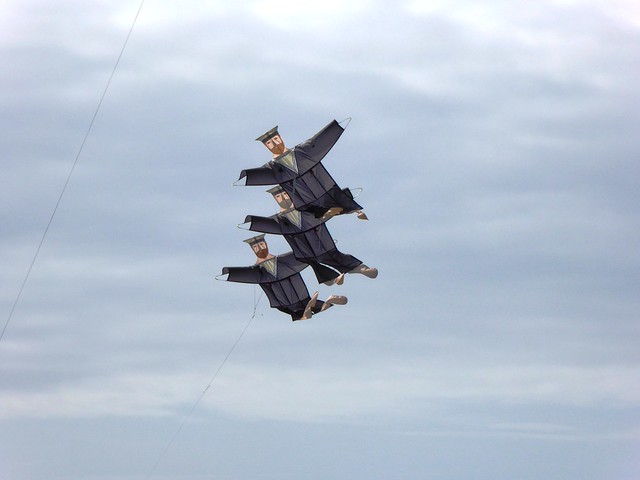
Dancing Sailors
Ahoy there its time for dancing sailors high in the sky.  The crew are flying past at the Haverigg Kite Festival and required quite a bit a skill both to get them in formation for their hornpipe but also to get them aloft in very little wind.
There was still plenty of kite flying and routines to enjoy but some of the larger pieces such as this seahorse remained resolutely earth bound on a still August day.

One could sail up the coast from Port Haverigg and come across some sailors forever on land near Whitehaven harbour.
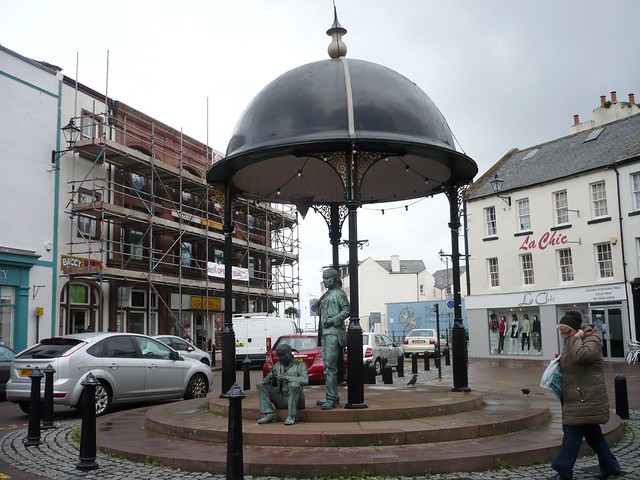
Sailors Under the Gazebo
Created by John McKenna as part of the port's 'Quest' project these two are simply called "Sailors Waiting for Crew Work".  Happily to add to the 'S' count for this ABC Wednesday post there is also some scaffolding ready for the roofers in the background. Apart from its Georgian harbour one of Whitehaven's other claims to fame is of the attempt by the USS Ranger commander, John Paul Jones, to set fire to the hundreds of ships anchored in the port in 1778. Alas for him the row in small boats against the tide for 3 hours, the wind, a mutinous crew and the lure of the local pub for the sailors this was not a success.  The full story can be found here  The Quest project produced other sculptures around the town by John McKenna including one of John Paul Jones in action and spiking the guns at Half-moon Battery here.

An entry to ABC Wednesday, a journey through the alphabet, this week sojourning at S here

Tuesday, 24 February 2015

Ghostly Greyhound

A ghostly figure emerges from the wall by a Victorian fountain but alas water no longer runs or perhaps it still flows in the world beyond the veil, the man looks straight at us but the dog is more interested in quenching its thirst (or perhaps trying to extricate itself from the wall).  There was plenty of water around when I took the photograph on a grey day but it was all coming from the sky.  The figures were created by John McKenna as part of the Quest art trail project in Whitehaven, Cumbria.  It portrays the ghost of a miner and his whippet but of course I could not resist the alliteration of ghostly greyhound in my title and indeed whippets are descended from the greyhound but are a smaller dog.

The sculpture was installed in 2000 but as can be seen the fountain is dated 1859.  The provision of clean water was part of the Public Health Act of 1848, one effect of which was the appearance of drinking fountains in cities and towns.  Whitehaven originally had six or seven but I think this is the only one that survives.  The first fountain was paid for by the Society of Rechobites, a temperance movement, but this particular one was paid for by the local Water Committee.  The town itself started life as a small fishing village, expanded to a port and with the coming of the Industrial Revolution grew even larger.  One of the movers and shakers of earlier times was Sir John Lowther (1642-1705) who designed the layout of Whitehaven in a grid pattern and it is considered one of the first "post Renaissance planned towns in Britain".  The fountain is located on one of those wide straight street so what else is could it be called but Lowther Street but it was also where Rosina Murray, who lobbied successfully for fountains to be installed, lived.  The fountain features the Lowther coat of arms which was incorporated into Whitehaven's crest,
here seen on the side of the Civic Centre.  A dragon appears on the top of the Lowther coat of arms however the council say their mythical beast is a griffin. The motto is 'Concilio Absit Discordia' - "Let discord be absent from your deliberations"  so no doubt there can be an amicable discussion about the difference between a griffin and a dragon.

An entry to ABC Wednesday, a journey through the alphabet, this week sojourning at G here


Tuesday, 17 December 2013

Wellington at Whitehaven

The instruction is clear, dismount your bike before wending your way down the slope to Whitehaven harbour on the Cumbrian coast.
Having an interest in industrial archaeology this chimney (known locally as 'The Candlestick') takes centre stage in my photograph.  Today it is just a landmark but its original purpose was as the ventilation chimney for the Wellington Mine which was sunk in 1838/40 and ran out under the sea.  Known as a what is called a "fiery pit", that is it suffered from fire damp (flammable gases), which made it a difficult pit to work and potentially dangerous with numerous accidents.  The worst disaster underground occurred in May 1910 with an explosion and  fire which took 132 lives.  There is a plaque dedicated to the men, women and children that lost their lives that day by the Candlestick.  The pit closed in 1933
 The other remnant of the mine is Wellington Lodge (seen here with the harbour light) which was the mine entrance and today the home of the coastguard.
It appears here in the artist's impression of the Wellington mine hanging outside the pub that takes its name.  

An entry to ABC Wednesday, a journey through the alphabet, this week sojourning at W