An entry to ABC Wednesday, a journey through the alphabet, this week sojourning at P here
Tuesday, 27 October 2015
Pan Pipes
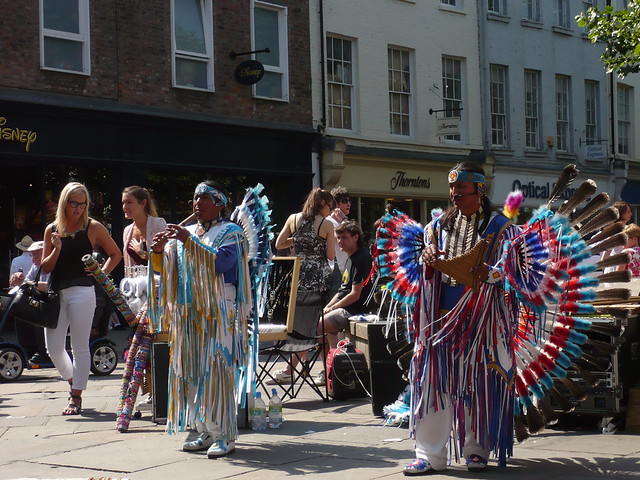
On a summers day in York this duo of South American street musicians were entertaining the shoppers with their feathers, flute and pan pipes. I have seen them in various town centres in the north of England on both sides of the Pennines. I imagine in the winter they would have to wear something a little warmer, or perhaps they fly south.
Tuesday, 13 October 2015
Needle Navigation
Known locally as simply 'The Needle' this is the only survivor of 13 navigation beacons build in the 19th Century (c1875) to lead ships in the port of Barrow in Furness. The brickwork is red and yellow but the June flowers are outdoing the structure for yellowness. Its official title is Leading Light Number 4 and the 66 feet (20m) needle rises on the foreshore at Rampside. Originally one of the other towers would have been nearby on the Island of Foulney, a low lying shingle spit home to nesting birds which can be walked to at low tide
on an old shingle and rock causeway
and is somewhere in the middle distance to the left of the Needle in this photograph. Piel Island and its castle can be glimpsed on the horizon to the right. What a pity there is no time machine to journey back in time and see the glow of 13 beacons shining out in a dark 19th Century sky warning and guiding ships as they thread their way through channels, past sandbanks, islands and shingle spits safely into port.
on an old shingle and rock causeway
and is somewhere in the middle distance to the left of the Needle in this photograph. Piel Island and its castle can be glimpsed on the horizon to the right. What a pity there is no time machine to journey back in time and see the glow of 13 beacons shining out in a dark 19th Century sky warning and guiding ships as they thread their way through channels, past sandbanks, islands and shingle spits safely into port.
Labels:
ABC Wednesday,
Barrow in Furness,
Beacon,
Navigation,
Needle,
Rampside
Tuesday, 6 October 2015
Monkey Puzzle
Here is a conifer on the very start of its journey when instead of looking down we will be looking up to eighty, a hundred or more feet. This is the Chilean Pine which used to be abundant in that country but a million have been burnt in forest fires as the climate becomes hotter and drier and the fires become more frequent. The English speaking world knows the tree more familiarly as the Monkey Puzzle and you can judge its hight here below by the house in the background..
The seeds of the tree are edible (although do not appear until the trees are 30-40 years old). When the botanist Archibald Menzies was served them as a desert at a dinner given by the Governor of Chile in 1795 he pocketed a few and grew them on the ship back to Europe, of the resulting 5 healthy plants two were planted at Kew Gardens. Fast forward to 1850 and Charles Austin (a barrister who made his fortune during the Victorian Railway Mania era) was being shown around a garden in Bodmin, Cornwall and made the comment "It would puzzle a monkey to climb that" and the tree became popularly known as the Monkey Puzzler and then the current name of Monkey Puzzle. The French call them désespoir des singes (monkey's despair)
Like the set of four trees above most were planted in the landscape gardens of large houses in the 19th Century and these trees from the Jurrasic era (sometimes called a living fossil) were quite a status symbol. In the 1900s and especially the 1920s they became a very popular plant for the suburban garden where they just grew and grew. I seem to remember there used to be a lot more around but perhaps their large size and sharp pointed leaves may have overwhelmed the owners, or maybe I just found them fascinating as a child so noticed them more. Today a lot of these long lived trees have tree preservation orders on them so they cannot be cut down and remain to entrance us. Perhaps I am wrong about the numbers for Sarah Horton in a labour of love is mapping Monkey Puzzles here and blogs about it here joined by her Monkey Puzzle agents to potentially photograph and map the Monkey Puzzle world, although as she is based in Liverpool there may be a British Isles bias.
The seeds of the tree are edible (although do not appear until the trees are 30-40 years old). When the botanist Archibald Menzies was served them as a desert at a dinner given by the Governor of Chile in 1795 he pocketed a few and grew them on the ship back to Europe, of the resulting 5 healthy plants two were planted at Kew Gardens. Fast forward to 1850 and Charles Austin (a barrister who made his fortune during the Victorian Railway Mania era) was being shown around a garden in Bodmin, Cornwall and made the comment "It would puzzle a monkey to climb that" and the tree became popularly known as the Monkey Puzzler and then the current name of Monkey Puzzle. The French call them désespoir des singes (monkey's despair)
Like the set of four trees above most were planted in the landscape gardens of large houses in the 19th Century and these trees from the Jurrasic era (sometimes called a living fossil) were quite a status symbol. In the 1900s and especially the 1920s they became a very popular plant for the suburban garden where they just grew and grew. I seem to remember there used to be a lot more around but perhaps their large size and sharp pointed leaves may have overwhelmed the owners, or maybe I just found them fascinating as a child so noticed them more. Today a lot of these long lived trees have tree preservation orders on them so they cannot be cut down and remain to entrance us. Perhaps I am wrong about the numbers for Sarah Horton in a labour of love is mapping Monkey Puzzles here and blogs about it here joined by her Monkey Puzzle agents to potentially photograph and map the Monkey Puzzle world, although as she is based in Liverpool there may be a British Isles bias.
An entry to ABC Wednesday, a journey through the alphabet, this week sojourning at M here
Labels:
ABC Wednesday,
Cumbria,
Holker Hall,
Monkey Puzzle,
Tree
Saturday, 3 October 2015
Small Tortoiseshell
Small tortoiseshell enjoying the unusually warm October weather amongst the flowers.
which are as brightly coloured as it is.
Soon it will be time for winter sleep and a dreaming of cloud flowers.
Tuesday, 29 September 2015
Little Lines
Little trains on little lines and running today, well actually Sunday afternoons from March to October in Barrow Park.
Here is one of the diesels running past the old Furness Railway Signal Box (Devonshire Road) which provides water for the steam engines
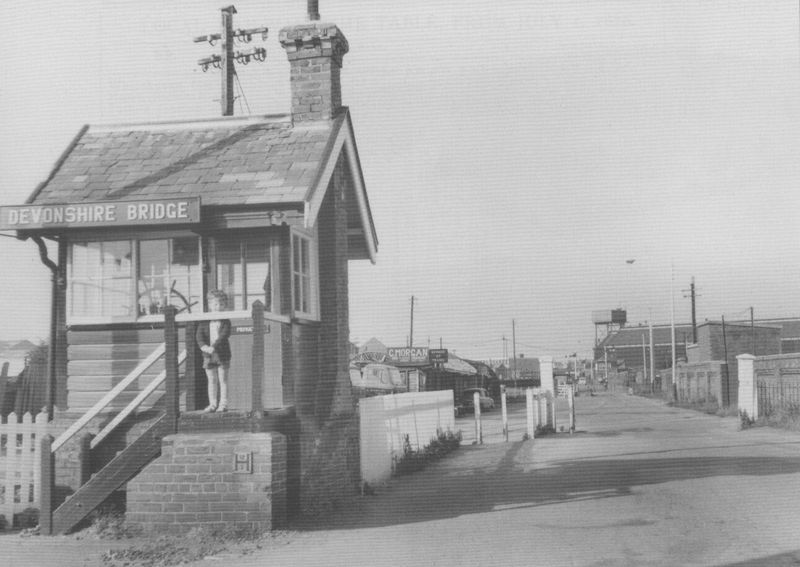
and copious cups of tea for the member of the Furness Model Railway volunteers. I'm not sure how long this little railway has been running in the park but the society itself was formed in 1956 and in the 1960s the Devonshire Road Signal Box was still located on the old railway line on the Low Road.
Returning to the present here is one of the little trains completing its circuit.
Of course every railway has an engineering shed and the Furness Model Railway is no exception
On a beautifully warm September afternoon the best place to tinker with the rolling stock
The signals up, the engine's steaming and a wave from the 'station'
The little lines run in a quarter mile circuit on an elevated 3.5 and 5" gauge track and various model locomotives pull the 'carriages'.Here is one of the diesels running past the old Furness Railway Signal Box (Devonshire Road) which provides water for the steam engines
and copious cups of tea for the member of the Furness Model Railway volunteers. I'm not sure how long this little railway has been running in the park but the society itself was formed in 1956 and in the 1960s the Devonshire Road Signal Box was still located on the old railway line on the Low Road.
| Photo from: http://www.southlakes-uk.co.uk/userrequested.html |
Of course every railway has an engineering shed and the Furness Model Railway is no exception
On a beautifully warm September afternoon the best place to tinker with the rolling stock
is under clear sunny skies
Walking through Barrow Park today all was quiet, the signal was at stop, the signal box locked up (I'm cheating here as I took this photo back in March), the lines were empty but nearby there was still a set hobbyists in place but in this case, model ships rather than trains, and putting their
sailing ships through their paces round the buoys of the park lake for Tuesday is their day.
An entry to ABC Wednesday, a journey through the alphabet, this week sojourning at L here
Labels:
ABC Wednesday,
Barrow in Furness,
Cumbria,
Furness Model Railway,
Park
Location:
Barrow-in-Furness, Cumbria, UK
Tuesday, 22 September 2015
Kine
The kine are gathered by the bridge. Do you think they look like cows? You'd be right. The word kine has fallen out of use but it is the plural of cow and one of the rare words in English that has no letters in common with its singular form. The only other ones I can think of are - I/we and me/us.
The bridge is over Kirkby Pool, another name to confuse because it isn't actually a pool but a river. I thought I had a photo of it with he traffic sign indicating vehicles keep to a 5mph limited over the bridge and only cross one at a time but could only find this side view. The building to the left is Moss House Farm, maybe the kine are from there.
Lets take a closer look at this one with the cute kink in its coat between its eyes.
An entry to ABC Wednesday, a journey through the alphabet, this week sojourning at K here
Tuesday, 15 September 2015
John Laird Centre
I took this photograph some time ago for two reason, I love Victorian buildings and the added bonus was it started with the letter J and I knew it would could in handy for ABC Wednesday, however I kept forgetting my intent and diverted into other Js as the rounds past by but eventually it now makes an appearance.
This was originally the Laird School of Arts, the first public art school outside London, and the first ever purpose built college of art and science in England which opened in September 1871. John Laird not only financed its construction but the also running costs and it was given to the town of Birkenhead. Laird is most famous as part of the shipbuilding company Cammell Laird but he was also a great philanthropist and endowed many of the fine buildings in Birkenhead, would become its first mayor of and then retire from shipbuilding to become Birkenhead's first Member of Parliament.
The school closed in 1979 and the building was purchased by Stanton Marine to use as their headquarters when it was extensively renovated and renamed The John Laird Centre. Stanton Marine later became part of the British East India Company who now use the building as their headquarters which is rather appropriate, and perhaps the building has come full circle, because Cammell Laird built most of their ships in the 19th Century.
This was originally the Laird School of Arts, the first public art school outside London, and the first ever purpose built college of art and science in England which opened in September 1871. John Laird not only financed its construction but the also running costs and it was given to the town of Birkenhead. Laird is most famous as part of the shipbuilding company Cammell Laird but he was also a great philanthropist and endowed many of the fine buildings in Birkenhead, would become its first mayor of and then retire from shipbuilding to become Birkenhead's first Member of Parliament.
The school closed in 1979 and the building was purchased by Stanton Marine to use as their headquarters when it was extensively renovated and renamed The John Laird Centre. Stanton Marine later became part of the British East India Company who now use the building as their headquarters which is rather appropriate, and perhaps the building has come full circle, because Cammell Laird built most of their ships in the 19th Century.
An entry to ABC Wednesday, a journey through the alphabet, this week sojourning at J here
Labels:
Birkenhead,
Buildings,
John Laird,
Merseyside
Subscribe to:
Posts (Atom)