Showing posts with label Holker Hall. Show all posts

Tuesday, 8 March 2016

Inigo Jones

Inigo Jones (1573-1652)  was a true renaissance man. Little is known of his early life, the son of a Welsh cloth worker he may have been employed as a joiner but at some point a rich patron, impressed by his sketches, sent him to Italy to study drawing and from there it was onwards and upwards.
The stamp set issued in 1973 for the 400th Anniversary of his birth and designed by Rosalind Dease probably sums up this polymath whose fluent Italian gave him an insight into Palladian architecture and the rules of proportion and symmetry; the concepts he put into practice with his architecture when he returned to England.  The stamps show two of his buildings and the stage settings and costumes he created  for court masques (he is also credited with bringing the proscenium arch and moveable scenery to the English theatre).  Some 450 drawings of costumes and theatre design survive however his statue was destroyed in the Great Fire of London in 1666 along with some of his buildings.

The statue I show is by the 18th Century Flemish sculptor John Michael Rysbrack and I thought it a bit random being here at Holker Hall as it did not seem to connect to anything.
It turns out indeed it doesn't and was originally installed at the neo-Palladium villa, Chiswick House in west London built by the 3rd Earl of Burlington in 1729 to showcase his art collection "and enthral his guests". An Inigo Jones statue would have been a nice nod to architectural history. The statue arrived at its present location because the 7th Earl of Burlington brought it north to Holker Hall.  He was part of the Cavendish family who have many properties and land throughout the country.   The statue at the time of this photograph in 2014 was on one of the garden walks to the north of the house.

The next time I visited Holker Hall Gardens (which have recently been awarded Garden of the Year 2015/16 by the BBC Countryfile Magazine) Mr Jones had moved
nearer the house and was on a bare mound of earth tucked away in a corner
I presume from the way the trees are cut they are going to plant up the mound.  As I usually visit the gardens when I take my car in for its annual service at a nearby garage (due next month) I wait in anticipation to see where Inigo Jones peregrinations have taken him.

I leave you with some views of the 'Queens House' at Greenwich, London, designed by Inigo Jones, which is supposed to be fabulous inside but being short of time I contented myself on the way past with some views of the entrance
and part of the south facade
and the view from Greenwich Park hill
gleaming white in the centre on a  very misty London day. 

An entry to ABC Wednesday, a journey through the alphabet, this week sojourning at I here   

Tuesday, 15 December 2015

Water

We have had a lot of water recently weeks and weeks of rain  as the storms come in wave upon wave from the Atlantic but here on the sunny May days of my photographs there is not a drop is in the air.  Silently and unseen an underground water supply makes its way to the taps of the valley.  Nature gave us a dryish summer and the boating house of the local park lake closed up because water levels were too low but they were high enough for the resident water fowl. 
The Goose family were too quick for me, taking to the water as I approached.  I often saw this pair in May always attentive to their lone chick, the other eggs cannot have hatched and probably fallen victim to a predator, I suspect the local herring gulls who are always after an easy meal.  Inland the gulls are nowhere to be seen and in a water fountain
this duck is showing off  its waterproof feather as it made a slow turn changing direction under the rhododendron trees
the sunlight dazzlingoff the droplets. 
Russell Square fountain, London
Was this little boy about to test the waterproof nature of his clothing (nil) or skin (good)?  Water fountains are an irresistable attraction with their frothing water but I think he is undecided and one small step might be enough. It was a rather chilly day, as you can see from the number of people wearing jackets and scarves.

An entry to ABC Wednesday, a journey through the alphabet, this week sojourning at W here   
 

Tuesday, 6 October 2015

Monkey Puzzle

Here is a conifer on the very start of its journey when instead of looking down we will be looking up to eighty, a hundred or more feet.  This is the Chilean Pine which used to be abundant in that country but a million have been burnt in forest fires as the climate becomes hotter and drier and the fires become more frequent.  The English speaking world knows the tree more familiarly as the Monkey Puzzle and you can judge its hight here below by the house in the background..
The seeds of the tree are edible (although do not appear until the trees are 30-40 years old). When the botanist Archibald Menzies was served them as a desert at a dinner given by the Governor of Chile in 1795 he pocketed a few and grew them on the ship back to Europe, of the resulting 5 healthy plants two were planted at Kew Gardens.  Fast forward to 1850 and Charles Austin (a barrister who made his fortune during the Victorian Railway Mania era) was being shown around a garden in Bodmin, Cornwall and made the comment "It would puzzle a monkey to climb that" and the tree became popularly known as the Monkey Puzzler and then the current name of Monkey Puzzle.  The French call them désespoir des singes (monkey's despair)
Like the set of four trees above most were planted in the landscape gardens of large houses in the 19th Century and these trees from the Jurrasic era (sometimes called a living fossil) were quite a status symbol.  In the 1900s and especially the 1920s they became a very popular plant for the suburban garden where they just grew and grew.  I seem to remember there used to be a lot more around but perhaps their large size and sharp pointed leaves may have overwhelmed the owners, or maybe I just found them fascinating as a child so noticed them more.  Today a lot of these long lived trees have tree preservation orders on them so they cannot be cut down and remain to entrance us.  Perhaps I am wrong about the numbers for Sarah Horton in a labour of love is mapping Monkey Puzzles here  and blogs about it here joined by her Monkey Puzzle agents to potentially photograph and map the Monkey Puzzle world, although as she is based in Liverpool there may be a British Isles bias.

An entry to ABC Wednesday, a journey through the alphabet, this week sojourning at M here 


Tuesday, 23 June 2015

Xystus

On a sunny midday in April (which as it turned out was warmer than any day in May) I took a walk around Holker Hall formal gardens and along this path under a tree canopied garden walk - a xystus.

 Here one of the excellent gardeners who keep the gardens looking immaculate making her way, bag in hand, between the xystus
If one takes some steps back amongst the forget-me-nots and tulips (and the bare branches of the willow leaf pear tree) then in the distance can be spotted a gateway
which leads out from the formality of the the manicured gardens and into the meadows. The mown pathway
leads eventually to a sundial.  In the synchronism of ABC Wednesday it was exactly one year ago I featured it here because of its Roman numeral X. 

The Holker Hall gardens are near the garage I take my car to for its annual service so they make a nice diversion to while away the time (while hoping nothing expensive is wrong with the car). If you noticed that in my second photo the planters were empty it is because image was from 2014 when the gardeners were finished with Spring and getting ready for the next planting. There is always something to delight the eye in the gardens so here is this year's April planter.
and one of the many x factor plants in giant bushes and trees that people come to see in May and June
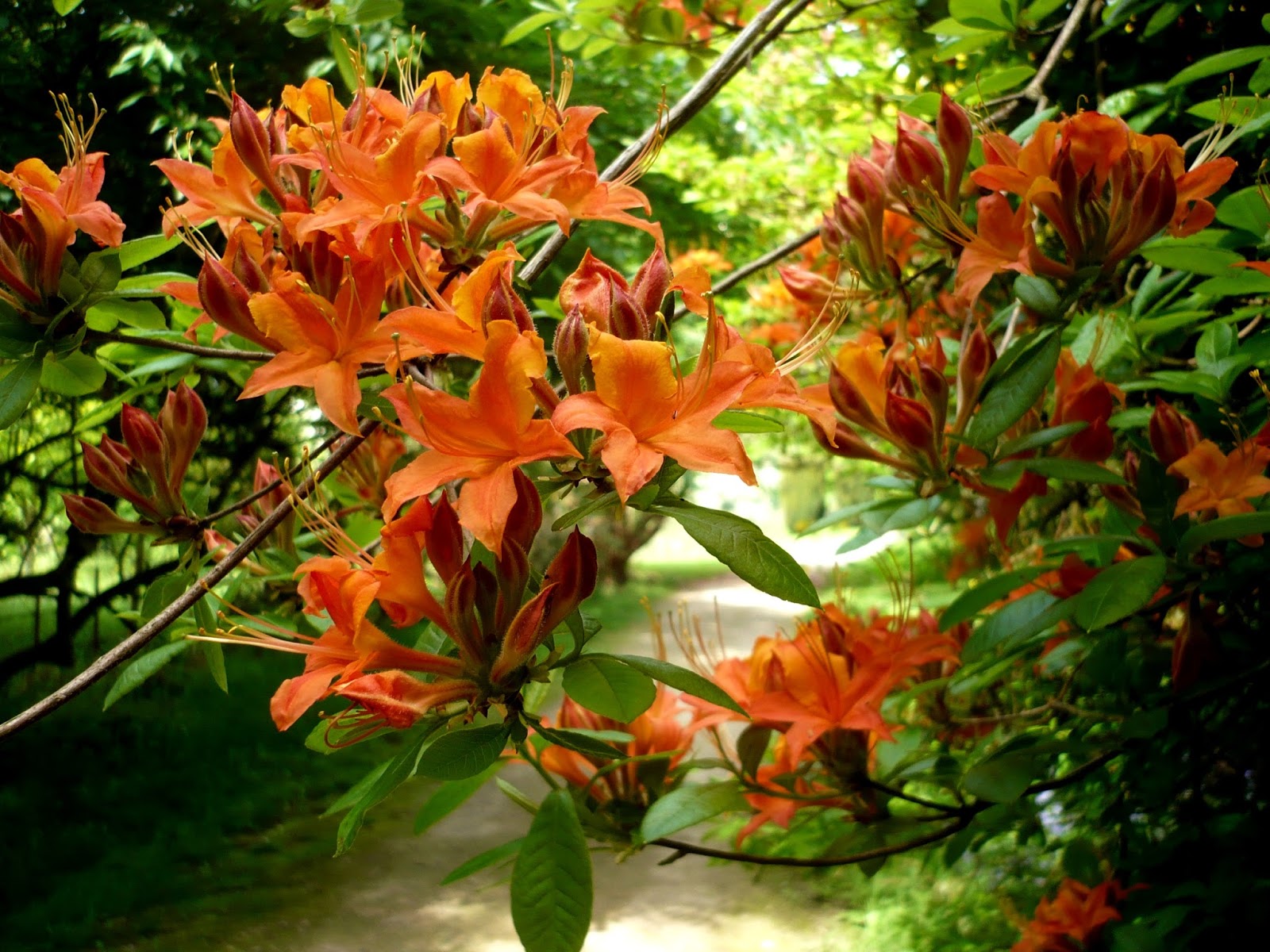
     When the azaleas and rhododendrons are in full exuberant flower. 

An entry to  ABC Wednesday, a journey through the alphabet, this week sojourning at X here
  

Tuesday, 24 June 2014

X O'Clock

Roman numerals to the rescue when it comes to the X week of ABC Wednesday. This particular X is telling me it is 11 O'Clock and its summer time.
Taking a step back you can even see my position on the planet on the rim of this sundial, an amazingly flawless piece of polished blue grey slate engraved with an hour scale, calibrated to fifteen minute intervals. The seven declination lines mark the six divisions for the 12 zodiac signs which are engraved on the rim. None of our little group could remember what symbol any zodiac sign was so that part was a bit of a mystery to us all, as it will be for you but for a different reason, the signs which are highlighted in gold leaf on the far sides don't show up in my photograph.
Here is the sundial in its setting, a wild flower meadow on the Holker estate in Cumbria. Weighing in at a tonne and measuring 5' 1" (155cm) with a depth of 15" (38cm) its placement on the large rock beneath it makes it look deceptively small.  Designed by Sir Mark Lennox-Boyd of the British Sundial Society it is a homage to the ancient scaphe sundials invented 2,300 years ago by astronomers on the islands of Samos and Kos.  The Greeks and Romans both used large stone sundials like this based on a partial sphere or scaphe which could tell time accurately if carved to a true sphere and correctly calibrated for a given site like this one. 

An entry to ABC Wednesday, a journey through the alphabet, this week sojourning at X here


Tuesday, 17 June 2014

Water Feature

Leaving the formal gardens of Holker Hall in Cumbria the eye is immeditately taken by these two limestone obelisks and a tempting path leading to the steps in the distance.
Those first steps lead to a plateau and fountain, water gushing into the air, and as I discovered, misting over the photographer if you get too close. Continuing past the fountain uphill eventually leads to a god surveying the scene,
Who else but Neptune riding his sea horse (a marble statue created by Italian craftsmen in the 17th Century).
The Neptune Cascade
This is his view down the water cascade which flows over an inlaid zig-zag slate pattern at either side of the path, the fountain can be seen in the distance at the bottom. The owners of Holker Hall, Hugh and Grania Cavendish. were inspired by water features in Rajasthan in creating this cascade. One of the businesses they own is Burlington Slate Quarry whose blue grey slate can be spotted decorating many parts of the gardens but this is the most extensive use. 
The mallard ducks don't care about that they just enjoy the water.
And the cranes are forever bathing in the fountain. The cascade climbs through rhododendrons and oaks, and is a good reason to visit the gardens in spring when the rhododendrons are in full flower throughout the 25 acres of garden and woodland.
Detail on fountain surround
An entry to ABC Wednesday, a journey through the alphabet, this week sojouring at W here