Showing posts with label London. Show all posts

Tuesday, 26 April 2016

Petrol Stop

Petrol in Bloomsbury
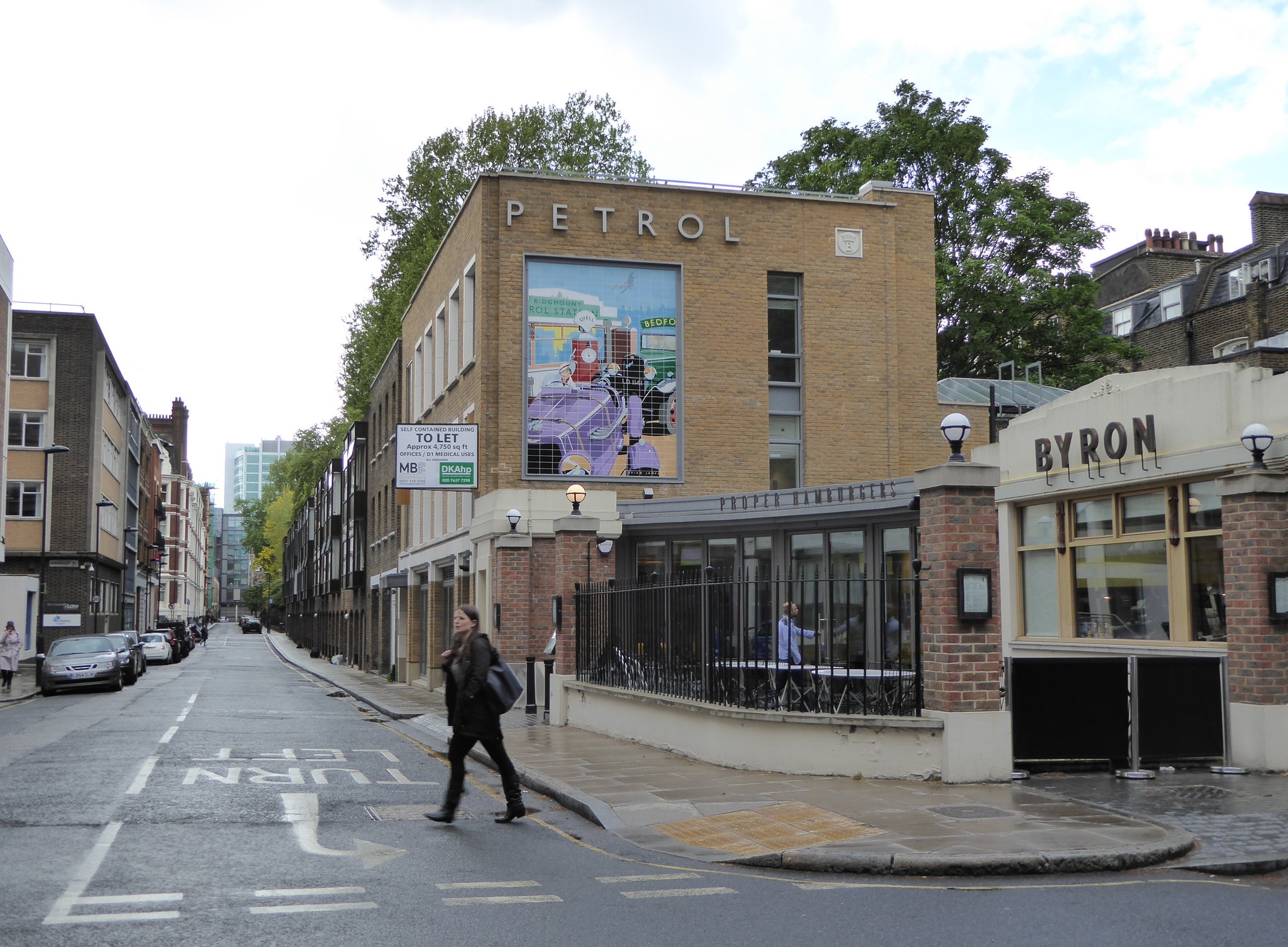
On the corner of a London street is, what was, the site of Central London's oldest petrol station which opened in 1926.  The Ridgmount Petrol Station (also known as Bloomsbury Petrol Station) closed in 2008.  There was a failed attempt to get it listed and today the site is occupied by a burger chain and office buildings. Where the outdoor seating is in the photograph was once the petrol station forecourt which can be seen on Vici MacDonald's 'Shopfront Elegy' blog here.  I haven't been able to find a period photograph of the petrol station but did discover on the way that the history of petrol pumps is called Petroliana and here is a photograph of some 1920s petrol pumps somewhere in rural Britain.     

Of course what attracted my attention in this corner of London was
Ridgmount Petrol
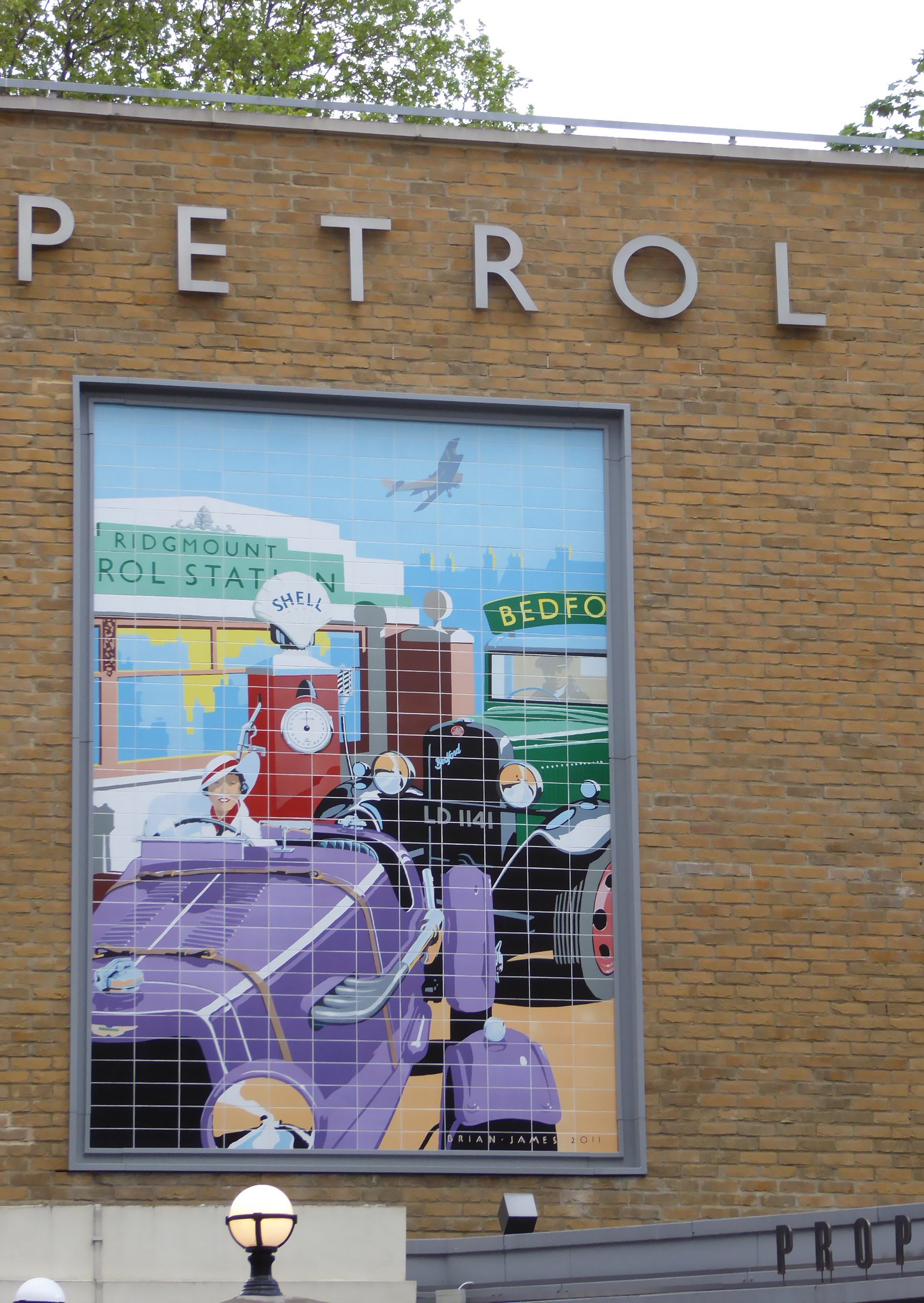
the eye-catching ceramic mural by the automobile artist Brian James influenced by Art Deco style. The work was commissioned by the Bedford Estate who own much of the land and features a Bedford van and sports car of the 1930s.  The driver is Mary Dutchess of Bedford of whose eventful life a whole book could be written.  She took up flying in her 60s but disappeared at the beginning of a solo flight in bad weather somewhere over the North Sea in 1937.  The colour chosen in the mural was the Bedford Racing colours.

An entry to ABC Wednesday, a journey through the alphabet, this week sojourning at P here

Tuesday, 8 March 2016

Inigo Jones

Inigo Jones (1573-1652)  was a true renaissance man. Little is known of his early life, the son of a Welsh cloth worker he may have been employed as a joiner but at some point a rich patron, impressed by his sketches, sent him to Italy to study drawing and from there it was onwards and upwards.
The stamp set issued in 1973 for the 400th Anniversary of his birth and designed by Rosalind Dease probably sums up this polymath whose fluent Italian gave him an insight into Palladian architecture and the rules of proportion and symmetry; the concepts he put into practice with his architecture when he returned to England.  The stamps show two of his buildings and the stage settings and costumes he created  for court masques (he is also credited with bringing the proscenium arch and moveable scenery to the English theatre).  Some 450 drawings of costumes and theatre design survive however his statue was destroyed in the Great Fire of London in 1666 along with some of his buildings.

The statue I show is by the 18th Century Flemish sculptor John Michael Rysbrack and I thought it a bit random being here at Holker Hall as it did not seem to connect to anything.
It turns out indeed it doesn't and was originally installed at the neo-Palladium villa, Chiswick House in west London built by the 3rd Earl of Burlington in 1729 to showcase his art collection "and enthral his guests". An Inigo Jones statue would have been a nice nod to architectural history. The statue arrived at its present location because the 7th Earl of Burlington brought it north to Holker Hall.  He was part of the Cavendish family who have many properties and land throughout the country.   The statue at the time of this photograph in 2014 was on one of the garden walks to the north of the house.

The next time I visited Holker Hall Gardens (which have recently been awarded Garden of the Year 2015/16 by the BBC Countryfile Magazine) Mr Jones had moved
nearer the house and was on a bare mound of earth tucked away in a corner
I presume from the way the trees are cut they are going to plant up the mound.  As I usually visit the gardens when I take my car in for its annual service at a nearby garage (due next month) I wait in anticipation to see where Inigo Jones peregrinations have taken him.

I leave you with some views of the 'Queens House' at Greenwich, London, designed by Inigo Jones, which is supposed to be fabulous inside but being short of time I contented myself on the way past with some views of the entrance
and part of the south facade
and the view from Greenwich Park hill
gleaming white in the centre on a  very misty London day. 

An entry to ABC Wednesday, a journey through the alphabet, this week sojourning at I here   
Tuesday, 1 March 2016

Horse Guards Parade

Here is Horse Guards Parade an area where in the 16th Century Henry VIII held jousting tournaments since when it has been used for a variety of ceremonies and today is a ceremonial parade ground, the site of the Trooping the Colours when it is the Queen's official birthday. Her love of horses is well know so I imagine she enjoys this part of here official calendar.  The building shown, with the top of the London Eye behind it, contains the Household Cavalry Museum
and was once the headquarters of the British Army.
My own favourite building of the quadrangle is the Old Admiralty Building (at the moment occupied by part of the Foreign and Commonwealth Office) and was the place Admiral Lord Nelson lay before his funeral in 1806. The building has undergone many alternations but the screen wall was designed in the 18th Century by Robert Adams and later restored in 1923.
The space is large so it is difficult without to fit everything in but luckily Wikipedia provides a panorama
Farwestern Photo by Gregg M. Erickson - CC

Of course what draws the tourist crowds are the actual Horse Guards themselves who Change the Guard every morning and stand guard to the official entrances and are not supposed to move, a skill in itself. 
Did I say the Horse Guards were the attraction, well of course we mustn't forget the horses.  The notice just out of picture on the right says "Beware. Horses may Kick or Bite. Thank You".  If the horses are getting upset the Horse Guard will warn to get back.  The mounted guards

 are at an advantage high above the crowds but those standing still on foot 
are right in the middle of an every changing melee.

An entry to ABC Wednesday, a journey through the alphabet, this week sojourning at H here

Tuesday, 26 January 2016

Candy Baa

I am not sure which is the more colourful, Shaun the Sheep as Candy Baa, the little girl dresses for sale in the background or the floral handbags to the right.
But Shaun in his guise as Candy Baa does look good enough to eat as painted by Emily Golden (see Painting Candy Baa here).  This was temporarily on display at Covent Garden before a gathering of 300 different Shauns arrived in the Piazza and they were all sold off for charity.
The west Piazza is also where street performers come to put on a show and here the crowd is enjoying the sunshine and those on the balcony of the Punch and Judy pub, the beer.  It is thought that the Punch and Judy pub takes its name from the puppeteers who put on performances here and indeed Samuel Pepys makes mention in his diary of 1662 of "Italian puppet plays".  For this reason Mr Punch's birthday is celebrated on the 9th May (the date of Pepys entry)
The annual gathering of Punch and Judy Professors (as the puppeteers are known) takes place by Covent Garden's St Paul's Church at the same time as the 'May Fayre and Puppet Festival'.  The pub sign (where you can spot another 'C') shows when the pub arrived here, 1787, which would have been when Covent Garden was famous for its flower sellers and
although the wholesale of flowers moved location in the 1960s to the New Covent Garden a few miles away, the statue to Flora the Goddess of flowers and Spring still reigns supreme on the roof top
The statue is by Robert Sievier (1794-1865) and is made of Coade stone, an artificial but hard wearing stone resistant to both frost and heat created in 1769. There are many statues made of the material around London which Eleanor Coade called  Lithodipyra (Greek for 'stone fired twice')  and promoted heavily for its ability to be able to be moulded into complex shapes. Eleanor died in 1821 when the factory passed to other family members but ceased to trade in 1840. It was said the 'secret formula' had been lost at this time (although people knew that one of the main ingredients was Cornish white china clay) but this is not true and Wikipedia lists the ingredients here but marvels at the skill needed to manufacture it which is probably why the Coade factory was the only one to produce it.

An entry to ABC Wednesday, a journey through the alphabet, this week sojourning at C here


Tuesday, 12 January 2016

Analemmatic Sundial

No watch or mobile phone and wondering if the Lady Lever Art Gallery pictured in the distance will be open yet?  No problem. At ones feet is an Analemmatic Sundial.  Stand on the appropriate month on the marked
  indentation and a shadow will be cast across an hour pillar.  The inner circle is British Summer Time and the outer circle is winter's Greenwich Mean Time.  This analemmatic sundial was installed for the Queen's Diamond Jubilee in 2012 at Port Sunlight on the Wirral and was, I thought, the first I had seen, although that was not true, it was just that I didn't know they had a name.  Here is my assistant demonstrating the one near the Houses of Parliament in London 
 where his shadow tells us it is 11 O'clock (my camera's date stamp may be a little more precise at 11:30).  

An explanation of the word Anelemmatic without any bamboozling mathematics:
 "The more common sort of sundial has an angled post (usually called the gnomon, or sometimes the style) which casts a shadow on a circular dial. Its analemmatic cousin, on the other hand, has a vertical gnomon, which casts a shadow on an elliptical scale. For it to tell the time with adequate accuracy (you may recall Hilaire Belloc’s verse complaint: “I am a sundial, and I make a botch, of what is done much better by a watch”), the gnomon must first be moved to the correct position along a north-south axis according to the season. Though a small sundial of this type is rather fiddly to make and use, large ones laid out on a flat area permit a person to act as the gnomon (my local one is of this sort). Earnest enquirers after chronological intelligence then need only position themselves at the appropriate spot along the axis for the time of year and — weather permitting — they can then read off the time by noting where their shadow falls on the scale".  Source: World Wide Words
 An entry to ABC Wednesday, starting another journey through the alphabet here


Tuesday, 15 December 2015

Water

We have had a lot of water recently weeks and weeks of rain  as the storms come in wave upon wave from the Atlantic but here on the sunny May days of my photographs there is not a drop is in the air.  Silently and unseen an underground water supply makes its way to the taps of the valley.  Nature gave us a dryish summer and the boating house of the local park lake closed up because water levels were too low but they were high enough for the resident water fowl. 
The Goose family were too quick for me, taking to the water as I approached.  I often saw this pair in May always attentive to their lone chick, the other eggs cannot have hatched and probably fallen victim to a predator, I suspect the local herring gulls who are always after an easy meal.  Inland the gulls are nowhere to be seen and in a water fountain
this duck is showing off  its waterproof feather as it made a slow turn changing direction under the rhododendron trees
the sunlight dazzlingoff the droplets. 
Russell Square fountain, London
Was this little boy about to test the waterproof nature of his clothing (nil) or skin (good)?  Water fountains are an irresistable attraction with their frothing water but I think he is undecided and one small step might be enough. It was a rather chilly day, as you can see from the number of people wearing jackets and scarves.

An entry to ABC Wednesday, a journey through the alphabet, this week sojourning at W here   
 

Tuesday, 8 September 2015

Isle of Dogs

Taking the water bus down the Thames I passed the Isle of Dogs and the new waterside developments between Burrell's Wharf and Millwall Dock
Burrell's Wharf
This place has a long history of change and is located in the meander of the river surrounded on three sides by the Thames and the old East Indies Dock on the other.
It was such a beautiful day that once we were on dry land decided to take a stroll and idle along the riverside and with no destination in mind we enjoyed the skyline views while passing
through little parks (this one complete with what looks like a scouting group), residential properties and somehow ended up on the Isle of Dogs
where I imagine you could take your small boat down this slipway.
We wondered if we would come across the docks coming away from the river and down the road passing by the parish church of Christ and St John with St Luke.  (They were certainly covering all the bases rounding up a spiritual trio). We did walk further along but got lost in a maze of streets and with no map to guide us retraced our steps
past the post office and its post box
and the Great Eastern pub in Tower Hamlets.  I was not aware at the time but since learnt that the vast iron sailing ship imagined and built by Isambard Kingdom Brunel in 1858 (at the time the largest ship ever built), was constructed nearby at the shipyard of John Scott Russell in Millwall. I believe there are remnants of the launch ramp at Canary Wharf.   A missed opportunity there!  The Great Eastern is always referred to as 'the ill-fated', for despite Brunel's vision of it journeying to the far east carrying 4000 passengers, the boiler exploded on her maiden voyage, J Scott Russell went bankrupt and Brunel had a stroke. It did eventually sail across the Atlantic but it was not a success and was later modified into a cable laying vessel. Eventually she was beached at Rock Ferry, Liverpool and broken up just thirty years after her launch.
Great Eastern harboured at Milford Haven by Unknown - Licensed under Public Domain via Commons - https://commons.wikimedia.org

A little bit of her still stands proud in Liverpool as the flag pole at the kop end of Liverpool's Anfield ground once was one of Great Eastern's topmasts (Source: From Millwall to the Kop).

Meanwhile we left the Great Eastern pub behind to continue our walk back and stopped for refreshment at the
Island Gardens Café in its peaceful surroundings with a tea pot and cup embellished in the buildings brickwork before going back to the other side of the river via the foot tunnel.


An entry to ABC Wednesday, a journey through the alphabet, this week sojourning at I here 
 

Tuesday, 9 June 2015

Velocipede

This speeding velocipede attracted my attention in London and as an added benefit when our velocipedian's stint as a living statue ends for the day she has her own transport to get home.  I have difficulty sitting still for five minutes so can't imagine how it must be to sit like this for hours on end and how much the muscles must start to ache.  There are many living statues here in Trafalgar Square because the pitches are a free for all but if wanting to ply their trade elsewhere, such as on the South Bank or Covent Garden, then a licence is required. On a Tuesday the pitches are allocated by a lottery system
which this person must have won. We passed him as he was putting on his gloves and getting ready to set up for the day on the South Bank. I imagine this is a very good pitch because of the high footfall of people and also it was a Sunday which means there are all-sorts of other attractions to gather the crowds.

Living statues have increased in recent years but it is a tradition that goes back to medieval times when they were assembled as tableaux vivants (living picture) for festivities and royal pageantry.  In the present day companies hire out living statues for parties and events and there is even a World Championship every year in Arnhem in the Netherlands when the 'statues' will be judged in four ways - Content (what is their story), Craftsmanship (do they look like a statue), Aesthetic (are they beautiful in some way) and Entertainment (how do they interact with an audience).   The World Living Statue Festival website shows some of the participants here

An entry to ABC Wednesday, a journey through the alphabet, this week sojourning at V here