Showing posts with label Film. Show all posts

Saturday, 18 February 2012

Film Stars

The Sepia Saturday meme "Using old images as prompts for new reflections"

This Sepia Saturday prompt reminded me that I had two old Picture Show Annuals "The Year's Best in Pictures".  These I  inherited from my mother and they fascinated me as a child.  As I grew older I thought it out of character she owned them for although she liked films she was not a collector of memorabilia.  When she was in her 80s and clearing out some books she said  "I must give these back to Mabel".  What the!!!  Now consider this, she had borrowed them as a teenager from her friend Mabel Gardner, it must have been in her mind to return them, but war had intervened, she joined the Fire Service and was posted elsewhere in the country. She kept in contact with Mabel but I don't think she had seen her in person for at least 55 years.  We decided, well OK she decided,  that we would go and visit Mabel, even identified the area of the town she lived in as we passed it on one journey to visit my uncle, but my mother's memory deteriorated with dementia and she became frail before we could do it and now sadly neither of them is with us any more.  So here am I now sharing some of its pictures from the golden age of cinema from one of the books.        

'Picture Show' was a weekly magazine containing the latest news of film favourites such as
Clark Gable (1901-1960).  The caption says
"He is known as a man's man. Which means that he has a devastating effect on women. He likes to omit the morning shave on shooting and fishing trips with a couple of other congenial companions of similar tastes. "Parnell" gives him his greatest acting opportunity".  
Guess the smooth cheek was only for the women he had the devastating effect on, and why his frequent co-star and friend Joan Crawford said he was the most masculine man she had ever met, as anyone who has seen him playing Rhett Butler in  'Gone With the Wind' could probably guess. 

I wondered if the dog in this picture was his and discovered that he always seemed to have kept dogs, including dachshunds, hunting dogs and this one, Parnell, who shared photo opportunities on numerous occasions
 (Photo from www.acertaincinema.com)
such as this picture taken in 1939 which ties in with the date of this Picture Show Annual of
1938 where Greta Garbo (1905-1990) in her role as Camille graces the cover. She looks remarkably cheerful for such a tragic story. Like Clark Gable, Greta Garbo started her career in silent films and her first talkie (Anna Christie) was famously promoted by the strap line "Garbo talks".

Now our host said if we did not have pictures of film stars them people sitting on chairs might be a possibility so here is Joel McCrea (1905-1990) combining both elements and  looking relaxed on a film set,
The caption which the scan has fuzzed says:
"1937 marked the tenth year of film work, which he began as an "extra". It was not until three years later that we saw him in a leading rôle, but since then he has been consistently popular. He is still "un-actorish" likes a simple life on his ranch and outdoor rôles on the screen".
McCrea used to write his occupation as 'rancher' and his hobby as 'acting', and spent much of his later career in cowboy films of which he said:
 "I liked doing comedies, but as I got older I was better suited to do Westerns. Because I think it becomes unattractive for an older fellow trying to look young, falling in love with attractive girls in those kinds of situations...Anyway, I always felt so much more comfortable in the Western. The minute I got a horse and a hat and a pair of boots on, I felt easier. I didn't feel like I was an actor anymore. I felt like I was the guy out there doing it".

Tuesday, 23 March 2010

ABC Wednesday - Just In Time

Joyce of Whitchurch, clock-makers since 1690 and still going strong all over the world. Supposed to be the oldest tower clock makers in the world. This is probably an equivalent of a wrist watch to them, but it is one of their most famous.  Have we time, are we just in time


to jump on board the train....the doors are open.  Or should we go underground to the other platform

out into the light. What is this,  is it the cavelry

no, just in time to see the Oliver Cromwell steaming as the Cumbrian Mountain Express as it takes on water and then crosses the tracks to join the main line for the run up to Shap Summit en route to Carlisle.  A train built in 1951, the Britannia class was part of the  railway post war revival.  It was also chosen in 1968 to be the last passenger steam train to run between Liverpool Lime Street and Carlisle as 'The Fifteen Guinea Special'.  Just take a minute to watch a minute of that last trip, the commentary is just of its time, with its  juicy vowels.


Are you thinking what about the Joyce clock.  Built in the 1890s it has had a tough times in those past years (there is a rather wonderful poem by Lynne Alexander on its five ages just by the clock on the wall) but it was made famous by David Lean


in Brief Encounters, filmed in February 1945 on Carnforth station.  Here is Celia Johnson getting a speck of dust in her eye, ready for Trevor Howard to come to the rescue with a handkerchief.  The station and the clock is a major part of the film, although the clock was actually given a false face to prevent continuity errors, so the clock  showed the right time for the plot.

It you ever visit Carnforth station you can go into the cafe this 'still' shows, it is identical to the film, not only that there is not a tea bag in sight, proper pots of tea.  That this exists is testament to the Carnforth Station and Railway Trust formed 1996 in attempt to rejuvenate the station after years of decline, which started in the 1970s with the electrification of the west coast main line (those pesky wires on my train photos). Carnforth was no longer part of the main line, one of its platforms was demolished, and it became just a branch line.  It was a sad sight as paint flaked, the station became grubby and the cafe was boarded up, it only needed tumble-weed rolling across it to complete the picture.

After fund-raising, including a donation from the David Lean Foundation, and with Railtrack's assistance work started in 2000, and was completed in 2003.  The cafe and visitor heritage centre was opened.  So not only can you see lots of railway memorabilia, Brief Encounters playing on a loop, old photographs and browse round the shop, but there may be some live music in the cafe.  The owner is ex RAF and as he says never thought he would end up on a railway station, but he always wanted to run a tea shop and wishes everything to be made fresh as it would have been in the 1940s.   He has recently installed equipment, purchased from a bakery that was closing down, so they can make their own bread. While we were there one of the volunteers from the Trust was playing the piano, the atmosphere was relaxed and cheerful, so unlike the time of quiet desperation that Lean filmed so long ago. 
Celia Johnston and Trevor Howard would re-unite in 1980 in Staying On as an elderly couple in India but they will always be remembered for the wonderful intense Brief Encounters.  Lean was a film-maker who could portray the intimate and the immense with equal skill.

Jump over to the ABC Wednesday meme for more words beginning with the letter J

Monday, 15 February 2010

Il Divo. The spectacular life of Giulio Andreotti

A film directed and written by Paolo Sorrentino, 2008
117 minutes, English subtitled version.
What I know about Italian politics could probably be written on the back of an envelope.  If I were to sum it up it would be that  in the twentieth century its leaders seemed to change on a regular basis. The kidnapping of Aldo Moro in 1978 by the Red Brigade and his death because the government refused to negotiate.  The death of the Vatican's banker, Calvi, found hanging beneath a London bridge, was a window into a dark and murky world of power, politics and religion.

This film has expanded my knowledge.  The director Paolo Sorrentino has made a brave attempt at encapsulating the second half of the 20th century politics in the years of 1991-92.

The right wing Christian Democrats had been in power since 1946 and Guillio Andreotti had been elected president of the council of ministers seven times, and also held some of the great offices of state.  One position he had not occupied was President of the Republic and this film follows his quest for election.  He has his own clique and there is also a link to the shadowy P2 Masonic Lodge.

In the past, Sorrentino shows, opposition to Andriotti has been dealt with by making people disappear in various ways, explosions and machine-guns to name but two.  Murders like that of the journalist Mino Perocelli.  Links with the Mafia are rumoured.  In fact this film has been tagged as "The Godfather meets Nixon".  There are an overwhelming cast of characters which are introduced with subtitles


but Andriotti has many complex entanglements.  I did flag in the middle of the film for about ten minutes as more and more information was given, it seemed overloaded and without direction, but once this was over we were led into the scandal and criminal trial of Andreotti as his political life unravels, and things picked up for this viewer.  This is the scandal that will break the party.

The acting of Toni Servillo playing the part of Guilio Andriotti is amazing.  As the lead and main protagonist one would expect him to dominate the film, but he does more than this and portrays a dark sinister person as he scuttles down the corridors of power, like a giant spider manipulating people and events. But this is not a one dimensional view as he shows the continual physical suffering of headaches, his relationship with his wife Livia (Anna Bonaiuto) and his secretary.  An impression is given of a person with huge intellect, a rapier like wit, an icy will, who only shows his interior life to very few people. Perhaps his raison d'etre could be summed up in his own words "Power is the disease one has no desire to be cured of".

For the non Italian it is difficult to remember all of the people, some stand out like Pomicino (Carolo Buccirosso) who parties and always seems to have a woman on each arm, Cardinal Angelini (Archille Brungnini) of the church and the reason for the Christian in Christian Democrats, always a strange concept to me as a northern European. I would think a second viewing might seperate a few more, but it does what good films can do, give an insight, and make you want to know more.

Sorrentino has said "all Italian people grow up knowing Andriotti".  He has been called many things such as The Fox, The Black Pope, The Hunchback, Beelzebub and of course Il Divo.  His character remains enigmatic, did he really regret the death of Aldo Moro, did he really break with the mafia. More questions than answers but this film presents a view of the man.

One last word for the cinematography, of Lucca Bigazzi, which helps create the atmosphere, hughe looming classical interiors, dark rainy streets and sparce rooms of power.  A nice mix of classical and sharp staccato modern music completes the film.

For a more informed view of the film read Philip French's review

Here is the English trailer

Friday, 11 December 2009

Everlasting Moments

A film directed by Jan Troell and shot on 16mm film and using available light where possible, is based on the life of his wife, Agnetsa Ulfsater, great aunt. She had been researching Maria Larsson's history through her family for 6 years, intending to make a documentary, instead they made this film.

It is a story of a working class housewife, Maria Larsson, living in Malmo early in the 20th century. Her daughter narrates the film, and tells us in the beginning her father, Sigge Larsson, bought her mother a raffle ticket with which she won a camera. He says the camera is his, but she says that he will have to marry her to share the camera.

The marriage produces many children but Sigge is a drinker with a temper and a womaniser. During a strike when money is short Maria tries to sell the camera but the Danish owner of the photographer's shop, Sebastian Pedersen, persuades her to keep it and take pictures. She has a wonderful eye and produces, against the odds, wonderful photographs, despite her husband's disapproval. As Pederson says she has "the gift of seeing"

As Jan Troell has said "I never knew Maria, of course, so I thought of her purely as a character, not as family. But I could relate to her very much as an artist. When I was 14, my parents gave me a camera, exactly the same as the one she used, with the 9x12 glass plates. It made me see the world very differently, preserving images and moments like that. It's a miracle, which is what Maria learns in the film. It changed her life. And mine"

The film follows the family from the beginning of the century, through the 1st world war and beyond, showing the changes in working class life and the transformation of Sweden and its people.

Maria Heiskanen who plays the main character gives a wonderful performance of a strong but gentle woman which draws you into the film. Mikael Persbrandt as the husband shows both sides of the character, the charming dancer and member of the Temperance Society and the faller off the wagon wife beater. Jesper Christensen as the tender-hearted photographer who accepts Maria as his equal makes up this strong trio.
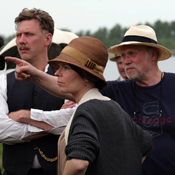
Mikael Persbrandt, Maria Heiskanen
and Jan Troell on the set

The film runs for 125 minutes and it is one of those rare occasions when I wish it could have been a little bit longer. Here is the trailer, which I think does not quite do it justice.


Friday, 22 May 2009

Star Trek - 2009


Heard the hype, read the good reviews so off we went to the new Star Trek movie with high hopes.

The story is a prequel on how the crew of the first Enterprise get together, with the twist that a Romulan wants revenge, and has travelled back through time to destroy Spock, his planet, and the Earth.

The special effects CGI are excellent, planets, interiors and exteriors of spaceships its all there in spades. The plot sort of holds together but has gaping holes in it of the "and with one bound they were free" type. The monster/reptiles scene where they chase after James T Kirk seems tacked on for no reason, only to irritate. How would a reptile exist on an ice planet? OK might have adapted in some alien way. Both seemed to travel at speed, and a human being is notoriously slow, even hens can outrace us.

The cast was good. I wondered if Zachary Quinto's previous role as Sylar in Heroes would overshadow his performance, but he was excellent as Spock, coming to terms with is half human/half Vulcan nature. Chris Pine as James T Kirk was a whole lot less irritating than Shatner in the original, but that may be because of some of the moralising in the original series scrips. He played the part in a different way but then threw in some of Shatners mannerisms and speech patterns at certain times which added to the enjoyment. The stand out performance was Simon Pegg as Scotty who brought some energy to the film.

Nerd alert. The Romulan space mining ship was a puzzle. I am sure the idea was lifted from a similar ship I've seen somewhere like Babylon 5.

Overall the verdict would be, good as an action SF film, and if they follow it up with another film the cast should develop well. The downside was it was rather a Spielbergian type schmaltzy version of Star Trek so I hope they choose another director next time rather than JJ Abrams. Abrams also seemed to accentuate the military nature of the Federation rather than the Roddenberry version of the future. I suppose that just reflects the times we live in.

Friday, 15 May 2009

My Brother Is An Only Child


The film clubs Thursday film 'Mio fratello e figlio unico' (2007) directed by Daniele Luchetti
"Luchettis sweeping saga, divisions within working class family encompasses 15 years of political turmoil in a nation's history"

Set in the 60s and 70s this film is based on the novel by Antionio Pennacchi called 'Il Fasciocomunista'. The story follows the lives of two working class brothers living in Latina, a small model town built by Mussolini near Rome in the Pauline Marshes.

The film opens with a young 13 year old Antonio Benassi, whose nickname is Accio (bully) due to his belligerence, training in a seminary to be a priest. He questions the institution and leaves suddenly to return to his family. They don't exactly welcome him with open arms as the apartment is overcrowded and rundown. His sister has taken his bed so he has to sleep in the corridor.

Accio wants to continue his studies in Latin but his father thinks this is pointless and sends him to the technical college so he can get a trade. Disaffected, he forms a friendship with a father figure, Nastri, who is a fascist and influences Accio with his ideas. Accio joins the movement.

In contrast Accio's older brother Manrico (Riccardo Scamerico) is a handsome, charming leftist. He meets Francesco (Diane Fleri), a student with similar ideas and they become lovers, when Accio meets her he too falls in love.

Manrico starts to work at the factory where his father is employed and begins to organise the workers. The fascists plot to burn his car and Accio tries to stop them, to no avail. Now disillusioned with the violence of his fellow fascists he breaks with them but Nastri's wife Bella's (Bonaiuto) interest in him is beyond politics. They go to bed together under the Mussolini bed sheets. She is besotted and buys him that quintessential Italian small car of the 60s the Fiat 600 (Love those doors that open backwards).

The brothers are now both on the communist side as the sit ins spread across the Europe of 1968.

Francesca has moved to Turin and Manrico visits at weekends and if he doesn't then Accio does. The brothers are growing closer but Manrico is becoming more extreme whereas Accio just wants to see things change. The need for change is symbolised by the Bonassi's house where cracks appear, walls crumble and they are promised new housing. The keys to the houses are available but corruption prevents them occupying them. The posturing of the right and left give no practical help.

This is an engaging film with its squabbling but loving family, a coming of age of a boy, a love story and a country and people desperate for change. The term bittersweet would encapsulate the feeling of this film and Luchetti has a light touch while dealing with some dark times but not without humour.

The soundtrack is superb taking you, with music, to that period and the end tune 'Amore Disperato' by Nada sends you humming out of the cinema although not all has gone well. The handheld camera in one of the fight scenes put you right in the way of harm! The acting is first-rate of all the participants. Vittorio Emanuele Propizio who plays the young Accio is suitably belligerent and I believe that Elio Germano who takes the role of the older Accio won a best actor award.

Monday, 16 March 2009

Q & A by Vikas Swarup

A darker story than its film spin off 'Slumdog Millionaire' but with a similar structure of the question asked and then the story. The experiences Ram Mohammad Thomas has had in life enables him to be able to answer the questions as he takes part in the Indian version of Who Wants to be a Millionaire. Arrested by the police he has to prove he is innocent of cheating by recounting how he knows the answers to the questions because, as an orphan slum dweller, how could he know. As he says "The brain is not an organ we are authorised to use. We are supposed to use only our hands and legs"

Modern India as experienced from he bottom of the pile travelling from Mumbai, Delhi and Agra backwards and forwards in Ram's life. (differing from the film which is a linear story). Confronted by dacoits, employed by aging Bollywood stars, exploited, shown kindness and friendship, discovering love and tragedy. All these things make Ram the person he becomes, an extraordinary everyman.

This is a pacey book with a compelling narrative looking at the underside of society but ultimately it is that old fashioned thing a fable of good triumphing over evil.

Verdict - Good read

Thursday, 22 January 2009

The Edgars & In Bruges

The Mystery Writers of America's Edgar Award Nominees have been announced in this year of the 200th anniversary of Edgar Alan Poe's birth.

I love a list but with this on top of the Guardian's "1000 novels everyone must read" series also coming out this week, I suspect, I may be tempted into more book buying.

What I like about the Edgars is the all encompassing nature of the awards within the genre. As the name mimics it is indeed like the Oscars although I don't know if they have a red carpet, maybe just a Masque of the Red Death with dripping blood.

I must admit that I have not read any of the books mentioned, yet, but Book Club Buzz has the full list and some links to his reviews.

I have seen one of the films that is up for Best Motion Picture Screenplay which is 'In Bruges' written and directed by the Irish playwright Martin McDonagh. It is the story of two Irish hit men who have been sent away to a wintry Bruges at Christmas after one of their jobs goes wrong. Ray (Colin Farrell) hates Bruges and is haunted by the fact that he killed a little boy by mistake on this last assignment but Ken (Brendan Gleeson) loves the city and tries to enthuse Ray about medieval sites. The plot is clever and the dialog sparkles, there's a girl, a dwarf, Bruges itself and some black comedy plus a cameo appearance by Ralph Fiennes as the cockney boss. The two leads inhabit the parts and are wonderfully acted. A marvelous two hander as Brendan Gleeson's world weary part allows Colin Farrell to really shine on screen.

Verdict - Unpredictable Thriller. Recommended