Showing posts with label Sepia Saturday. Show all posts

Friday, 28 February 2014

Looking Out

Alan has provided a wonderfully evocative photograph for this week's Sepia Saturday prompt which was taken on Mount Løvstakken in Norway.  Perhaps our trio are looking out for Henrik Ibsen to come walk into view. The photograph could certainly be a scene from one of his plays. I have a confession to make. I speed read and missed the musical trio reference because I read Röntgen, and thought German physicist.  Read Beyer and thought Friedrich one of the founders of the pharmaceutical giant. This indeed would have been a disparate trio to walk in the Norwegian mountains so no wonder my first thought was wow, who knew.  Well nobody did as I discovered when I reread the intro and it is the reason for my scientific take on the theme.  Having said that a telescope is definitely the star of the show but in this case a giant one.
The Westinghouse |Electrical and Manufacturing crew in South Philadelphia assemble in the rig that would later attach to the 200" mirror of the Palomar telescope.  Construction sites of companies all over the USA in the 1930s were all making different parts for the telescope.  Our story starts in 1928 when George Ellery Hale got a large Rockefeller grant to build an observatory and he started his search for an appropriate place to site it, having had to eliminate his original idea of the Los Angeles area due to light pollution.  That fact is rather appropriate because I found this photo on the Palomar Skies blog created by the then Public Affairs Coordinator who left Palomar to work for the International Dark Skies Association, he hoped that someone else would continue his Palomar blog.  Unfortunately it looks as nobody has but it remains a wonderful resource.

But lets get back to Hale who found his ideal position for the telescope in the early 1930s on the 5,600 feet of Palomar Mountain and proceeded to buy 160 acres from local ranchers and the US Forestry Service.  His next next problem was to get a 200" mirror. General Electric failed to make one out of fused quartz so that was $600,000 down the drain. He turned to Corning Glass who decide  Pyrex would be less prone to expand and contract than ordinary glass. At the second attempt they are successful. 

The project moves on in 1936 with construction of the dome
(Caltech Astronomy)
which also involves road building, cottages for personnel and camps for the workers. The next problem is to move the mirror blank across country and the crowds come out to watch the "Great Eye" travel by train in 1936 from New York to Pasadena.  The trip takes 16 days travelling at a speed of 25 mph and on arrival Caltech start to grind and polish the mirror, an immense task which is interrupted by World War 2 when production is stopped and the disk is stored and protected by timber for three years.  As Caltch explain "to make the final mirror, almost 10,000 pounds of glass are polished away, including the top two inches which contain "scar tissue" left over from the casting and annealing process". 

Now finished the mirror has to move from Pasadena to Palomar, enter the Belyea Truck Company, who were famous for driving a ship across a desert and saying there was no cargo they could not move.
In November 1947 the 40 ton cargo rested on 3 diesel tractors pushing it up the mountain.  The 25 mile trip is completed in 32 hours and engineers install the mirror but the image is not ideal so another two years are spent polishing and aligning and adjusting. In July 1948, although still not fully operational the telescope is dedicated and named after Hale who had died in 1938 his vision outliving him.  The story goes that in the last few days of his life Hale looked up into the sky and said  “It is a beautiful day. The sun is shining, and they are working on Palomar.”
Hale "The Journey to Palomar" University of Chicago
 Another famous name, Edwin Hubble took the first photograph with the "Big Eye" in January 1949 and the telescope became fully operational and remained the largest in the world until 1993.  Today it is still used for research and visitors are welcome to visit the public area or take a conducted tour.
Caltech's observatory on Palomar Mountain | Photo: Kevin L. Moore/Flickr/Creative Commons License


Saturday, 22 February 2014

The Lads

Australian men in suits and oversized hats is this week's Sepia Saturday prompt here.  I know I have an elusive postcard somewhere of men in hats and suits, but failing to find it I flipped through the Gardner family album and found this:
I hoped there would be a photographers name on the back when I took it out of its pocket but alas no. Were these men brother, cousins or friends?  We will never know but the photographic studio must have had a shortage of chairs as you can see when I crop the photo and the strange carpet out of the frame:-

Leaning, kneeling and the lone sitter. Sheet music and two flutes, one held and one on the table but is the man at the back smoking a pipe or holding a short flute?  I've seen a similar photograph to this before but despite an entertaining search on the internet nothing appeared, they look an amusing trio and if living today might just be getting together to go for a night out on the town. I would guess the photo is from the 1860s but may be later, the bowler hat became more popular as the 19th century progressed. The suit was de rigueur and like hats the Victorian man was never seen without one.  My father, who always wore a three piece suit even in retirement (although it did latterly alter to a sports jacket) recounted his father in law( my grandfather) saying a gentleman should never removed his jacket no matter the temperature.
Charles Henry Gardner (1874-1958)
And here is my grandfather living up to that maxim although in casual knickerbockers and straw hat.  This is the only photograph I have of him as a relatively young man.   I think he liked winged collard shirts as he continued to wear them and they appear in the few photographs I have of him.  The album I took the first photo from was his, it is one of three each separately held today by his grandchildren.  They were always kept by my grandmothers in the bottom of a huge chest of drawers where she used to collect all the family material together, and occasionally get them out and entertain her many grandchildren with a flick through the pages, although the photographs I liked best as a child she kept in a old tin box.


Friday, 31 January 2014

Waiting

I just want to unpack this week's Sepia Saturday suitcase (which features an advert for the Pacific Trunk Company) lay it out and look at all the objects they imagined a male traveller would carry.  For other Sepian adventures that may, or may not, involve suitcases see here.  I knew I would have photos of suitcases. In those times before tablets and mobiles there were always moments to fill when waiting for a train so why not take a photograph.
This Friday is a special day for me and I am featuring the reason, which is my mother, whose birthday was the 31st January.  I also always associate her birthday with change, the lengthening of days becoming noticeable and the promise of the year ahead.   To return to the photograph, taken at a different time of year, October 1958.  I would be about 9 and it looks as though my growing spurt is on the way to overtaking my mothers hight of 5 ft. She was an accomplished in sewing so the coat is one of her creations, as is the hat.  She would continue to knit hats, both when she ran a wool shop and towards the end of her life when she specialised in brushed woollen ones, always admired.  The photo shows us packed and waiting at Ulverston station on the way to Preston.   The journey would have been to visit my Auntie Phyl who lived there for a short while.  I think that was also the time I fell off the dining room chair, (yes I was swinging back on it) and put my teeth through under my bottom lip. I was in good hands though because my Aunt was a nurse and like my mother very good at needlework although I hasten to add not on me, there was more blood than injury, although  enough that I was given Dettol antiseptic mouthwashes for the duration of the stay, and afterwards.  I still remember the pungent smell.      
Sarah (Sadie) Pugh
As a child holidays were always spent visiting relations, usually my mothers sisters, or on a weekly run-around rail ticket.  When my parents became more affluent then their holiday of choice was to go walking.  Here she is waiting at the outside of the station of the previous photograph, Ulverston .  Is it me or do those plants in the background look remarkably like cabbages?  The suitcase may have changed but the strap on one of them has a familiar look to the first photo, belts and braces packing. My farther has filled the backs of this set of photographs with information, it was one of their favourite holidays.  This one says "Saturday June 30th 1984. After the holiday at Freshwater Bay, Isle of Wight. I wait with the bags while Sadie goes to the phone (for a taxi) at Station Corner".  Is this before, or after, she has charged off to the phone box? She only had one pace, fast, even into her eighties she was going the same speed.  She also always liked to be busy so the walk up the hill to the phone box would fill in some of that pesky waiting time.                

Friday, 17 January 2014

Named But Unknown

An entry to Sepia Saturday "Using old images as prompts for new reflections"

The face of an ordinary soldier killed in the Great War at the Battle of the Somme for this week's Sepia Saturday is one of loss but my choice of images is a different kind of loss, that of a life story.
On the back of the photograph is a question "Did I send you one of these before?" Well I only have one so maybe he hadn't.  A name has been added on the back - Henry Taylor, Royal Artillery.  It was amongst my Grandmothers stash but I have no idea of the connection. To find a member of the Royal Artillery from WW1 is like a needle in a haystack, each town in the country had an artillery unit.  I can surmise he could be from Westmorland or abutting Lancashire area from the family connection, but I don't know what section he was from Royal Field, Royal Garrison or Royal Horse Artillery. Maybe the indistinct lapel badges will give clues with further research.  
 There are about 150 'Henry Taylor' listed and if we go to those only listed as H Taylor then we are up about 650.  What can be told from the photograph, when not being mesmerised by those immaculately shined shoes, is the absence of ribbons or medals which indicates he was neither a regular soldier or a territorial and was war raised. From the jodhpurs like trousers and whip he might have been connected to the horses but I know nothing about the artillery. I did find an ebook on Project Guttenburg printed for private circulation in 1919 by CA Rose MC  called 'Three Years in France with the Guns' which had this photo
The 'Grey Battery' at St Omer, May 1917

The name written on the back of the card was in my father's handwriting so I had to check that uniform just to make sure it was WW1 and from my Grandmother's collection.  Was the name Henry Taylor familiar, I  know he had a scouting friend called Wilf Taylor so I turned to something I inherited from my paternal Grandparents  a bound collection of the weekly "The War Illustrated" -
 and yes this the uniform was the same as this Royal Horse Artillery Battery from the Great War, on the occasion of 3 of their members being recommended for the VC in the November 1914 issue.  The deed took place at Compiègne which was also the site of the signing of the armistice in 1918.  I wonder how many survived?   

Friday, 10 January 2014

Journeys

An entry to Sepia Saturday
Using old images as prompts for new reflections
My unexpected discovery in book was a purchase in a second hand book shop.  The book had a very small printed last name on the frontispiece, Quemby,
and that same small writing appeared on the back of the two photographs left inside. No need to guess where we are in the world here with pyramid looming in the background. I love the white walled tyres of the car, not to mention those two toned shoes.  On the reverse of the card it says - "Welcome", Vi, Jean, Siabhra, Driver. There is even a date 2.3.51 but the era might have been guessed from the immaculate white gloved hands, although Vi is more free-wheeling.  I'm not sure if our party is arriving or departing but here they are on the ultimate tourist experience-
We are treated  to camels and the sphinx in the background plus an extra member of the party. The driver must be waiting by the car as only the guide appears on a donkey, the photo says on the back "L to R Cliff, Vi, Jean, Siabhra - 'Welcome' 2.3.51"  I wonder if Cliff is the photographer of the first photo and the owner of the book or is there another person behind the camera. I'll never know, at least I can make an educated guess from the name Siabhra that she may be Irish. These photographs were perfectly placed in a book as I found them in next to a map
of  Laurens van der Post's journey down Africa by plane (and that is where they remain).  He disliked this mode of transport, no wonder, he'd set off from what was then called Heath Row Aerodrome, landing at different refuelling points, to eventually arrive at Chileka aerodrome 7,000 miles and 72 hours later and says he was "pleased to have done flying for some months at least".  The book, 'Venture into the Interior', was published in 1952, one year after our unknown travellers appear in the photographs.  I wonder if they were planning another trip?  I don't think any side of my family had travelled this far at this time, unless they were in the uniform of the navy or the army.
Which is how the publisher shows Lauren Van der Post who had left England in 1940 as a soldier behind enemy lines in Abyssinia, then the western desert to Syria and the Transjordan frontier, ultimately through the Dutch East Indies where he walked into a Japanese trap and spent several years in a prisoner of war camp. I remember picking up this "Venture to the Interior" (his first travel book) in the shop because I'd read his novel "Flamingo Feather" (first published in 1955) which had remained lodged in my head.  Rationing was still in place when Van der Post journeyed from England in May 1949, on instruction from the government, to Nyasaland (modern day Malawi) to look at two tracks of land that had not been accurately mapped. One was a rugged mountain mass and the other a large plateau.  The reason was the British government was worried about production of food and Van der Post was going to have a close look at the area on foot.  He travelled light and only took a few clothes and sealing wax.  Why sealing wax? Because it was the only thing he thought he would not be able to buy in Africa.  I haven't used sealing wax for about 45 years but remember using it to seal bags going to the Ministry of Defence, there is something very satisfying about dripping wax, but Van der Post was going to use it to seal samples he hoped to collect in Nyasaland.  

Friday, 22 March 2013

The Abraham Brothers

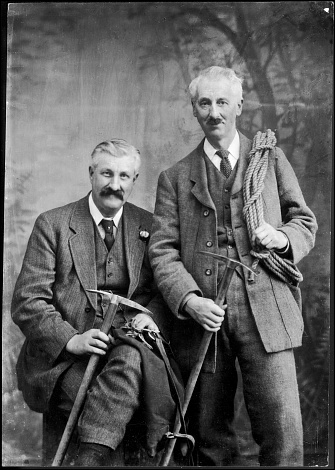
The Abraham Brothers George (1870-1965) and Ashley (1876-1951) whose father ran a photography business  in Keswick so it was fated that they too would follow him into photography but in  ground-breaking ways for they were the first to venture onto the Lakeland crags laden with photographic gear (often weighing up to 20 lbs) climbing on ridges and ledges in all weathers to take photographs of both climbers and the views.  The photograph shows them in middle age (when I imagine the cameras were a lot smaller) with their climbing accoutrements and  of course the obligatory tweed suits which everyone wore to climb at the time complete with nails hammered into boots.  I remember a story about them borrowing their mothers washing line (which may be apocryphal) when they tried their first climb  but discovered that was far from satisfactory and moved onto more robust twine.
)
They made many first assents in their career as both climbers and photographers. It must be useful to have a brother's shoulder to help one make a move across a rock face.
Unfortunately unlike the Sepia Saturday's prompt photograph of photographers taking pictures of the famous cherry blossom in Washington I have been unable to find any of the Abraham Brothers with their cameras. I know there is one because I have seen one of them in their early days with huge cameras and being amazed at the possibility of being able to climb with them.  They are probably most famously associated with
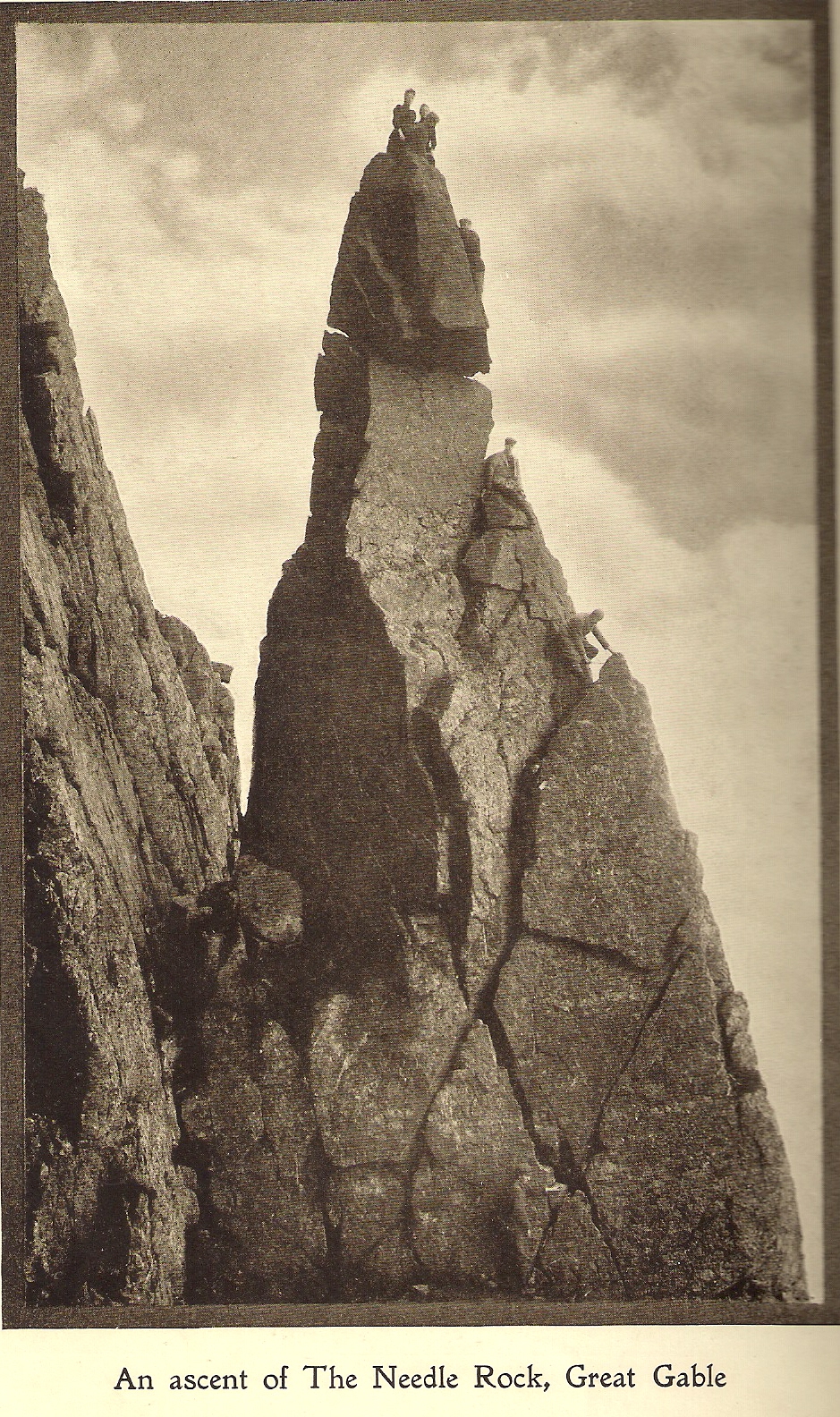
Napes Needle on Great Gable in the Wasdale Valley, an important part of the early history of rock climbing in England first climbed in 1886 its iconic status is combined with the Wasdale Head Inn in the valley which is the place these early climbers gathered  and so too do the modern climbers  The decent of Napes Needle is considered more difficult that the climb but those people on the top are just feeling the exhilaration.  The Abraham Brothers climbed this with cameras and also for the fun of just climbing it.  This photograph is from "Beautiful Lakeland" published in 1912, one of the many of their books  featuring their photographs. The book credits Ashley with the text and George with the photographs and describes this as "A very favourite climb, short but exceedingly difficult and only for those of long experience" and goes on to describe how to do it but as we all know from holiday disasters the best stories are those of adversity survived and enjoyed in retrospect so here is an extract from the book

"I recall a very unpleasant experience of my own on the Needle. It was a bitterly cold Christmas day of 1897, that a part of three of us climbed to its apex.  We had no sooner arrived there than it came on to rain and as the rain fell it froze immediately on the rock; the Needle became almost like a huge inverted icicle.  I essayed the decent, but the small handholds near the top were veneered with ice.  It was quite impossible, so, with great difficulty, I regained my companions on the top.  By this time a driving wind had sprung up and it behoved us to descend at once, or else be frozen and then blown off.  It was an unpleasant dilemma, but we got out of it in the following manner.  The strongest man of the party lowered first one and then the other of us, swinging round and round on the rope end like a spider at the end of its clew, until we reached the neck between the Needle and the mountain, seen in the illustration.  Then the last man tied his rope round the top of the rock and came down hand over hand for about twenty feet, when off slipped the rope from the top and he came tumbling down on to us.  Fortunately he retained his grasp of the rope and, as we were tied to the other end, we were able to arrest his fall before he had gone far.  Beyond a severe shaking he was no worse, and this, with a bruised shoulder where his boot struck me as his body flew through the air; was all the damage sustained in our escapade". 
And here is George's photo on firmer ground, an aspect that would have appeared on the Abraham's postcards and still does on modern cards, the road complete with potholes will be pretty similar too.  In fact the potholes have got so bad that the council were to close the road to repair it this week, I wonder how far they got before the snow storm hit today and nature closed the roads in the Lake District.  Great Gable appears as the middle mountain but the title of this book plate of "the gathering storm" put me in mind of the changeability of the Lake District weather and the time I sat on the mountain to the left, Kirk Fell, it was a beautiful summers day and we were fascinated to watch the speed the mist was rolling down the valley, over the lake until it climbed and covered all the mountains and everything disappeared around us, one of the many occasions it is good to have a compass to descend and regain the Wastdale Head Inn bar.      

Friday, 1 March 2013

Paper Counting

I've made more than a few boxes in my time from flat cardboard but the object was to store or display. I've also been involved in moving a library twice, and my mother's wool shop once, all those occasion requiring well labelled cardboard boxes.  My last job also involved a move but  by that point  I had left libraries far behind and only had a mini research library, CDs and a computer, ah how times change, it was a breeze.   So there are all my cardboard experiences without even mentioning that of moving house  however I have never stood and made boxes all day for a living as in this week's Sepia Saturday prompt.  I have no boxes to show but
"Counting the paper at Barrow Paper Mills, Salthouse"
do have someone counting paper at the Barrow Paper Mills in pre automated days. Look at those stacks towering behind her. No dangerous moving machinery but don't forget the horror of  paper cuts, she looks as though she has kept clear of those judging from her happy demeanour.  All that can be heard is the soft rustle of paper.  The place she works in was constructed in 1889 as the Barrow Chemical Wood Pulp Company, it imported logs by ship and moved them from the port by train to the mill.  They chopped the logs boiled them with sulphur to make pulp which was supplied to paper mills. A few years later (1892) paper making machines were installed and the firm renamed Killner Partington Paper Pulp Co  and they started to import pulp rather than make it, then in 1919 the firm was reorganised as Barrow Paper Mills Ltd. They made cartridge paper, printing paper, and in a link to this week's prompt, coverings for carboard boxes and lastly high quality fine paper for books.

The company who employed 400-500 people, 200 of them women, would close in 1973.  One of the men who was part of decommissioning and moving the machinery at that time, Terry Hesseltine, remembers it as a happy place to work although the conditions were "hot and sticky with a smell of bleach and wood-pulp".  
Barrow Paper Mill works and Cavendish Dock, Barrow in Furness 1929
 Here is the Barrow Paper Mills in 1929 from the "Britain from Above" resource.  You can see the train steaming into view top left, trains still go past the site which is now derelict but always referred to as Salthouse Mills despite the paper mill having long gone.  All sorts of things have been suggested for the area, the latest was a waterfront residential. development but the economic climate and cost of cleaning up a brownfield site means its acreage is still unused apart from a few small businesses.  Wood pulp is still shipped into the Barrow port but it is going into the opposite direction of this site and the Kimberly Clark factory making paper tissue branded with the Andrex puppy.

Saturday, 23 February 2013

The Unknown Family

I haven't done a Sepia Saturday prompt for an age but hopefully I'll get back in the swing of things this week with the theme of the unknown and nameless family.  Those enigmatic photographs whose stories and people we do not know like this one
in the Gardner family album. My father was always prompted his mother in law to write the names in the albums whenever she got books out. Happily she did, under duress, write on some of the photographs but even she did not know all the faces.  I have chosen this photograph because it is the only one in the book which is from Burnley, a place which I have no knowledge of any of the family coming from.  I would guess this is a Grandmother with her granddaughters, a memento perhaps because they do not live nearby.  Apart from Grandmother's fine Victorian posture they look a relaxed group and I think there is affection in the portrait, one girl resting are arm on her Grannie's shoulder.  
The photographer's details are on the back "all negatives are kept", wouldn't that be a thing to find, all neatly catalogued.  Dream on.  I had a look to see what Healey Wood Road looked like and it turned out to be a typical Lancashire terraced house street but I also found someone who was doing some research on David Brooks and discovered, through them,  that the Brooks families lived at 11, 14 and 18 Healey Wood Road for a number of censuses, David Brooks appearing on the 1891 census as a photographer.  This ties in nicely with the back of this card because as can be seen bottom left it is a Marion & Co*  design. These designs for the back of carte de visite and cabinet cards from 1870 onwards were sold to photographers all over England. This particular design and the number on the bottom right dates the card to between 1892-4 so although I still don't know who the family is I do know the dates the photograph was taken. If we go back to the Brooks family their daughters in 1881 were cotton weavers which as Burnley was at the heart of  cotton mills country (at one time having 99,000 power looms) would have been very common but by 1891 the daughter of the family were dressmakers.  I wonder what the girls in the photo went on to do. 

Source:-


Friday, 28 September 2012

Football for All?

An entry to Sepia Saturday. "Using old images as prompts for new reflections"

"Miss Nettie Honeyball captain of the British Ladies Football Club who is coming to America to initiate American girls into the mysteries of football".
This is what every lady footballer was wearing in 1895.  The gloriously appropriately named Miss Nettie Honeyball.  Hettie was a pioneer of football who persuaded J W Julian (a player for Tottenham Hotspur) to coach the British Ladies Football Club, training took place twice a week and the first football match was played in 1895 at Crouch End, dividing the players up to play north against south (London that is rather then England). The North won 7-1.  The Manchester Guardian reported on the match  "Their costumes came in for a good deal of attention.... one or two added short skirts over their knickerbockers.... When the novelty has worn off, I do not think women's football will attract the crowds."

 Well he was wrong.  Jump to the next century and
Dick Kerr's Ladies 1921
 enter Dick Kerr's Ladies, dispensing with the ties but adding a neat hat.  Dick, Kerr and Co was a tramway and light railway company in Preston which was converted to making munitions during World War 1. Competitive sport was thought a good way to improve the moral of factory workers and after the women beat the men at the Dick, Kerr factory a proper team was formed playing for charity taking on the name of their workplace. The first match was at the Preston North End ground of Deepdale in 1917 drawing a crowd of 10,000.  They continued to play and in 1920 played their first international matches against France (won 2, drew 1 and lost 1).  After the UK tour by the French, the Dick Kerr Ladies went on an extensive tour of France.  The publicity gained from this meant when on Boxing Day 1920 they took on St Helens at Everton's ground of Goodison Park a crowd of 53,000 came to watch.  They beat St Helens 4-0.

The male run Football Association  unsettled by the popularity of the women's game and no doubt also by the changing role of women in society banned women's games at all its members grounds, saying that women were not physically suitable for playing the game. This did not stop Dick Kerr's Ladies they continued to play on non FA grounds and toured North America becoming the most famous of all female football teams.
Hayes Ladies training in the 1930s
Football is sometimes called the people's game so nothing is going to stop half the population playing it even if the FA didn't allow it on their fields of play for the next 50 years.
So here am I on the  left stood next to Jim our coach who used to play for Preston North End home of that first match of Dick Kerr's Ladies.  We also were a sort of company team as we all worked at Vickers Shipbuilding and this photo I think was taken at the company's sports club in about 1966 or 7.  We, like Dick Kerr's Ladies, also played for charity on hockey grounds, rugby grounds, anywhere, but of course not on a football ground.  Things could be tricky for our goalkeeper Karen when playing under rugby posts.  We had a great deal of fun and lots of exercise. In 1971 the Football Association lifted the ban on women's football.


Saturday, 8 September 2012

A Flat Cap and Bonnets

An entry to Sepia Saturday. "Using old images as prompts for new reflections"

Charles A Pugh
Here is my father wearing a substantial flat cap.  He has written on the back "about 1924" when he would be 17 or 18.   When he was a lot younger than this there is a link to this week's theme of hats. His first job was delivering hats across the town to the women of  Barrow in Furness for their social occasions.  I never thought to ask him who he worked for or how many he delivered but he visited the full span of social classes.  When he got his orders he was disappointed if the address was in a wealthy area for he said that they were poor tippers, but if his task was to call at one of the terraced house where the girls who  worked  in the factories lived he knew it was likely they would tip generously.  He left the job to work for Cases Brewery but he observed that to do so meant he took a drop in wages but had better prospects.   Perhaps his job with the hat shop influenced him for he was never seen without a hat throughout his life, although his preference was for a trilby rather than a cap.  A three piece suit was a constant too.
 
The photograph was taken at Hawcoat Quarry on the highest part of the town, a wood and views may have made it a pleasant walk. The red sandstone blocks taken from this quarry built most of the Victorian public buildings in the town.
 
Going further back in time
is a carte de visite of two of my maternal ancestors, names unknown 
Peering at the mother's straw hat I am wondering if the bow on the top was an added embellishment for the photograph, but the child's smile is perfect for the all encompassing bonnet and wonderfully frilly dress.  The woman looks towards the camera but the baby sees something to smile at to its left and out of the picture
 
The all important mirror to look in to see the hat is on right.  I've never had this carte de visite out of the album so it was a surprise to see Albert Gorton's pretty advert on the reverse. 

Saturday, 14 July 2012

Pram-bulating

An entry to Sepia Saturday "Using old images as prompts for new reflections"

From the gardens of the Schloss Belvedere and the wonderful needlework seen on the Sepia Saturday prompt picture lets journey to northern England
and wave.  I'm waving at my father here but was told I used to wave at everyone from the pram; I still enjoy waving.  This is Bardsea Road one Sunday in June 1950 it encompassed a walk which I would take with my mother Sadie shown here until her old age, you had to take up a brisk pace because she considered that slow walking tired her out. While browsing through the many pictures of me in a pram I noticed for the first time the pretty woven basket which seems to vary from half to brimming full.

Wheeling back in time a month to
May 1950 here at Canal Foot by the side of Morecambe Bay, the railway viaduct just visible in the background.  Now there are two elements from the prompt both a pram and a blanket. My mother and her life long friends Julia and Harry Boyd share a rug while it looks as though my 'Aunt' Julia is instructing her son Roger to do something or more likely not do something, I'm an 'innocence bystander'. 
Five years later and I don't think I quite fit a pram although it was good fun to roll up and down the garden path in it. The month is August and the photo says it is a warm day; I look brown so, unlike this year, it has been a good summer. I once stayed with Mrs High, the mother of my friend here Marion (who you can see is blond with complexion to match).  She tried to scrub the 'dirt' off my knees in the bath until I told her it wasn't going to come off because that was me.   But lets get back to the pram, I suspect this is the one from which I saw a tyre in a stream and insisted on visiting it every day which meant that the Bardsea Road walk in the first photo was one that my mother could not deviate from for some time.

Not long after this photo only the wheels survived of the pram when they were turned into Go-cart, not by me but one of the neighbourhood boys, although I did get rides on the completed construction, bliss. You never see home made go-carts today and I have no photos of these particular wheels but to relive those memories of simpler times with the help of Flickr and the National Library of Wales
The Longden Bay Go-cart Racers, September 1953 - Photographer Geoff Charles (1909-2002)

Saturday, 30 June 2012

What A Raquet

An entry to Sepia Saturday. "Using old images as prompts for new reflections".

 Photo of 1880 from the International Centre of Photography, New York
Subjects and photographer unknown
I came across this photograph by chance while looking for something else, irresistible to use this week. I can't decide if this is a hallway or a backdrop but they are having fun with this whimsical shot.  Who knows they may be about to run out of the door and start batting balls about.  Peering through those strings is a similarity of face that makes me think they are a family.  The boy's clothing at the back makes him looks as though he could have wandered in from the 21st century to join the photographic experience.

From one posed shot to another
which featured in the Picture Show Annual 1938 captioned "Dolores del Rio and her bull terrier, Michael, are inseparable, and he even accompanies here to the tennis courts".  Maybe a pooch like this is also useful for retrieving tennis balls.

Dolores del Rio (1905-1983) had a long career in film, theatre and television although at the time of this photo, at the end of the 1930s, was not finding roles in Hollywood and continued her career in Mexico for the next two decades, returning to the US in 1960 to make 'Flaming Star' starring Elvis Presley.  George Bernard Shaw was quoted as saying the two most beautiful things in the world were the Taj Mahal and Dolores del Rio.  Despite it being said her beauty routine was that of a diet of orchid petals and sleeping 16 hours a day
she seems to have fitted in a certain amount of racket sports.  The date is 1935 when del Rio filmed two musical comedies 'In Caliente' and 'I Live for Love',  both with the musical choreography by Busby Berkeley, and who can resist those elaborate kaleidoscopic and slightly wacky numbers he produced.   The photo looks as though it may have been taken on a film set, everyone seems dressed for hot weather apart from the suited man, not that Dolores
couldn't play in a suit herself although goes for the comfort of kicking off her shoes here.  Lastly
 Zsa Zsa Gabor and John Hann, Long Beach TTA President
we enter the world of Zsa Zsa Gabor.  Not sure what husband number she is up to at the time of this photograph but she is dressed for any occasion, those puff sleeves serving to distract her opponent as she flips the ball across the net.   

Table Tennis photographs from Larry Hodge's addictive "Celebrities Play Table Tennis" page.