Showing posts with label Lake District. Show all posts

Tuesday, 31 October 2017

Bannishead Quarry

There are many remains of the slate quarries around the Coniston area of the Lake District but in this view  nature and industry have colluded to form a watery oasis, with a little help from two schoolboys in the 1950s. This is Bannishead Quarry, sometimes also called Tanearth Quarry, the different names because it lies between the two areas on the fellside.
The sloping area to the right of the waterfall is where once the slate was hauled up from the quarry below, there was no waterfall then.  I hope you can make out the waterfall for the day was drizzly and misty not really the best conditions for my pocket camera. Torver Beck rushes down the mountain to one side of the quarry and those original quarry men took care to block off its natural inclination to run downhill towards this hole in the ground.  The mine was abandoned as the slate ran out and the years passed until our two schoolboys roaming the fells decided to remove the stone slab stopping the beck running into the quarry and with much determination eventually their task was achieved, they stood back to admire their handiwork and see the a small trickle turn into a waterfall.  The story is told here   The quarry filled with water and today it is about 6m (19ft 6ins) deep and although the perimeter is fenced off it still remains a draw for schoolboy adventurers in summer to dive into it.  The water remains at a constant level because of the sandstone layer that lies with the slate.

I didn't take any photographs of the old slate spoil heaps which the path weaves through
but here it is one in miniature, the cairn marking the pathways at the bottom.

An entry to ABC Wednesday, a journey through the alphabet, this week sojourning at Q here 
   

Tuesday, 28 February 2017

Hut

Want a cosy woodland shelter?  Here is a recreation of a Bark Peelers Hut at Hay Bridge Nature Reserve which looks as though nature is trying to colonise it.  In past times these would have been the summer residence of a bark peeler who would remove bark from oak trees before they were coppiced to supply local tanneries.  They would also make other woodland products to sell such as brooms, stakes, clothes pegs and baskets. We gathered around to admire the construction but some of those present disputed it was a bark peelers hut and suggested a charcoal burners hut (both occupations having used the Lakeland forests for centuries).
To give you some idea of  of the scale of the hut here is Bob bobbing down to enter.  Bark Peelers Huts had low circular walls and a central heath with a flue. Obviously the degradable material of the poles and sides of the original huts have long gone but the remains of the walls and hearths still can be found in the woods of Cumbria.  Charcoal burners huts on the other hand although the same shape were more temporary structures so their footprint can be harder to find.
Taking a higher view of the hut you can see that this is not the only piece of past woodland industries in this little corner of the Rusland valley for there is also a Potash Kiln.  These were usually built into hillsides and I think this one has been rebuilt by Hay Bridge Nature Reserve as part of their educational remit. Here is a front view...
Wood or more often green bracken would have been burnt in this to make potash for fertilisers but could also be mixed with burnt lime and tallow and boiled to make soft liquid soaps called lyes.  The other use was a combination of potash and alum which can fix the dye in the process of turning wool into dyed bolts of cloth.  About 15 miles east of here is the town that originally produced the colour Kendal Green, famous for being the colour that Robin Hood wore.  I have read that the last potash to come out of a Potash Kiln in Lakeland was about 1840.

An entry to ABC Wednesday, a journey through the alphabet, this week sojourning at H here

Tuesday, 15 November 2016

Castlerigg Stone Circle

One of the most visited stone circles in the Lake District is Castlerigg (also known as the Keswick Carles or simply The Carles). It has been dated to about 3000BC and is one of the earliest stone circles in Britain.  At the entrance to its location the raised map (above) is placed for visitors to see the positioning of the 38 stones and around the edge the names of the near mountains.
The circle measures about 100 ft (30 metres) and sits in a natural amphitheater formed by the surrounding hills with sight of the valley below


The ever-changing clouds and weather

form a  backdrop changing the light and the atmosphere of this magical place.  I arrived under gloom but gradually the sun started to break through and the low clouds started to break up and dissipate off the tops.
One of the unusual formations of the circle is this rectangular grouping of ten stones in the south east quadrant sometimes called the sanctuary or cove, although its purpose is unknown. Some have suggested it might have been a meeting place for trades of stone axes.
By the time we left the sun was starting to break up the clouds. Nothing much is known about the site but the astronomical alignments have provoked a lot of interest and also the observation that at the north east it flattens out for reasons unknown. Some have imagined that the stones reflect the the shape of the mountains surrounding them.  If only there was time machine to whisk us back to meet our ancient ancestors for them to explain. Until then The Megalithic Portal has a beautiful photograph of the circle taken by firelight which may be the nearest we'll get to seeing it how it might have been.   

An entry to ABC Wednesday, a journey through the alphabet, this week sojourning at S here
  

Tuesday, 1 November 2016

Threlkeld Quarry

How many chances will I get to encompass three of my interests in one photograph?  Here we have vintage machinery, a locomotive and a mountain.  The mountain is one of the 'must climbs' of the Lake District, Blencathra, also known by its English rather than local name, Saddleback, because of its shape.  I'm not taking you on a walk up there but a more leisurely 
ride on a quarry railway.  This little locomotive is a Ruston 48DL of 1947, once used at the Royal Armaments Depot nearby in Cockermouth (which closed in 1994) and brought here, re-gauged from 2'6" to the 2 foot (0.6096m) and now one of three locos used at Threlkeld Quarry.  The little steam locomotive Sir Tom was not running on the day we visited, a bit of a disappointment, but not for long with the chance of a narrow gauge train ride,  lets climb aboard with a choice of open or enclosed carriages to trundle through a  bit of mining history.
Eventually ending up in the very large quarry where the locomotive is uncoupled and run round to the  other end of the carriages for the return trip.  The Threlkeld Quarry and Mining Museum is also home to the Vintage Excavator Trust so there was lots of machinery to entrance the three boys who were running around.  I am informed this is a Priestman Luffing Shovel who the toy maker Corgi used to make lots of miniature versions.
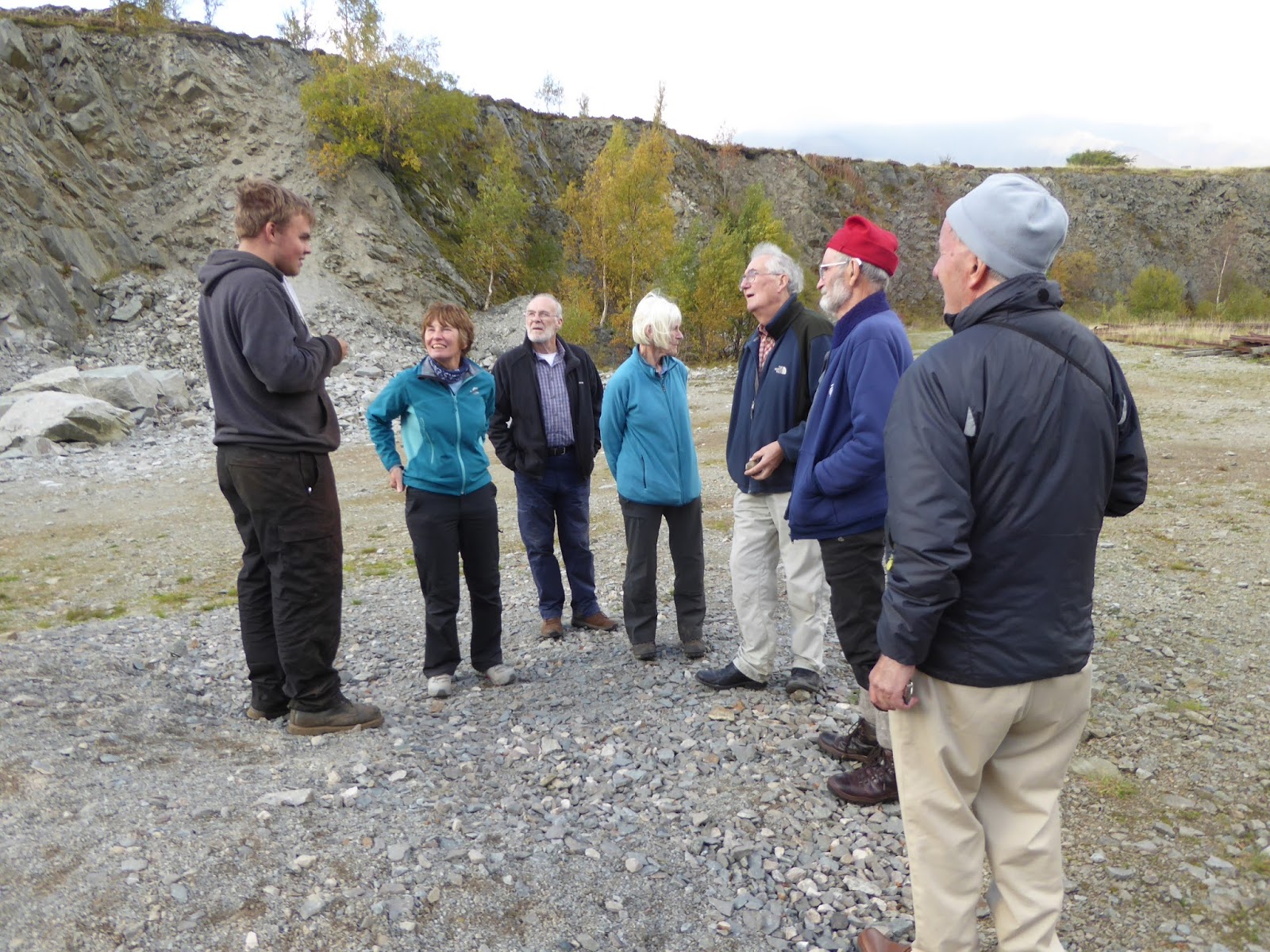
While the train was being readied for its return journey part of the Duddon History Group gathered around to listen to the quarry history told by the train 'ticket inspector'.  Our  history walk had run through the centuries having arrived here from a visit to a Neolithic Stone Circle (3000BC) to this quarry which was started in the 1870s to supply railway ballast for the Keswick to Penrith Line (now closed).  Although the Lake District is more famous for its slate this is a microgranite quarry where the rock was blasted from the quarry face with small explosives so it would shift rock without shattering and then loaded into railway wagons or tubs.

This particular type of granite is not suitable for polishing so is generally used as ballast.

 The quarry closed in 1936 but reopened in 1949 when it stated to produce precast concrete flagstones, the railway was dismantled.
The quarry eventually closed in 1982 when the demolition contractors moved in, stripped the slate roofs of the buildings etc and by the time a charity took over the site in 1992 things were deteriorating and in rather a state.

 As you can see what is now the train shed has a corrugated roof rather than nice roof tiles.  After various changes through the year the site was brought back to be a visitor attraction and the present organisation runs the train and mining trips, gold planning and a superb Mining Museum which encompasses the history of mining in the Lake District and minerals with examples of the complex geology of the Lake District. certainly for the geology enthusiast this would be worth more than one visit.  As one of our group said it was too much to take in for one visit although we will have wait until next year because it closed for the end of the tourist season yesterday (30th October) although their Facebook page says there is a Santa Special at Christmas. 

An entry to ABC Wednesday, a journey through the alphabet, this week sojourning at Q here 


Tuesday, 11 October 2016

Newfield Inn

A grouping of different communication systems in the Duddon Valley, post box, phone box and electricity substation. The notice directs the visitor to extra parking for the Newfield Inn but as it is mid afternoon on a Monday
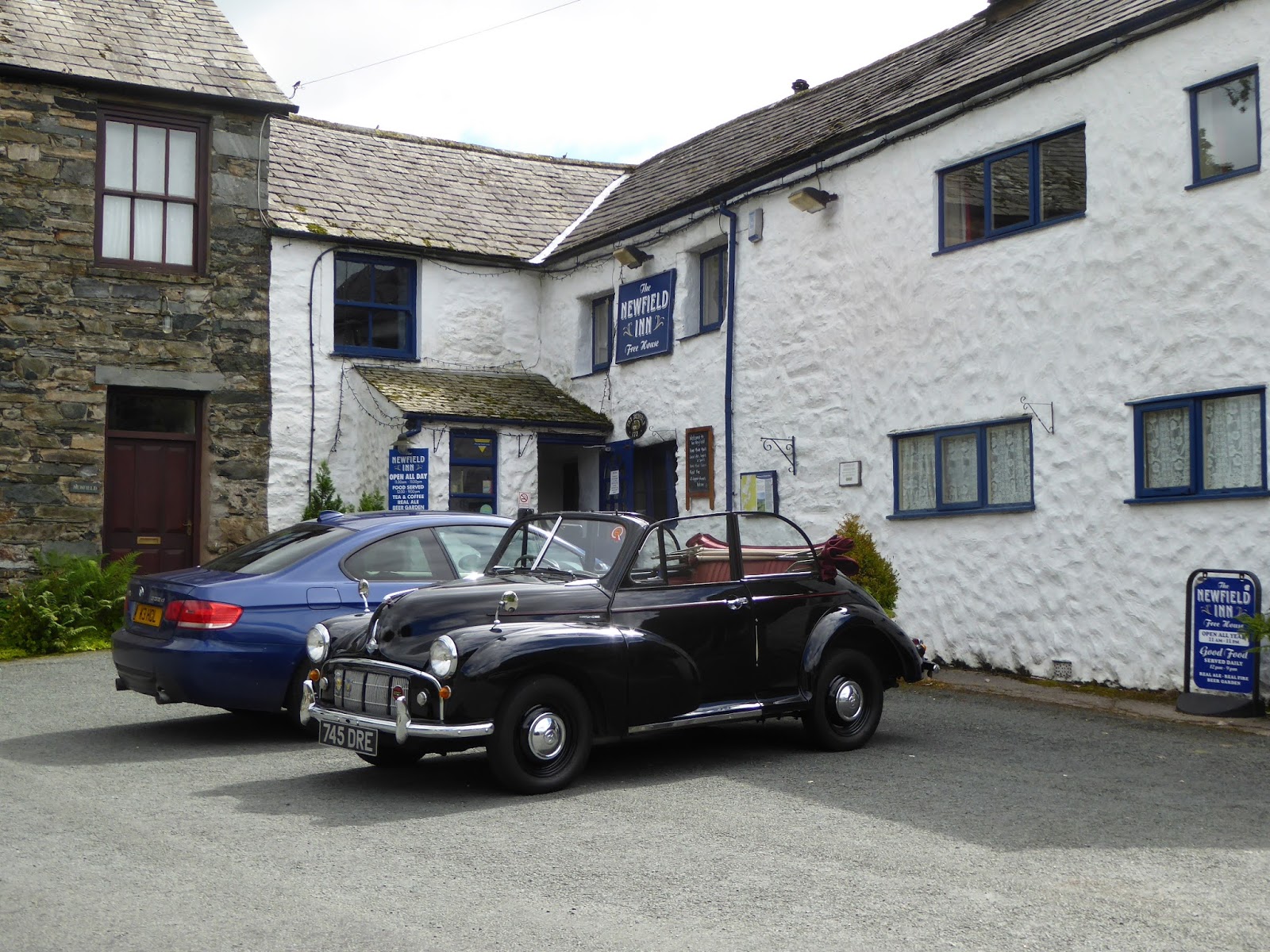
parking won't be a problem. The Newfield Inn squeezes itself in a corner between a house and a bank barn in the hamlet of Seathwaite.  I don't know the inn's age, and neither does anyone else, sources put it at 16th, 17th or 18th century, take your pick, could be all three.  It is possible the poet William Wordsworth stopped here when visiting Seathwaite and perhaps he penned some of his Duddon sonnets in one of the rooms, although more poetically when he wrote 'To The River Duddon' one of the lines said he "left his verses gummed to your rocks like lichen"
The shape of a 1950s Morris Minor cabriolet outside is instantly recognisable, and its owner is taking advantage of the warm sunny day with the top down and although there are clouds there are none of the nimbus ones which bring rain.  If not for the modern blue car I could masquerade this photo as being taken half a century ago.
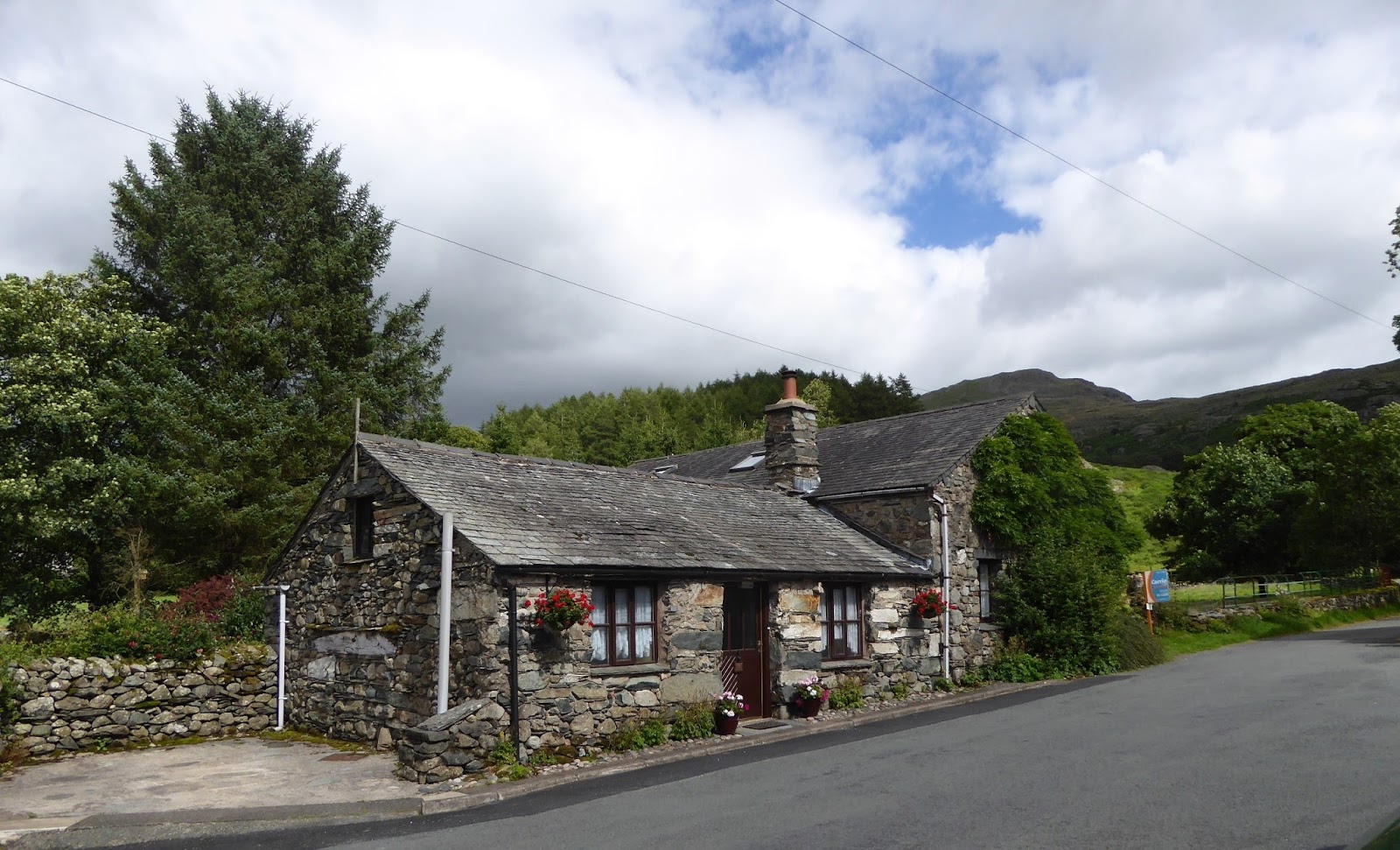
The occupants of the cottage opposite the Newfield Inn don't have far to walk for a meal, drinks or good company.  There is a blue for sale notice up at the front, which is round the corner.  If you have £550,000 to spare (five bedrooms, detached barn (out of view) and garden) its yours.

An entry to ABC Wednesday, a journey through the alphabet, this week sojourning at N here 


Tuesday, 12 July 2016

Eskdale Art

For the past 23 years St Bega's School in the Lake District has played host to the Eskdale Art Show at the end of May. (The show also raises funds for this small school).  If wanting to buy a picture, painting, prints or crafts this is the place to come, but it is also enjoyable just to browse and be amazed at the variety or art and artists in the area.  After that there will be copious amount of tea and a variety of home made cakes available to be enjoyed while sitting and admiring the surrounding hills.  No need to anguish about the number of calories consumed for there are plenty of walking opportunities in the area whether up hills or ambling by the side of  babbling brooks.

This year the road to the school was populated by small people
 inviting and enticing one along the road.

An entry to ABC Wednesday, a journey through the alphabet, amazingly starting its 19th Round here

Tuesday, 10 May 2016

Rust on a Rural Road

Lets tootle along a rural road near Ulpha where most traffic will be turning left here to leave the Duddon Valley and
 carry on to Eskdale. The fingerpost is showing signs of its age with a slightly rusting pointer.  I like these old black and white fingerposts with their roundel tops which date from the 1930s.  This one has had some other signs tacked for the tourist unsure where they are going.  Quite a busy corner behind the wall with a mini electricity substation and a rusting hut. 
The small but pointy peak on the right is Cor (1735 ft /528m) which may be something one says when reaching the top.
Whistling Green, Ulpha
The red of Royal Mail is a familiar sight in the valley and on all rural road.

An entry to ABC Wednesday, a journey through the alphabet, this week sojourning at R here

Tuesday, 17 February 2015

Flora and Fells

February, the month when by imperceptible degrees the days start to lengthen and someone, well yes I mean me, is taken by surprise by the time, 5 O'Clock and still light, yay.
The snowdrops are in full flower and the daffodils are long green shoots and just waiting for their moment in the sun.  Now is the time I like to look forward to the year ahead and wonder what new things I will see, what the year's weather will be like and
Small White (Pieris rapae) on buttercups
dream of the warmer days to come when fluttering wings will be in fields and hedgerows landing on flowers and the
ferns will be unfurling. The latter perhaps I'm fonder of in photogenic clumps rather than in whole impenetrable swaths of fell-sides as they can make finding a pathway through rather testing at times.  All this is in the future and at the moment there are chilly winds 
Coniston Old Man
but the only snow we have had this year floated down onto the fells so we had the pretty views without the icy roads.
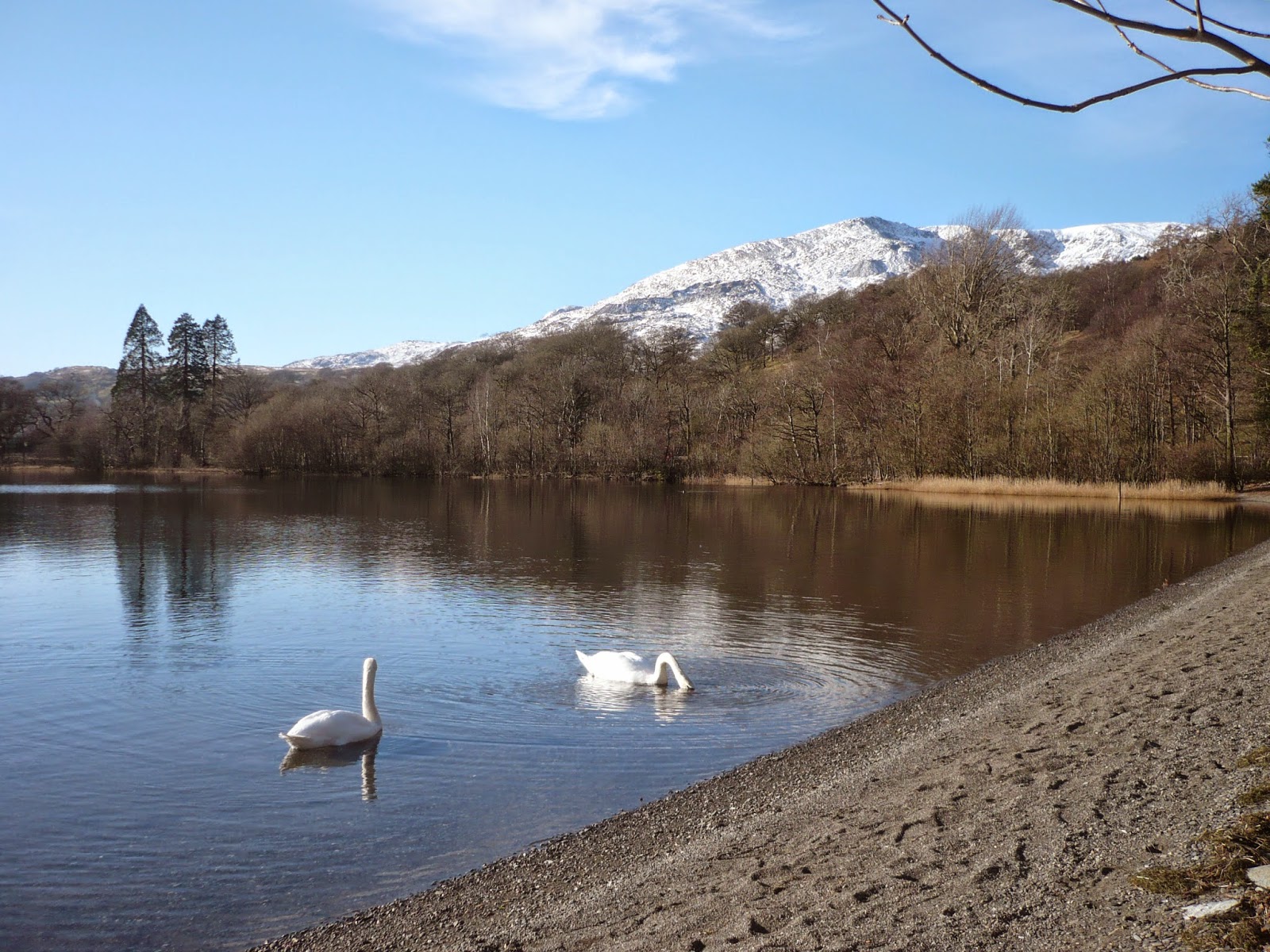
Swans on Coniston Water
In the first week of February the day that was so still that Coniston Water had not a ripple on it, only the ones made by these swans.  This is also the very last photo taken by my camera for like a boxer with a glass jaw it has taken many knocks and bruises to its body and shrugged them off but did not survive its careless owner putting it in her coat pocket with a bunch of keys and damaging the screen. The finish for this trusty little Panasonic.  (The photograph of the snowdrops at the beginning of the post is the first I've taken with my new camera, it will probably take me the rest of the year to get to grips with it, thank goodness there is always auto).   

An entry to ABC Wednesday, a journey through the alphabet, this week sojourning at F here


Tuesday, 2 September 2014

Hounds

I wonder where you would put a table like this?  I imagine in a very large hall where those heads would be irresistible to hang a hat after returning from hacking around the countryside.  This is the 'Deerhound Table' designed and created by the sculptor John Bell (1811-1895) for the Paris International Exhibition of 1855.  The life-size deerhounds support a table top painted to look like marble.  On display in the Coalbrookdale Museum of Iron you may guess from that name that it is made of the material loved by the Victorians, cast iron. and it weighs a massive 800 kg.
It would be impracticable for me to own a dog but that does not stop me musing on what type I would like to have.  These hounds might be perfect, the puppies are very lively but once they reach about three they like to lounge around and sleep, the place of preference being on soft furnishing. however their attention is always grabbed by food and the chance of a long walk.  Sounds a bit like me. Perhaps I would take them to the beach
but watch out for the Sea Holly
Bethecar Moor and the Coniston Hills
Their own place of preference would be the high hills with plenty of room to run for, as their name implies, they were originally bred to hunt deer. Want to see some real deerhounds bounding around?  I know I did, here is the Flickr Group.

An entry to ABC Wednesday, a journey through the alphabet this week sojourning at H here