Showing posts with label Pubs. Show all posts

Tuesday, 11 October 2016

Newfield Inn

A grouping of different communication systems in the Duddon Valley, post box, phone box and electricity substation. The notice directs the visitor to extra parking for the Newfield Inn but as it is mid afternoon on a Monday
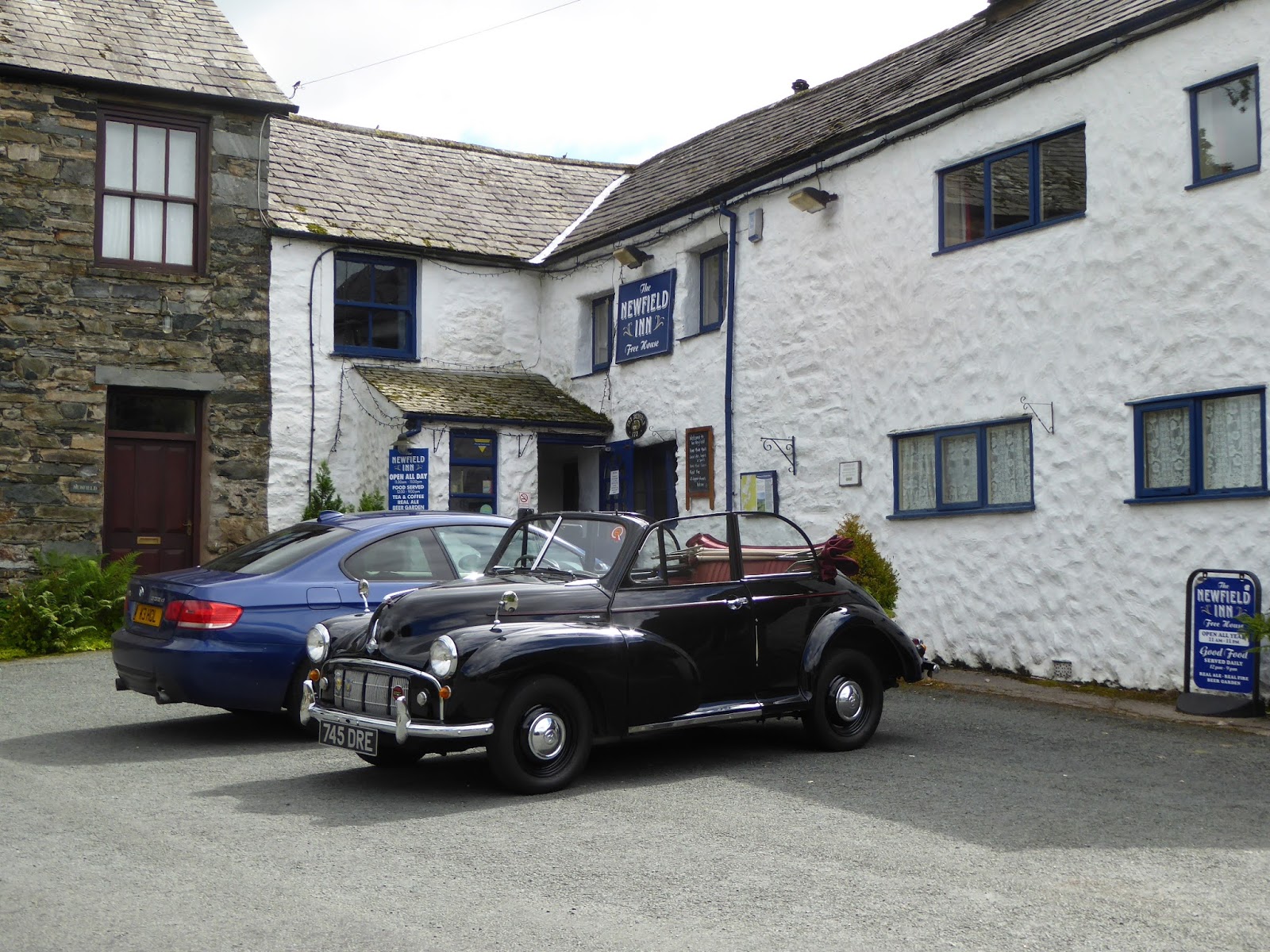
parking won't be a problem. The Newfield Inn squeezes itself in a corner between a house and a bank barn in the hamlet of Seathwaite.  I don't know the inn's age, and neither does anyone else, sources put it at 16th, 17th or 18th century, take your pick, could be all three.  It is possible the poet William Wordsworth stopped here when visiting Seathwaite and perhaps he penned some of his Duddon sonnets in one of the rooms, although more poetically when he wrote 'To The River Duddon' one of the lines said he "left his verses gummed to your rocks like lichen"
The shape of a 1950s Morris Minor cabriolet outside is instantly recognisable, and its owner is taking advantage of the warm sunny day with the top down and although there are clouds there are none of the nimbus ones which bring rain.  If not for the modern blue car I could masquerade this photo as being taken half a century ago.
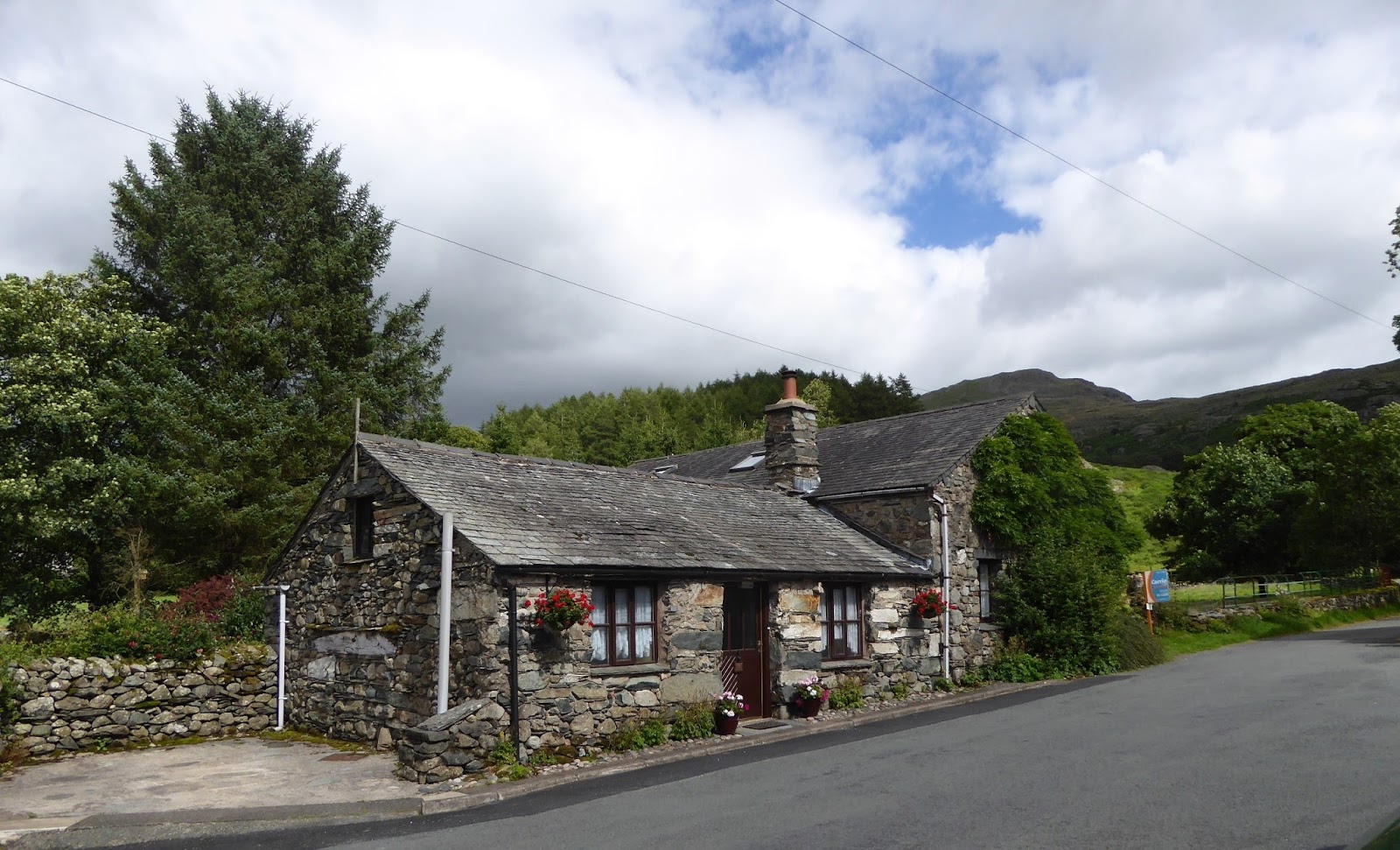
The occupants of the cottage opposite the Newfield Inn don't have far to walk for a meal, drinks or good company.  There is a blue for sale notice up at the front, which is round the corner.  If you have £550,000 to spare (five bedrooms, detached barn (out of view) and garden) its yours.

An entry to ABC Wednesday, a journey through the alphabet, this week sojourning at N here 


Saturday, 11 June 2016

Flags Flying

The Strawberry
The football calm before the storm?

Tuesday, 3 November 2015

The Queens

A liner floats in the sky above a building in Birkenhead which stands on the junction of two roads
and is named after the Queens who are the Cunard liners.  These are not their modern cruise ships whose design looks like a human container ship but the iconic lines of the Queens from the 1930s who vied with other vessels to make the fastest crossing of the Atlantic from Southampton to New York.
The building is a pub and hotel owned by Admiral Taverns (continuing the nautical theme).  I'm assuming the name is related to the fact that Cunard headquarters were originally in Liverpool and their beautiful old building forms one of the 'Three Graces' on the city's waterfront.  The Queens however is tucked away on the other side of the Mersey by Birkenhead Park. In the early afternoon on an April day the area seemed quite deserted, maybe the chill and grey skies had something to do with it.

To make up for the lack of activity on the photograph here is an interior shot of the Queen Mary (the first of the Queens), being fitted out on Clydeside in Art Deco style in about 1935.  (The photographer is Yevonde Middleton (Madam Yevonde) a pioneer of colour photographer)
The joiners are busy behind the bar.  The two 'customers' may have a long wait for any liquid refreshment.

An entry to ABC Wednesday, a journey through the alphabet, this week sojourning at Q here
  

Tuesday, 2 December 2014

Unspoilt by Progress

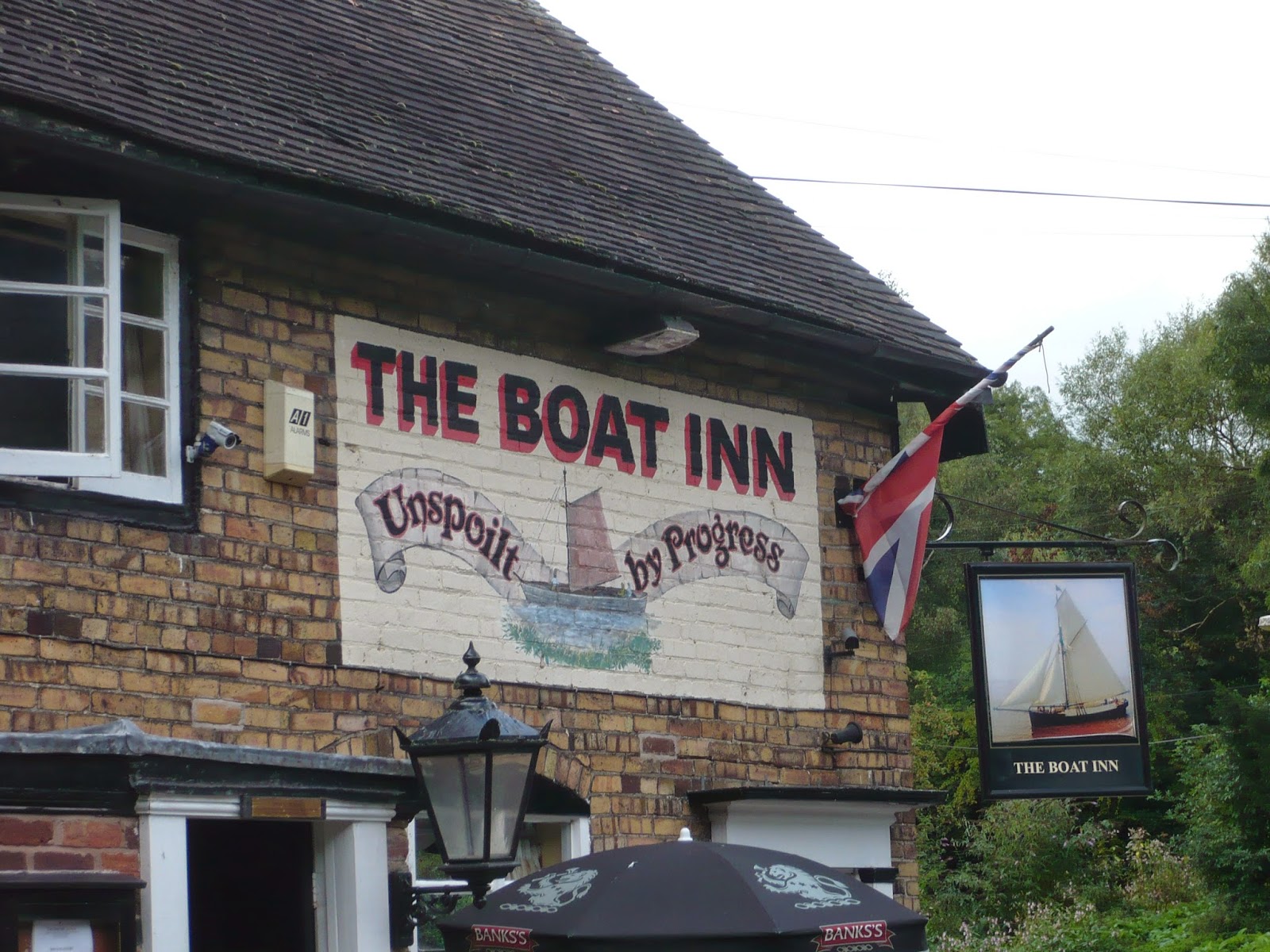
You rarely see a clock in a pub for the best ones live in their own alternate reality where time passes convivially and unnoticed.   The Boat Inn on the bank of the River Severn welcomes the visitor into its door with the boast that it is "Unspoilt by Progress".
First licensed in 1840 the pub's landlady thinks that some of the building is much older and could go back as far as 1740, or earlier, as a fireplace and interior timbers have been dated back to Tudor times.   Wondering why there is a lifebelt by the entrance?
It may come in handy.  This is its famous 'flood door' that records past flooding events.  The most catastrophic flood in the Ironbridge Gorge occurred in 1795, but that was before records began, so I'll start with the highest recorded flood marked on the top of the list which is that of 1st November 2000 at 19 ft 6" (6 metres).  The next one down is 19th February 1946 - 19 ft 5" followed by the 21st March 1947 19 ft 1".  The BBC Shropshire slide show on "Flooding through the Ages" has a photo of the Boat Inn in the flood of 1947 here ( See Image 4 on  the link).  I think the building also looks longer in the photo the BBC have used.  Lets go inside.
and indeed the bar area is unspoilt by progress.  Typically Victorian pubs would consist of many rooms but in modern times walls were knocked down to make a larger overall area and original features removed.  Notice the quarry tiled floor, the first appearance of flood water will not be through the door but bubbling through the tiles from the raised water table below.

An entry to ABC Wednesday, a journey through the alphabet, this week sojourning at U here


Tuesday, 4 February 2014

Drigg Dawdle

The name Drigg is probably Old Norse, drag or draga meaning 'watercourse down a valley', the village lies north of the River Irt as it makes its way from Wasdale Water to the Irish Sea .  On some old maps it gets called Dregg but that is probably the result of someone writing down the sound, the Cumberland dialect has a propensity for making two vowels sounds for one vowel. The parish of Drigg's population number has not changed much since 1688 when it was 560 even with the coming of the railways.
On the left are the old railway buildings now the 'Spindle Crafts' tea room and crafts shop. Straight ahead is the Victoria Hotel pub.  So much choice in a small area for a drink.  If we had been at the end of a walk the choice would have been the tea room but as it was the middle of the day
we choice the Victoria to slake our thirst with Jennings beer.
The gate by the pub leads to the railway station which originally opened in 1849 when the rolling stock was a step away, rather than a large step up as today, hence the portable steps for those who require them.
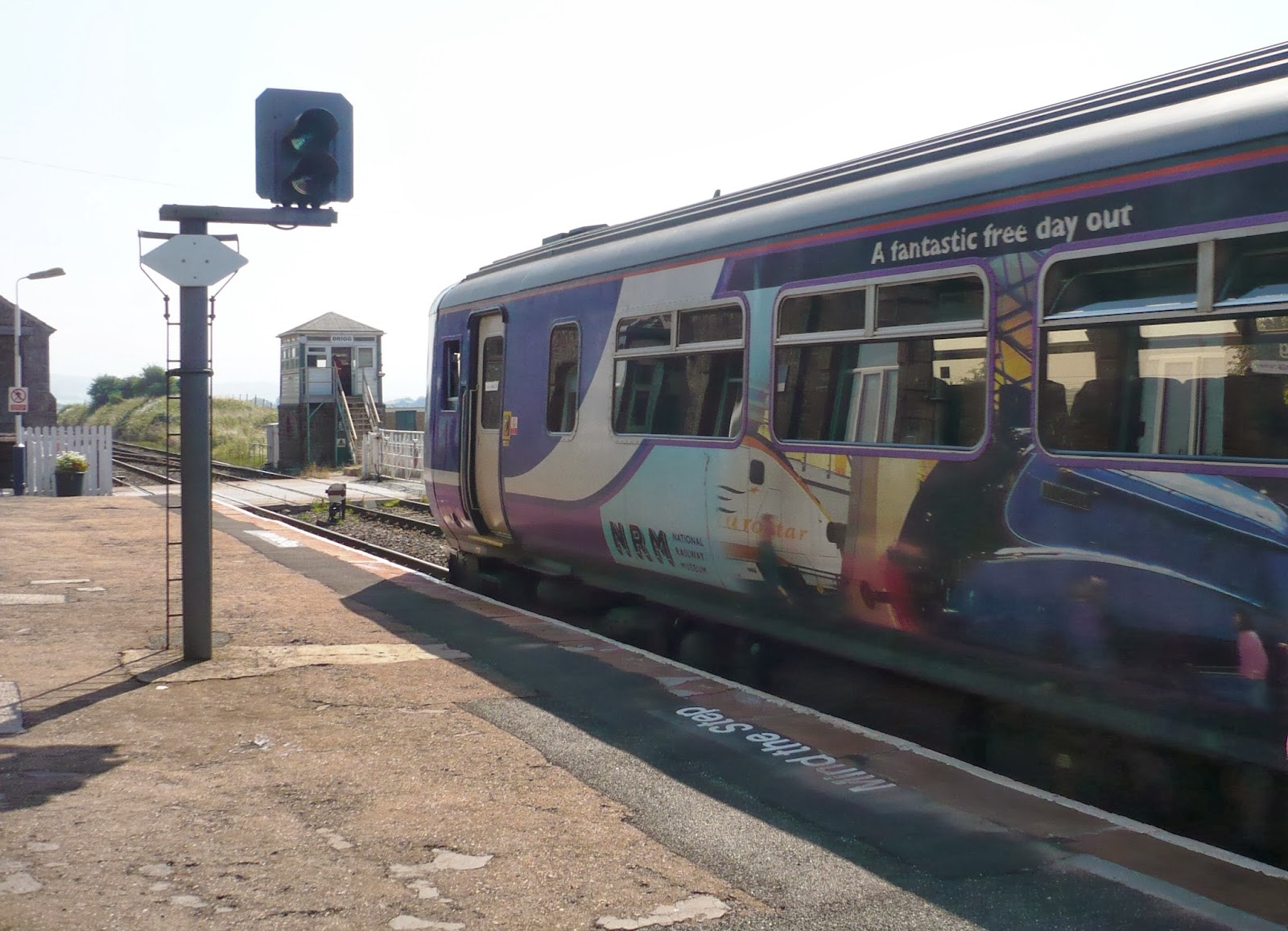
Any sign of a train?  This is a request stop only, a raised raised from the platform and the train will stop, although the drivers are always alert to passenger.  When a family with children took them from outside the pub just to watch the train coming we joined them so there was quite a crowd on the platform and the train
stopped.  I hope the driver was not too disappointed because nobody was boarding.  In its brief stop I managed to get part of the mural on the side (only a few of the local trains have these). It is advertising the National Railway Museum in York with a picture of the Mallard, holder of the world speed record for a Steam Train.  So much prettier than the sprinter train it appears on.
 As it turned out this was the perfectly themed headgear for this particular hot sunny day.
The signal man's duty over he comes down the steps, I'm going to take you over the crossing, through the gate and down the lane.
Passing the lazy bull, happily on the other side of the fence
And past the site of what was the Royal Ordnance Factory in World War Two, which  produced TNT.  Today it is a Low Level Waste Repository for the Nuclear Decommissioning Authority while they wonder what to do with it, there is a few million years to decide.
Through the path's new gate with is wonderfully rounded sandstone weight to ensure it closes after walkers pass through
Eventually reaching the beach which on this day seemed to be popular with sea fishermen, as this remote corner has been for centuries, and noted in times past for its fisheries and mussel beds. We stopped by the sand dunes to have lunch before walking further up the coast to Seascale where we would take the train back home passing, but not stopping, at Drigg.

An  entry to ABC Wednesday, a journey through the alphabet this week sojourning at D here


Tuesday, 23 July 2013

Round the Bend

Parton from Redness Point
Bit by Bit I am knocking off the various sections of the Cumbria Coastal Way and this bend of the railway line follows part of it. I'm walking on the the old tram road above (it is now a cycle path) that used to connect to the Parton Brickworks before the railway arrived. One of the ironies is that in 1840 the first locomotive for the Maryport to Carlisle railway was built further up the coast at Lowca but it had to be transported down to Parton to be sent by seagoing barge up to Maryport as this line did not exist.  This section of the Coastal Way from Whitehaven to Workington could be described as a walk through Britain's industrial past of ironworks, mines and engineering.
If you are having problems with bends this is the person to solve your problems, Bull Dog Drainage, making a house call at the aforementioned Lowca, we spotted his van again later in the day when we arrived in Workington picking up parts at the Plumb Centre. Problem solved.   As it was one of the hottest days of the year we were just looking a shop selling ice cream.
The Beachcomber, Parton
 No Beachcoming on this trip and no refreshing drinks at the Beachcomber pub, it closed in 2009.  There were plans for four houses to be built on the site but nothing seems to be happening, they would have great Irish Sea views.
Next week I will be on home ground in Morecambe Bay and just around the bend from this little bay.  It is unusual for me to know what I'm doing for a next weeks ABC but the reason is the object has both a B and a C in its name.

An entry to ABC Wednesday - a journey though the alphabet

Tuesday, 4 September 2012

Harbour Inn


I'm rather fond of pub signs so when approaching the Harbour Inn at Black Shore this was an irresistible photo, a rather romantic view of a fisherman in calm waters
'Relentless' on the River Ore
but then a slightly larger fishing boat we watched the following day on a nearby river may not have fitted the sign.  Continuing my walk past the pub I came to its other sign  
Harbour Inn, Black Shore, Southwold, Suffolk
of stormier weather and the reason can be spotted half way down the wall  which marks the flood level in 1953.  The inn sits beside the north bank of the River Blyth, a tidal estuary of marshes and flood plains.  The pub floods so the ground floor kitchen is on wheels, the fridges have the electric at the top and the plugs are near the ceiling. The landlord, Nick Attfield was reported as saying "I knew what I was taking on and its part of the charm here".
But the recent floods though inconvenient were nothing compared to the "perfect storm" of 1953 when a high spring tide met a deep depression and gale force northerly winds, creating a surge of water that deluged the east coast rising 10 feet above normal levels here and rushing half a mile inland.  The town of Southwold which is surrounded by rivers became an island.  It was the worst peace time disaster.  Known as the North Sea Flood over 300 people died on the east coast of Britain but the Netherlands counted their dead in thousands.  In this area of Suffolk I read a quote that said it was a year before the earthworm was seen again.  The land was not farmed for three years.

On the sunny day we past the fishing huts, some selling their catch, some just at rest and 

people waiting in holiday mood by the calm waters for the Walberswick ferry (which is a rather grand title for a rowing boat) I would never have imagined a disaster on this scale in this quiet corner of England.

An entry to ABC Wednesday, a journey through the alphabet


Tuesday, 31 July 2012

Cycling through the Counties

Haverigg, Cumbria
 Like the track seen here what passes for summer this year has been a bumpy ride but it hasn't put the cyclists off.  I travel up a hill on the way to work each morning which has a lay-by popular as a meeting place for road racing cyclists about to set off for mega miles.  No matter whatever the weather there is never less than three cyclists waiting for the rest of the group to turn up.
Coniston Water, Cumbria
They may be travelling past Coniston Water which is not too far away.  Monday here, as can be seen by the clouds, was a day of sunshine and showers, just the day for messing about on boats, or under cover in the launch. 
Cherry Orchard, Boughton, Chester, Cheshire
Or if it turns really wet, travel south to relax in the Cherry Orchard pub in Cheshire.  I see they too have a special Wednesday but rather than an ABC it is a quiz night with sandwiches at half time to keep those little grey cells in shape.
Clown Fish, Blue Planet Aquarium, Chester
Not too far away another indoor attraction at the aquarium are the fish that Disney made famous in Finding Nemo - Amphiprion osellarais - the clownfish, in its natural habitat found in the coral reefs of the Pacific.

An entry to ABC Wednesday - a journey through the alphabet now on its 11th circuit


Wednesday, 6 April 2011

Oblivion

The entrance to Oblivion. It was shut when I walked past so cannot testify to the accuracy of its message.

"The problem with the world is that everyone is a few drinks behind" - Humphrey Bogart

An entry to Sign, Signs

Wednesday, 2 March 2011

A Visual Pub Crawl

Wander along the streets of the town of Lancaster and not only are there many pubs but you are never in any doubt of what they are called. This, the Duke of Lancaster with his crown, is possibly meant to be the 14th Century John of Gaunt, a Plantagenet and brother to the Black Prince.  Lancaster lies on the River Lune
and this sign is a wonderful recreation of the 18th Century St Georges Quay and its warehousing along the banks  Of course if there are ports and ships there must be sailors
and they are rather fond of pubs. 

Photographs for the Signs, Signs meme