Showing posts with label Railway Station. Show all posts

Tuesday, 21 February 2017

Gone

The engine steamed and the whistle blew as Tornedo thundered down the track through Garsdale Station. As you can see I clicked too soon and forgot I was in 'sports' mode so such have kept my finger down to get multiple images, doh,
and there it was - gone.  Ah the perils of photography.  Tornado is limited to 75 mph on main line running but would be able to go a lot faster, even so it was very impressive.  It is modern steam locomotive completed in 2008 (based on a Peppercorn engine with modifications) and for the first time was running a scheduled public timetable from Appleby to Skipton prior to the re-opening of the whole track from Settle to Carlisle on 31st March which will be inaugurated by the iconic Flying Scotsman.  The scenic line has been closed for over a year after the winter storms created a landslip of 500,000 tonnes of earth at Eden Brows and it continued to move.  The engineering solution can be seen here.
The station at Garsdale Head has been described as being the "wildest on the line" being high up on the fells and although the day was beautifully sunny the wind was icy, I was well wrapped up but as you can see the signalman is obviously made of sterner stuff, one could almost say made of 'True Grit', in his short sleeved shirt.
No-one else was taking that option.


An entry to ABC Wednesday, a journey through the alphabet, this week sojourning at G here 


Tuesday, 20 December 2016

X

St Bee's railway crossing and station provides an X this week with the yellow cross hatching of the road's 'no stopping' lines.  This is also probably the only angle one can get a full view of the signal box on the right.  Built in 1891 it is a rare example of one built in the Arts and Craft style although the windows are no longer original, a shame for the viewer but not for the signalman who I imagine appreciates the double glazing at this time of year. The station and most of the village is constructed of the dark red St Bees Sandstone, the same type as in the nearby sea cliffs
here seen with a thin strata of white sandstone.  Its full geological name is St Bees New Red Sandstone, yes 'new' - a mere 200 million years old.  

Time to shoehorn another X, this time an Christmas, or rather Xmas, cactus.  Half of mine has just flowered but it looks as though the other half might actually flower at Xmas-time, which will be the first time it has lived up to its name. As my cactus is red Mr Google has helpfully provided a xanthic one in full flower. 
Blessings to you all and have a very Merry Xmas


An entry to ABC Wednesday, a journey through the alphabet, this week sojourning at X here

Tuesday, 2 August 2016

Dogtastic

I don't have a dog but I enjoy other peoples pets, whether playing with them, or just on dog watch with a camera.
Getting excited about a train arriving while those around them are intent on a mobile connection.
Taking a human for a walk
Wondering if this size of branch may be a little unmanageable
Temping us for an ice cream on the Saltaire Ice Cream Boat

An entry to ABC Wednesday, a journey through the alphabet, this week sojourning D here

Tuesday, 7 June 2016

Virol

Coming to a halt at Oakworth Station with its vintage signs and one in particular is perfect for this weeks letter - Virol.  The message underneath reads "for health and vitality" and it was recommended for making children healthy but also for the sporting cyclist who were advised for the best results to take it together with milk (no doubt making them able to zoom up hills).  This elixir was a malt extract product invented by Bovril in 1899 and was sold up to the middle of  World War II, when production ceased because it became too costly to manufacture. It is possible that production restarted post war because there was still malt extract being fed to small children but it may have been a different brand. 
The train moves off as I continue to take photographs through the window.  Oakworth Railway Station was opened in 1867 but this station on a heritage railway in West Yorkshire is created to look how it would have done from 1905-1910.  For some it may look vaguely familiar, especially if you are a fan like me of the 1970 film The Railway Children for here is where Mr Perks was station master and much of the story was filmed (some other locations in the area are listed on the Keighley and Worth Valley railway site).
Subconsciously I must have been very excited I was at Oakworth because I took photographs coming through the station both going and coming back, or perhaps I was attracted by the virnal displays of flowers. Thanks to the railway volunteers one can enjoy both stations and a trip behind a steam train and happily, unlike the railway children, there is no danger of a landslide onto the track.
For lovers of steam locomotives here is the teaser for next week and the letter W 

An entry to ABC Wednesday, a journey through the alphabet, this week sojourning at V here


Tuesday, 4 February 2014

Drigg Dawdle

The name Drigg is probably Old Norse, drag or draga meaning 'watercourse down a valley', the village lies north of the River Irt as it makes its way from Wasdale Water to the Irish Sea .  On some old maps it gets called Dregg but that is probably the result of someone writing down the sound, the Cumberland dialect has a propensity for making two vowels sounds for one vowel. The parish of Drigg's population number has not changed much since 1688 when it was 560 even with the coming of the railways.
On the left are the old railway buildings now the 'Spindle Crafts' tea room and crafts shop. Straight ahead is the Victoria Hotel pub.  So much choice in a small area for a drink.  If we had been at the end of a walk the choice would have been the tea room but as it was the middle of the day
we choice the Victoria to slake our thirst with Jennings beer.
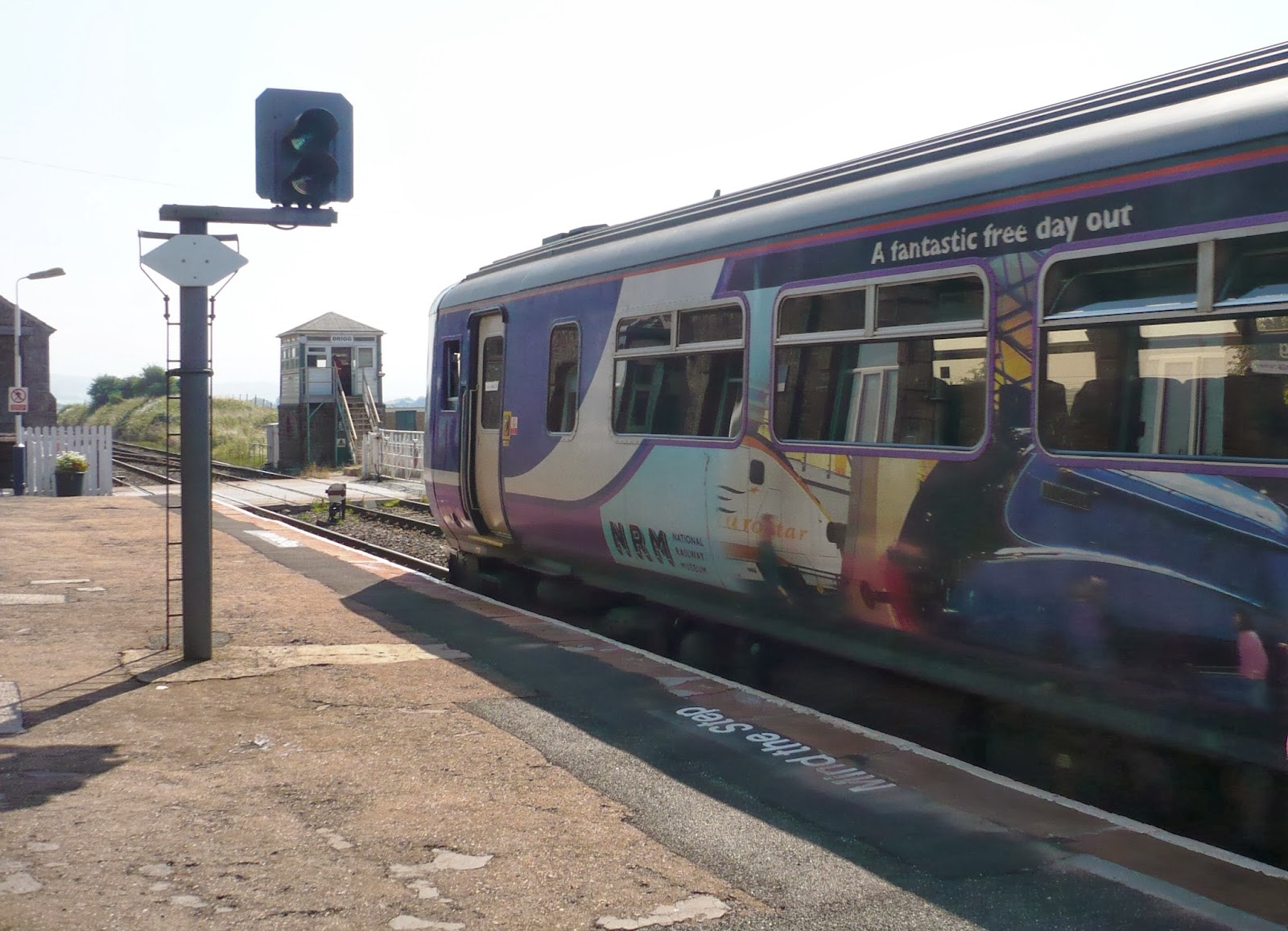
The gate by the pub leads to the railway station which originally opened in 1849 when the rolling stock was a step away, rather than a large step up as today, hence the portable steps for those who require them.
Any sign of a train?  This is a request stop only, a raised raised from the platform and the train will stop, although the drivers are always alert to passenger.  When a family with children took them from outside the pub just to watch the train coming we joined them so there was quite a crowd on the platform and the train
stopped.  I hope the driver was not too disappointed because nobody was boarding.  In its brief stop I managed to get part of the mural on the side (only a few of the local trains have these). It is advertising the National Railway Museum in York with a picture of the Mallard, holder of the world speed record for a Steam Train.  So much prettier than the sprinter train it appears on.
 As it turned out this was the perfectly themed headgear for this particular hot sunny day.
The signal man's duty over he comes down the steps, I'm going to take you over the crossing, through the gate and down the lane.
Passing the lazy bull, happily on the other side of the fence
And past the site of what was the Royal Ordnance Factory in World War Two, which  produced TNT.  Today it is a Low Level Waste Repository for the Nuclear Decommissioning Authority while they wonder what to do with it, there is a few million years to decide.
Through the path's new gate with is wonderfully rounded sandstone weight to ensure it closes after walkers pass through
Eventually reaching the beach which on this day seemed to be popular with sea fishermen, as this remote corner has been for centuries, and noted in times past for its fisheries and mussel beds. We stopped by the sand dunes to have lunch before walking further up the coast to Seascale where we would take the train back home passing, but not stopping, at Drigg.

An  entry to ABC Wednesday, a journey through the alphabet this week sojourning at D here


Tuesday, 3 December 2013

The Underground Overground

This year was the 150th Anniversary of the opening of the London Underground Metropolitan Line and the Royal Mail issued a set of stamps exactly 150th years to the day on 9th January.
I move forward some years to the Russell Square Station which for any lover of tiles or fonts is a great one to visit, that and the fact that it is near the British Museum.  One of many surviving stations designed by Leslie Green in an Arts and Craft style it opened in 1906 and although the upper ticketing areas have been altered some of the station level tiling survives
The last count was 1.2 billion passenger travelling on the various lines every year.
Although I'm not going to show you any of them because I had a bit of a camera glitch so here are the approaching train lights
Goodge Street station built in 1907 was closed for alterations when we were in London but it is one of the rare stations that has a different exit to the entrance. It is also one of eight London stations that had a deep level air raid shelter built underneath it.  Unlike this one
A postcard of a 1940s book cover with everybody carrying their gas masks in a sort of idealised blitz spirit kind of way, although perhaps reality was more like this
which looks rather more uncomfortable.  The Aldwych*  Station in 1940, one of 79 Tube stations used as air raid shelters

*UPDATE:  By one of those strange coincidences of life I just noticed that one of my favourite bloggers has written about his recent visit down to the long closed Aldwych Station (pictured above)  here (with pics and Doctor Who references).

An entry to ABC Wednesday, a journey through the alphabet this week sojourning at U


Tuesday, 12 November 2013

Railway Reflection

The Oxford Road Railway Station reflecting its surrounding in the late afternoon sun.  The original station on this site was opened in 1849 but became dilapidated and was demolished when the line was electrified and modernised, being rebuilt in 1960 (and  recently refurbished in 2004).  I have not been able to find a photograph of the 19th Century station but it was lucky to be rebuilt before the mid 60s and concrete brutalism. The architect Max Clendinning was joined by the structural engineer Hugh Tottenham of the Timber Development Association whose timber shell roof and this laminated timber façade make it so distinctive.  Rather than reverse the time in ones head from the reflection, turn around and see

the clock tower and the correct time.
Express Sprinter waiting at Oxford Road
The curved wooden beams inside the station support the canopy and there have been later additions of waiting shelters in the same theme
who occupants may be reflecting on when their train might arrive. 
To see what the clock tower is attached to one must walk away from the station and see it soaring above what was the Refuge Assurance Building built by Alfred Waterhouse in the 1890s and then later in 1910-12 a 217 ft (66m) clock tower and extension along Oxford Road was built by his son John. Refuge Assurance occupied the building for nearly a century but today it is the Palace Hotel a short walk from the ornate
entrance (still with the Refuge name on the stonework), to the railway station or vice-versa.

An entry to ABC Wednesday, a journey through the alphabet sojourning this week at