Showing posts with label Locomotive. Show all posts

Saturday, 6 October 2018

Galatea Comes to Life

Galatea (45699) took a trip down the Cumbrian coast at the end of September and we watched from Foxfield Station as it steamed round the estuary
then came into view as it approached the station bend
past Tony Sharp's Trailer yard and towards the crowd of steam enthusiasts, their numbers swelled by those that were attending the beer festival in the Prince of Wales nearby who also couldn't resist a steam loco.
Galatea thundered past.  The driver waved, we waved, and then passengers and spectators waved, the power of steam and history joining us together in a wave of pure joy.  Galatea the statue that came to life and a locomotive brought to life by the power of engineering.

Can't get enough of steam engines? Here are more photos of Galatea and some black and white photos of the Jubilee class taken in the 1960s

Tuesday, 21 February 2017

Gone

The engine steamed and the whistle blew as Tornedo thundered down the track through Garsdale Station. As you can see I clicked too soon and forgot I was in 'sports' mode so such have kept my finger down to get multiple images, doh,
and there it was - gone.  Ah the perils of photography.  Tornado is limited to 75 mph on main line running but would be able to go a lot faster, even so it was very impressive.  It is modern steam locomotive completed in 2008 (based on a Peppercorn engine with modifications) and for the first time was running a scheduled public timetable from Appleby to Skipton prior to the re-opening of the whole track from Settle to Carlisle on 31st March which will be inaugurated by the iconic Flying Scotsman.  The scenic line has been closed for over a year after the winter storms created a landslip of 500,000 tonnes of earth at Eden Brows and it continued to move.  The engineering solution can be seen here.
The station at Garsdale Head has been described as being the "wildest on the line" being high up on the fells and although the day was beautifully sunny the wind was icy, I was well wrapped up but as you can see the signalman is obviously made of sterner stuff, one could almost say made of 'True Grit', in his short sleeved shirt.
No-one else was taking that option.


An entry to ABC Wednesday, a journey through the alphabet, this week sojourning at G here 


Tuesday, 1 November 2016

Threlkeld Quarry

How many chances will I get to encompass three of my interests in one photograph?  Here we have vintage machinery, a locomotive and a mountain.  The mountain is one of the 'must climbs' of the Lake District, Blencathra, also known by its English rather than local name, Saddleback, because of its shape.  I'm not taking you on a walk up there but a more leisurely 
ride on a quarry railway.  This little locomotive is a Ruston 48DL of 1947, once used at the Royal Armaments Depot nearby in Cockermouth (which closed in 1994) and brought here, re-gauged from 2'6" to the 2 foot (0.6096m) and now one of three locos used at Threlkeld Quarry.  The little steam locomotive Sir Tom was not running on the day we visited, a bit of a disappointment, but not for long with the chance of a narrow gauge train ride,  lets climb aboard with a choice of open or enclosed carriages to trundle through a  bit of mining history.
Eventually ending up in the very large quarry where the locomotive is uncoupled and run round to the  other end of the carriages for the return trip.  The Threlkeld Quarry and Mining Museum is also home to the Vintage Excavator Trust so there was lots of machinery to entrance the three boys who were running around.  I am informed this is a Priestman Luffing Shovel who the toy maker Corgi used to make lots of miniature versions.
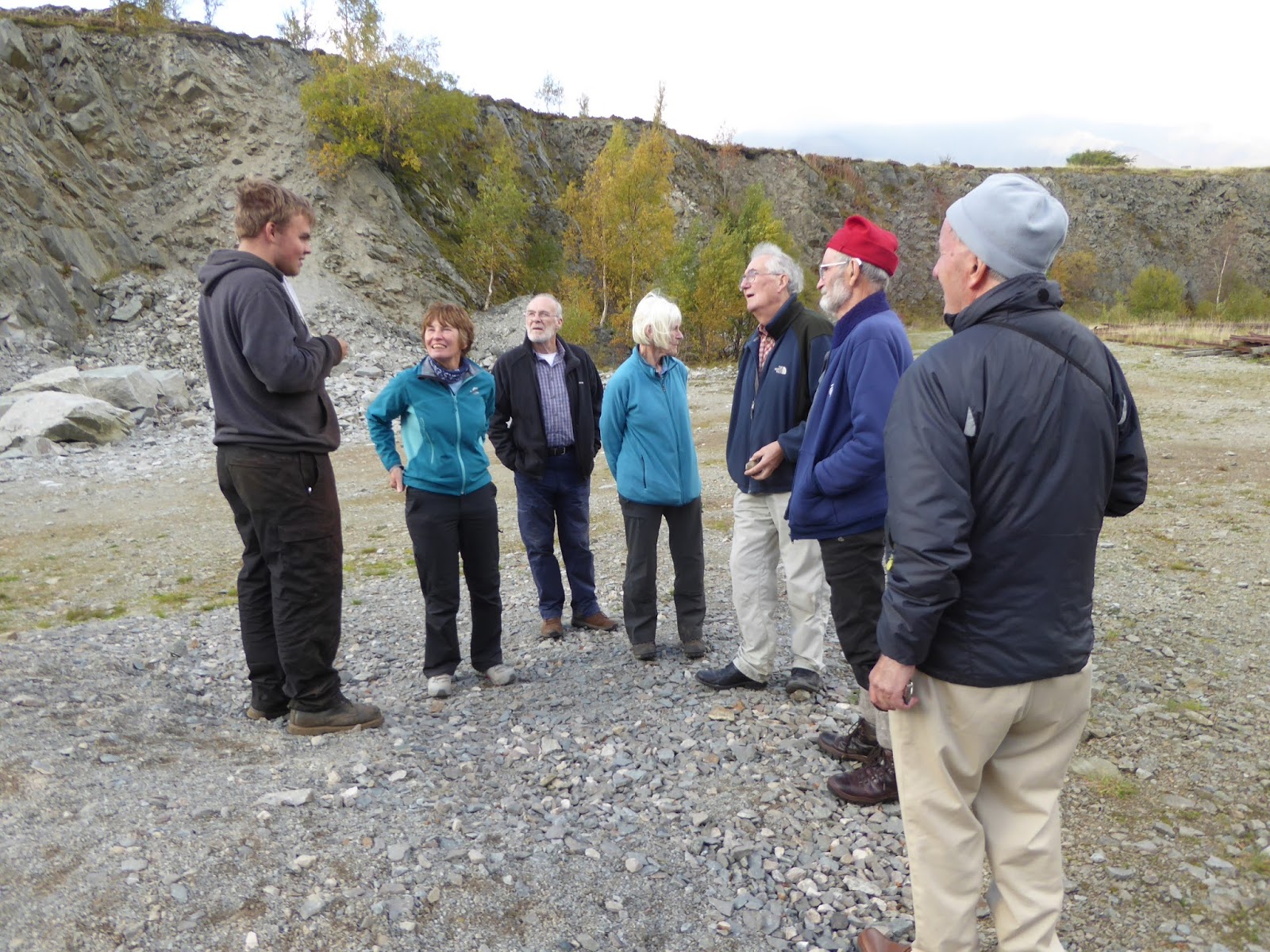
While the train was being readied for its return journey part of the Duddon History Group gathered around to listen to the quarry history told by the train 'ticket inspector'.  Our  history walk had run through the centuries having arrived here from a visit to a Neolithic Stone Circle (3000BC) to this quarry which was started in the 1870s to supply railway ballast for the Keswick to Penrith Line (now closed).  Although the Lake District is more famous for its slate this is a microgranite quarry where the rock was blasted from the quarry face with small explosives so it would shift rock without shattering and then loaded into railway wagons or tubs.

This particular type of granite is not suitable for polishing so is generally used as ballast.

 The quarry closed in 1936 but reopened in 1949 when it stated to produce precast concrete flagstones, the railway was dismantled.
The quarry eventually closed in 1982 when the demolition contractors moved in, stripped the slate roofs of the buildings etc and by the time a charity took over the site in 1992 things were deteriorating and in rather a state.

 As you can see what is now the train shed has a corrugated roof rather than nice roof tiles.  After various changes through the year the site was brought back to be a visitor attraction and the present organisation runs the train and mining trips, gold planning and a superb Mining Museum which encompasses the history of mining in the Lake District and minerals with examples of the complex geology of the Lake District. certainly for the geology enthusiast this would be worth more than one visit.  As one of our group said it was too much to take in for one visit although we will have wait until next year because it closed for the end of the tourist season yesterday (30th October) although their Facebook page says there is a Santa Special at Christmas. 

An entry to ABC Wednesday, a journey through the alphabet, this week sojourning at Q here 


Tuesday, 14 June 2016

Whistle

The warning whistle is a familiar sound on steam trains, the variability possible in pulling the cord meant that the operators in times past could express the warning in styles as individual as the drivers. Indeed even today one could find 'by popular request' a compilation of whistles and horns here  from modern to vintage.  This locomotive is just arriving for the morning trip and pushing the carriages into Oxenhope station on the Keighley and Worth Valley Railway.
You might observe from this photograph that I was distracted by the rather nice planting of evergreens, bulbs and heather by the trackside, but eyes right this is the locomotive now pulling the carriages.  I think this may be the only survivor of the Austerity class which were built for heavy freight in World War II. Over 900 of them were built from 1943-1945 and this particular engine pulled troops and supplies across Europe.  At the end of the war they were dispersed to various places, 184 went to mainland Europe, mainly the Netherlands, and this is where our engine 90733 travelled and then was later sold to Sweden, eventually ending up stored undercover in a Northern Swedish forest as part of their strategic reserve.  In 1973 it made its way back to the UK and the port of Hull and its home today on the Keighley and Worth Valley Railway in Yorkshire.

For steam (and steam whistles) water is needed and here is the water tower at the largest station on the line, Keighley.  (For non UK residents this is pronounced as Keithly or Keethly and I always have trouble spelling it)  The water tower at the station we started from, Oxenhope,
is very different

and looks more like a very large table lamp.  I'll end with some words of wisdom on the following sign
    Missed Your Train? ... You'll Catch the Next One

And for perfect relaxation after that visit to the cafe/bar, lulled to sleep by The Seekers singing 'Morningtown Ride' here
"Train whistle blowing, makes a sleepy noise,
Underneath their blankets go all the girls and boys.
Heading from the station, out along the bay,
All bound for Morningtown, many miles away.
Sarah's at the engine, Tony rings the bell,
John swings the lantern to show that all is well.
Rocking, rolling, riding, out along the bay,
All bound for Morningtown, many miles away.
Maybe it is raining where our train will ride,
But all the little travelers are snug and warm inside.
Somewhere there is sunshine, somewhere there is day,
Somewhere there is Morningtown, many miles away" (words/music by Malvina Reynolds)
 An entry to ABC Wednesday, a journey through the alphabet, this week sojourning at W here

Tuesday, 12 August 2014

Eee its Tea time

Here I am at the York's medieval city walls and the signs directing those in need of refreshment to Evie's Tea Room, envelopes can be posted on the way past in the double post box.  Nearby is Exhibitions Square the home of the City Art Gallery which is currently closed for a major upgrade until 2015.  This is Bootham Bar
the north west entrance and  one of four gatehouses into York.  In medieval times it restricted traffic into the city, sometimes collecting tolls and in times of war was closed and defended.  Although York's historic centre is its famous attribute it is also a key railway junction halfway between London and Edinburgh on the east coast line so where better to house the national railway collection which includes this  
beast, the enormous steam locomotive KF7, its scale can be judged by the family reading the information board.  It is one of originally 24 designed specifically for the conditions on the Guangzhou-Hankou Railway line in China. Built by the Vulcan Forge of Newton-le-Willows in Lancashire, a company that even had its own railway station (Vulcan Halt).  Completed in the 1930s these engines remained mostly unscathed through the turbulent period of China's history in the 1930s and 40s until they were retired in the 1970s.  There are two known survivors of this class, one in the Beijing Railway Museum and this one in York which was offered back to the UK by the Chinese Government for preservation and arrived in 1981.

An entry to ABC Wednesday, a journey through the alphabet, this week sojourning at E here


Tuesday, 16 July 2013

All Aboard for Appleby and ABC Wednesday

Let me take you on a journey to Appleby arriving by train, which is really just an excuse for me
Union of South Africa A4 Locomotive moves off after taking water at Appleby.
to show once again an A4 Pacific locomotive.  This one is, at the moment, halted in York and rests on a turntable in the National Railway Museum, joined by the iconic Mallard (the fastest steam locomotive in the world reaching 126mph in 1936) and the Bittern which became the fastest steam locomotive of the preservation era in June this year reaching 92½ mph.  The Dominion of Canada and Dwight D Eisenhower have crossed the Atlantic from Canada and the USA, been painted. cleaned and rebuilt at the Shildon workshop and become part of the Great Gathering of the six surviving A4s, including of course the one named after the great designer himself Sir Nigel Gresley.
But its time to leave Appleby Station and walk down the hill although perhaps pausing awhile to look
at the plaque commemorating Eric Treacy (1907-1978) railway photographer extraordinaire who died on the station of a heart attack while waiting to take photographs of the 'Evening Star', the last steam locomotive to be built by BR.
And it seems to be market day by the Low Cross which is an 18th Century copy of one from the 1600s there is also a 17th Century one at the top of the hill called, you've guessed it, the High Cross
This view is down the wide street of Broughgate and its Lime Trees which as this was taken in March have yet to acquire their intense green leaves
Going round the other side there is some writing from the 17th Century which says "Retain your loyalty, preserve your rights" which I presume is a reference the English Civil War. I wonder if it was put there by Lady Ann Clifford who was, as her title infers, a loyalist to the crown.  She is better known for her tenacious fight for the right to inherit her father's property against the prevailing male line of inheritance.
She is buried in a rather grand tomb in the St Lawrence Church for on obtaining her inheritance on the death of her father's brother she went on to repaired churches and built almshouses. The St Lawrence church dates from the 12th Century but was rebuilt in the 14th Century after being burnt down by the Scots in the Border Wars. The porch is 1300 but the dog tooth moulding is 100 years older, the church itself has been continued to be altered throughout the 17th-19th centuries. With regard to the Ann Clifford's tomb I appear only to have taken a photograph of the sheep
on her mother Margaret's tomb but I think it is rather sweet.

Maybe if I had called in at the Tourist Information (located in the 16th Century Moot Hall) they would have said take more photographs, although my long suffering partner would probably not agree with that last statement.
I could also have taken photographs of the Alms Houses built by Lady Clifford to the right of this white building but of course the white took my eye. If my memory is right it is the Masons Lodge.

 Time to take another photograph you never know when an A might needed for ABC Wednesday and an Astral Circus parked in Appleby might come in handy!  Time for a rest?
 
Then take your ease in the ABoard Inn (like the High Cross also dating from the 17th Century), and join these two enjoying drinking and playing draughts.

An entry to ABC Wednesday - join the journey through the alphabet now starting its 13th Round


Tuesday, 2 April 2013

Lakeside


There are many lake sides but unlike most of the names in the south lakes area which are Scandinavian or Celtic in origin and sometimes obscure, this ones meaning is in no doubt, because says exactly what it is in plain English, Lakeside.  In Victorian times tourists would come into the area by train but only so far as the margins of the lakes, the narrow valleys and mountains were the barrier.  The London Midland Region trains travel travelled up from London Euston to Carlisle and branches ran off, all change to the Furness Railway to get to Lakeside, but not today.
This heritage line is now cut off from its original route and only travels from Haverthwaite to Lakeside but the train seen here arriving is one that might have got you all the way in 1949 for it is an LMS Fairburn Tank loco.  277 were built and this is one of two owned by the Lakeside and  Haverthwaite Railway still steaming up and down the line.  Dismounting from the train cross the platform and round the corner
 is the steamer terminal, in this case of the boat variety rather than locomotive. 

a pleasant place to wait for the journey down the lake
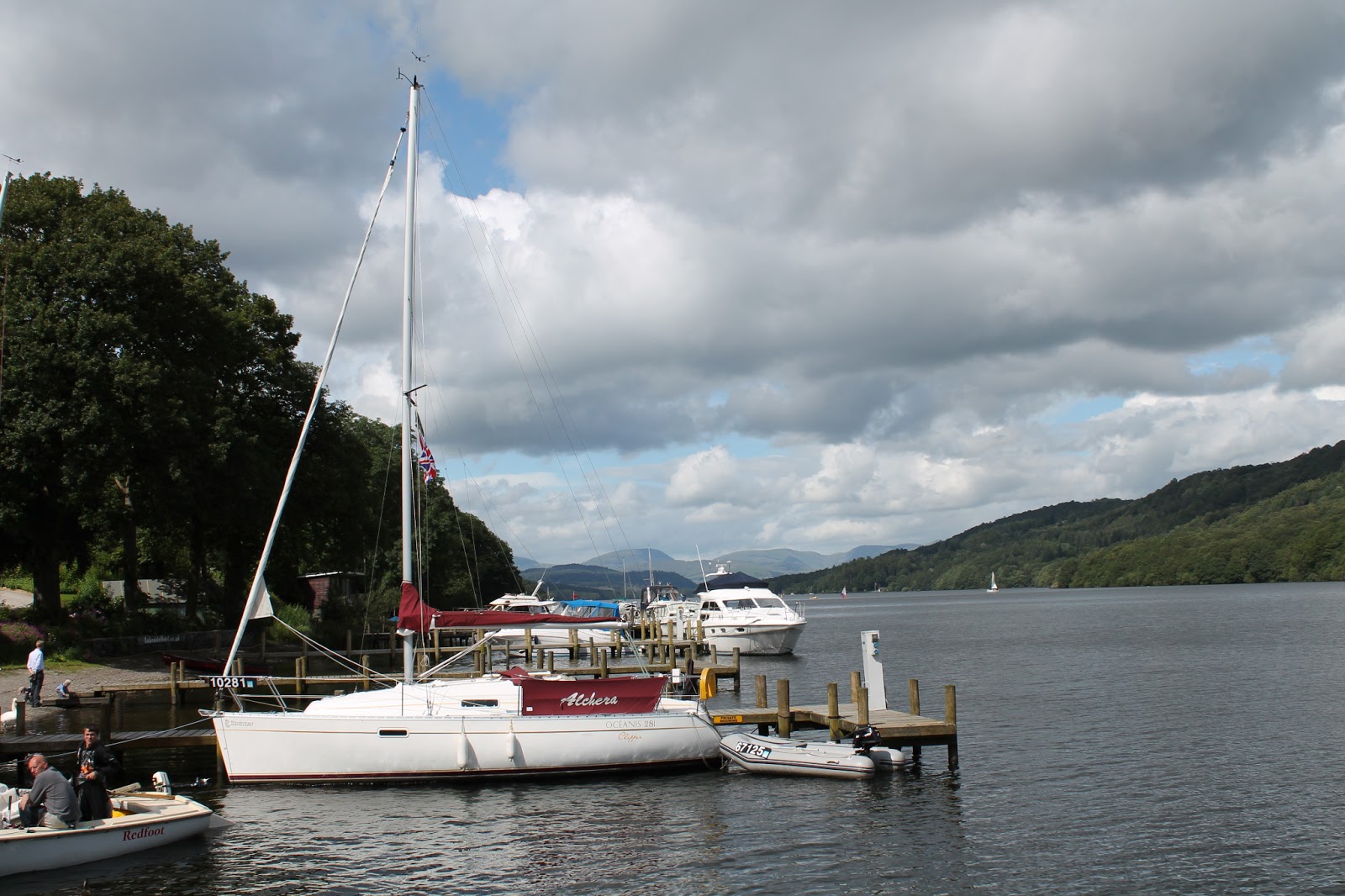
or watch the boats laid up by the jetties

All aboard.  Well not when I took this picture as it was laid up, but they are steaming every hour from 9:15 onwards now as we enter the tourist season.  Wonder what the weather is like?  Check the web-cam, although not as I post this as it is rather late in the day but hopefully it will be in sunlight on Wednesday.

An entry to ABC Wednesday.  A journey through the alphabet.