Showing posts with label Quarry. Show all posts

Tuesday, 31 October 2017

Bannishead Quarry

There are many remains of the slate quarries around the Coniston area of the Lake District but in this view  nature and industry have colluded to form a watery oasis, with a little help from two schoolboys in the 1950s. This is Bannishead Quarry, sometimes also called Tanearth Quarry, the different names because it lies between the two areas on the fellside.
The sloping area to the right of the waterfall is where once the slate was hauled up from the quarry below, there was no waterfall then.  I hope you can make out the waterfall for the day was drizzly and misty not really the best conditions for my pocket camera. Torver Beck rushes down the mountain to one side of the quarry and those original quarry men took care to block off its natural inclination to run downhill towards this hole in the ground.  The mine was abandoned as the slate ran out and the years passed until our two schoolboys roaming the fells decided to remove the stone slab stopping the beck running into the quarry and with much determination eventually their task was achieved, they stood back to admire their handiwork and see the a small trickle turn into a waterfall.  The story is told here   The quarry filled with water and today it is about 6m (19ft 6ins) deep and although the perimeter is fenced off it still remains a draw for schoolboy adventurers in summer to dive into it.  The water remains at a constant level because of the sandstone layer that lies with the slate.

I didn't take any photographs of the old slate spoil heaps which the path weaves through
but here it is one in miniature, the cairn marking the pathways at the bottom.

An entry to ABC Wednesday, a journey through the alphabet, this week sojourning at Q here 
   

Tuesday, 10 May 2011

ABC Wednesday - Quarry

An portal to another world?  It certainly looked like it as I passed, the steam rising with a gathering storm.

It is a different world down there. Hartley Quarry, which I have been told produces limestone aggregate. The colour looks like that at the 'portal' but the colour of the quarry is not as expected. The brown pigment apparently is due to iron compounds. Like most of the quarries in Cumbria it burrows amongst the hills.  Looking down the valley, it sits above the village of Hartley

which now runs into the larger place of Kirkby Stephen. In earlier times (the quarry opened in the 1920s) a klaxon used to sound when they were blasting but now I think there must be just a

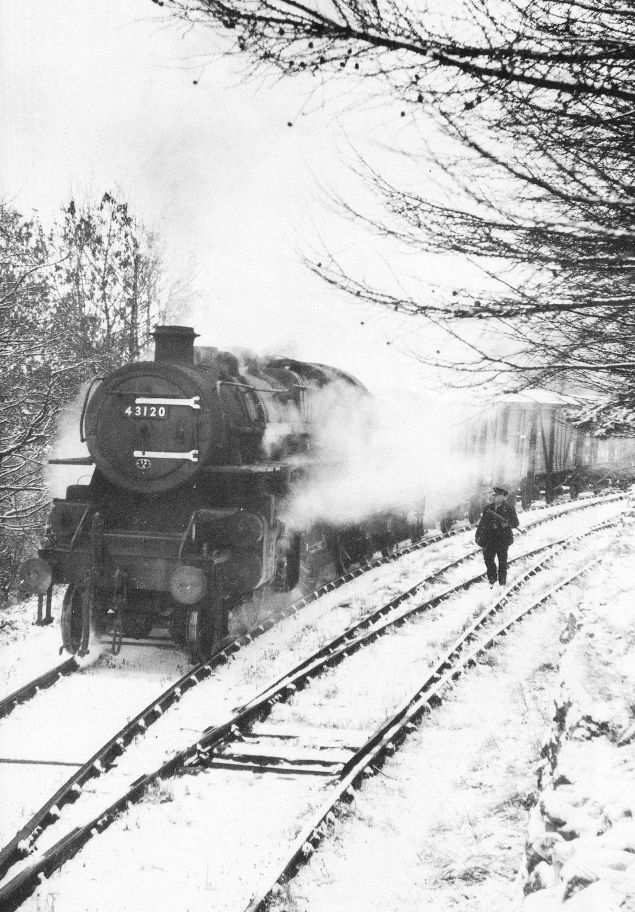
red flag hoisted. In those olden times a rail connection used to run to the quarry. Eventually the line closed but the 6 miles to the quarry remained and became their responsibility. By 1967 the metals running to the quarry deteriorated and were considered not strong enough to hold the weight of a British Rail steam locomotives and they were stopped.
 
This photo was taken in 1966 of one of the last runs to Hartley Quarry, showing a freight carrying Ivat 4MT locomotive. Nowadays of course lorries carry the aggregate on the road from the quarry, wonder if some of those loads will end up as roads.


Quoth I take a trip across to ABC Wednesday to see lots more words starting with Q

Tuesday, 9 November 2010

ABC Wednesday - Quarry

A popular place to take a break, perhaps for lunch, when in the middle of a walk in Tilberthwaite or Little Langdale is here, looking across to the
sheer faces of Hodge Close Quarry and its reflection in the
the water below. The quarry closed in 1964 after which the workings filled with water, we are after all in the Lake District, known for receiving its quota of rain.  The person standing at the bottom has come through from the adjoining Parrock Quarry, the steel 'skis' are the remains of a crane.
This part of the quarry is 300 feet deep, 150 ft of face popular with abseilers, and 150 ft of flooded workings popular with divers.  There are tunnel entrances to 3 chambers and 2 interconnecting tunnels down there. Cave divers are one may say, a special breed, and have no qualms in entering watery enclosed spaces, there have been fatalities here with divers getting lost in the passages.

The Lake District is a National Park and an area of outstanding beauty but it is, and has been, a place of industry as well, some of it which scars the landscape. Green slate has been quarried at Hodge Close since the 19th Century, gradually declining in the 20th century to its closure in the 1960s.  Green slate is commonly used for roof tiles, nowadays cut by machine, but in these times the pieces of slate would be riven or split by hand. To watch someone expertly splitting a slab of slate running with the layers and then making the thin sheets into slates is to watch and marvel at a skill. They then 'dress' the edges making them smooth.  Some of the slate is of no use and is left for waste or 'rid' and these spoil heaps scatter
across the valley, here looking towards the Langdale Pikes, the autumn trees softening the heaps.
As can be seen here the pieces of slate are quite small, in other areas of quarrying the residue can be a lot larger than this.  Pieces can be picked up if you want to make a sign or require one last piece for a wall.

Despite these industrial workings Hodge Close is a popular spot for people to park, to see the views of the surrounding hills and woods, the open space, and for car drivers who don't like to walk too much
a popular picnic spot.  On the day I was here there were also a lot of serious photographers with tripods taking pictures of the light on the Silver Birch, unlike this happy snapper, as you have seen, taking pictures of spoil heaps.

The road up to Hodge Close Quarry comes past a row of houses
opposite which are these slate roofed buildings which I think in the past would be wash houses for the row of cottages, before the days of the glories of indoor plumbing.

Quick jump over to ABC Wednesday for quite a lot of  words beginning with Q