Time for walkies at Canal Foot for the Duddon History Group, the entrance to what was once the shortest canal in the country which today is a magnet for anglers, runners and strollers. The ship on the sign gives a clue to the reason for the canal as these came in at high tide from Morecambe Bay but there were also shipbuilders here as well. The notorious shifting sands and channels of Morecambe Bay added a bit of jeopardy to the changing locations of piers. The canal had a short operational life and the coming of the Furness Railway sounded its death knell. Canal Foot is now an ideal place to see the long railway viaduct (part of which can be seen in the background of the photo above) and the trains crossing, watch the bird life and enjoy the view,
We however were in search of past industries of which little remains but limestone quarries and lime kilns. The limestone is used in the iron making process and there were quite a few plants here at one time with also an iron ore mine but this view is what was the track-bed of the industrial rail link coming into the area and a rather fine limestone wall.
When I downloaded my photos I wondered why I had taken a picture of a field. Sheep in fields I am rather fond of but they are way in the distance then it was pointed out that banking loop to the right is also the old rail track. In the distance can be see Hoad Hill
and the monument. One can never get lost in Ulverston with this landmark and for generations of people a marker from a long journey that "we are nearly home". After looking down the watery depths of the old iron ore mine we looped back to the canal
Low autumn light can make taking photographs tricky but it also lights up the colours of the few remaining leaves reluctant to let go.
After lunch at Canal Foot we journeyed half a mile down the road to the quiet hamlet of Sandhall with a handily placed postbox. In the 19th Century it was a hive of industry which included quarry, brick, and wire works and just round the corner
Carter Pool where the last ship to be built in Ulverston was constructed. From the size of it today it seems rather incredible. Nothing on the surface remains of these industries and today this is a watery flat land and we watched hundreds of geese flying in formation in the sky, dividing and and then combining making shapes as they wheeled across the sky. Did I say nothing remains of the old industry here? Well there are two slag banks where now bee orchids grow and
a rather beautiful chimney that was once part of the wire works which operated from around 1882 to about 1919 and was left as a navigation aid for vessels berthing at Ainslie Pier, Hammerside.
The white brick banding is actually more yellow but digital doesn't pick it out too well. It looks to be in rather good condition.
I got rather excited about this chimney so clicked happily away as we passed it. Our guide for the day was Rod McKeever whose book The Industrial Archaeology of South Ulverston no doubt will guide us for another visit to the area.
Further and more informed information of Ulverston Canal and South Ulverston can be found on the Cumbrian Industrial History site
Showing posts with label Ulverston. Show all posts
Tuesday, 20 November 2018
Ghosts of the Past
Labels:
Carter Pool,
Chimney,
Cumbria,
History Walk,
Industrial Archaeology,
Ulverston
Location:
Canal Foot, Ulverston LA12 9DR, UK
Tuesday, 29 March 2016
Egg Trail Loiter
The old loch gate has gradually disintegrated, years ago it was a popular spot for diving off on summer days. At only one mile in length the canal is a popular stroll on a nice day and in all weathers for dog walkers or sitting by for fishing folk. Lets set off along the Easter Egg trail and see how many Ls I can spot for this week's ABC Wednesday
Little Beasties, the local pet shop
Ulverston is the birthplace of Stan Laurel so of course there is The Stan Laurel Inn, a friendly pub with a wide range of beers one or more of which will be
from the Ulverston Brewing Company with their Laurel and Hardy themed beers which include, Laughing Gravy and Lonesome Pine. They have really gone to town with the canal theme and a lighthouse
Here is the Ulverston egg, nicely positioned with the 'real' lighthouse in the background at the top of Hoad Hill. To save you squinting here it is
The flag is flying so its open for visitors to climb to the top to take in the view of bay and Lakeland hills. Not actually a working lighthouse but a monument erected in 1850 to another of Ulverston's sons, Sir John Barrow, naval administrator, traveller and writer who also has a school named after him,
the Sir John Barrow Primary and Infant School, their Egg along complete with decorated wooden spoons
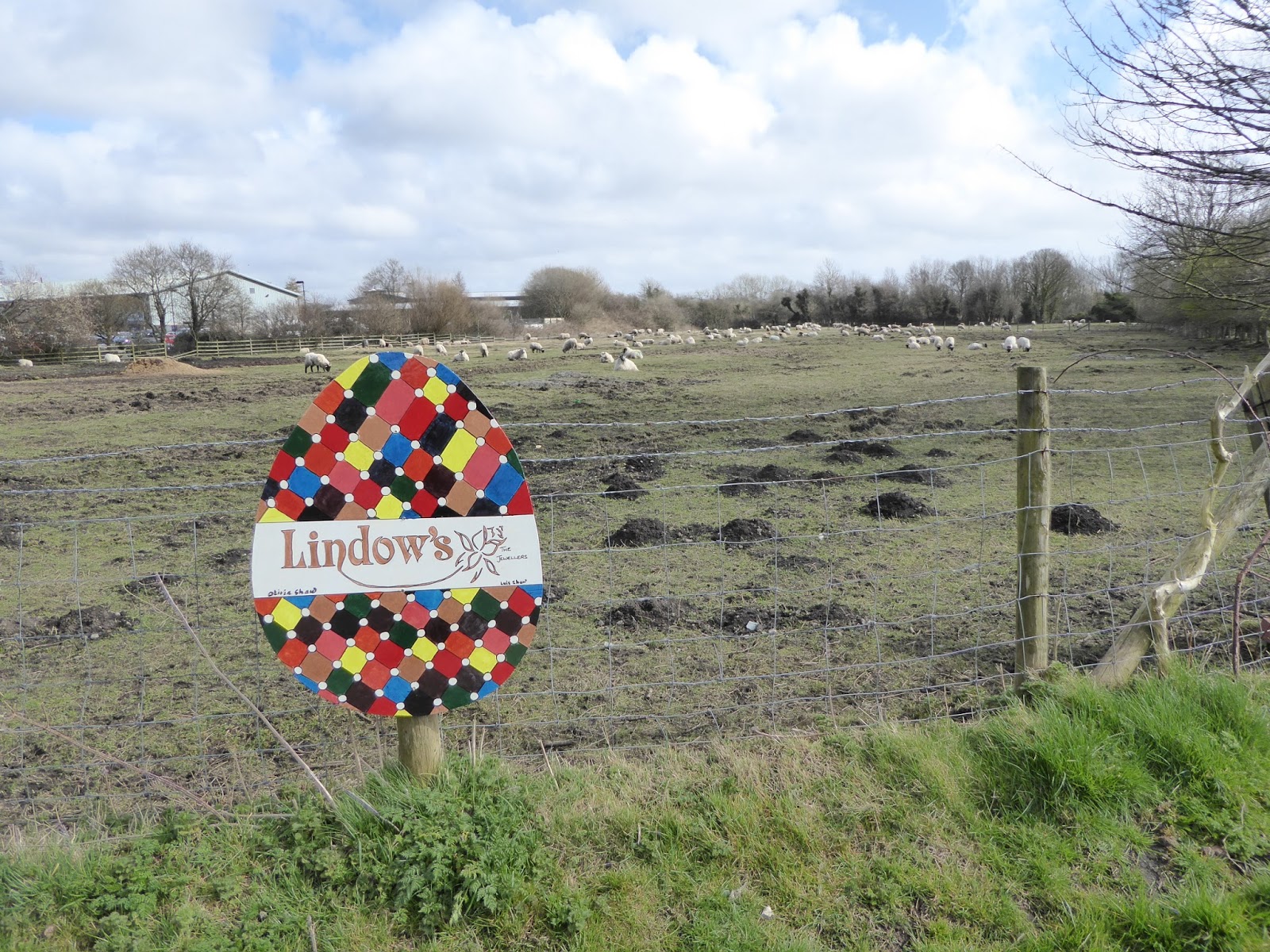
Lindow's, the jewellers. Only sheep in the field and no sign of lambs.
The long straight canal path, how appropriate that the bikes were 'parked' by the Appleseeds the health food shops Egg
Here is one that made me laugh, the Boogle and Bump shop (clothing for little people)
Lastly it is the Ulverston Lantern Festival Egg, an annual event that takes place in September.
I was pleased to see an Easter Egg with an X, always a tricky letter for ABC Wednesday so that one is tucked away for another occasion.
An entry to ABC Wednesday, a journey through the alphabet, this week sojourning at L here
Tuesday, 27 January 2015
Cinemas
Before the Great War cinemas were being built at an ever increasing number and opening at a rate of about 60 a month, this is one such cinema and stands on the corner of Grosvenor Street and Oxford Road in Manchester. It takes part of its name from its location, The Grosvenor Picture Palace, although today it is now a Sports Pub called The Footage with two big screens for the sports enthusiast. Designed by Percy Hothersall in 1913 its green and cream faïence tiles are striking. You will observe the two sides are different
the longer one being located along Oxford Road, I rather like the stained glass circular windows. It must have looked like an entrance to another world when it was all lit up for its opening in 1915 with the historical drama Jane Shore starring Blanche Forsythe. Hothersall designed at least two other cinemas locally, one which does not survive, and the other, a 'supercinema' of 2,324 seats The Piccadilly Picture Theatre only the façade survives and it is now a retailing outlet, one the residents is Co-operative Food which also moved into an old cinema premises further north in
Carnforth. Once again only the façade survives but this has a bit of cinema history in that it stands near Carnforth station where the filming of David Lean's Brief Encounters took place in the 1945 and it stood in for 'Kent'. (Worldwide Guide to Movie Locations) Locals were used as extras so I imagine when it was screened in Carnforth the interest was not only in the film's story. I have in the past asked what the cinema was called but nobody ever seemed to know but thanks to the Cinema Treasures site I eventually discovered it was built some time pre 1923 as the Kinema (Frith postcard image here) and later renamed The Roxy it closed in the 1960s. In those early days it was one of the James Brennan's portfolio of cinemas and theatres who was sometimes called the 'cinema king' because of the number he owned in this corner of north west of England including
my local, also called the Roxy (a lot of his cinemas were called The Roxy). Here is a postcard image from possibly the 1950s and in this case the cinema survives (but not the Rose Garden) although the art deco interior has been split horizontally with the cinema now living on what used to be the balcony. This is not my nearest cinema which is a rather unadventurous multiplex but it is my cinema of choice for its atmosphere and large screen, it celebrated its 75th birthday in 2012.
the longer one being located along Oxford Road, I rather like the stained glass circular windows. It must have looked like an entrance to another world when it was all lit up for its opening in 1915 with the historical drama Jane Shore starring Blanche Forsythe. Hothersall designed at least two other cinemas locally, one which does not survive, and the other, a 'supercinema' of 2,324 seats The Piccadilly Picture Theatre only the façade survives and it is now a retailing outlet, one the residents is Co-operative Food which also moved into an old cinema premises further north in
Carnforth. Once again only the façade survives but this has a bit of cinema history in that it stands near Carnforth station where the filming of David Lean's Brief Encounters took place in the 1945 and it stood in for 'Kent'. (Worldwide Guide to Movie Locations) Locals were used as extras so I imagine when it was screened in Carnforth the interest was not only in the film's story. I have in the past asked what the cinema was called but nobody ever seemed to know but thanks to the Cinema Treasures site I eventually discovered it was built some time pre 1923 as the Kinema (Frith postcard image here) and later renamed The Roxy it closed in the 1960s. In those early days it was one of the James Brennan's portfolio of cinemas and theatres who was sometimes called the 'cinema king' because of the number he owned in this corner of north west of England including
my local, also called the Roxy (a lot of his cinemas were called The Roxy). Here is a postcard image from possibly the 1950s and in this case the cinema survives (but not the Rose Garden) although the art deco interior has been split horizontally with the cinema now living on what used to be the balcony. This is not my nearest cinema which is a rather unadventurous multiplex but it is my cinema of choice for its atmosphere and large screen, it celebrated its 75th birthday in 2012.
Labels:
Carnforth,
cinema,
Gosvenor PIcture,
Lancashire,
Manchester,
Palace,
Roxy,
Ulverston
Friday, 30 November 2012
Mountain View
| Ulverston with Dow Crag and Coniston Old Man |
The late slanting winter sun shadows the Coniston hills. The remains of ice/snow in the gullies can just be seen on the top of Coniston Old Man (right). In this early winter week the snow appears and disappears on the tops
| Looking East from Birkrigg |
although turning ones eyes to the east and the higher fells the snow ridges look suitably winter white. The wind is sharp and chill
| Birkrigg |
and this farmer is on his way home. I'm wishing I had my gloves on but imagine it is nice and cosy in his cab.
My skies to join those in SkyWatch Friday
Labels:
Birkrigg,
Coniston Old Man,
Cumbria,
Dow Crag,
Ulverston
Location:
Birkrigg, Ulverston, Cumbria LA12, UK
Saturday, 14 July 2012
Pram-bulating
An entry to Sepia Saturday "Using old images as prompts for new reflections"
From the gardens of the Schloss Belvedere and the wonderful needlework seen on the Sepia Saturday prompt picture lets journey to northern England
and wave. I'm waving at my father here but was told I used to wave at everyone from the pram; I still enjoy waving. This is Bardsea Road one Sunday in June 1950 it encompassed a walk which I would take with my mother Sadie shown here until her old age, you had to take up a brisk pace because she considered that slow walking tired her out. While browsing through the many pictures of me in a pram I noticed for the first time the pretty woven basket which seems to vary from half to brimming full.
Wheeling back in time a month to
May 1950 here at Canal Foot by the side of Morecambe Bay, the railway viaduct just visible in the background. Now there are two elements from the prompt both a pram and a blanket. My mother and her life long friends Julia and Harry Boyd share a rug while it looks as though my 'Aunt' Julia is instructing her son Roger to do something or more likely not do something, I'm an 'innocence bystander'.
Five years later and I don't think I quite fit a pram although it was good fun to roll up and down the garden path in it. The month is August and the photo says it is a warm day; I look brown so, unlike this year, it has been a good summer. I once stayed with Mrs High, the mother of my friend here Marion (who you can see is blond with complexion to match). She tried to scrub the 'dirt' off my knees in the bath until I told her it wasn't going to come off because that was me. But lets get back to the pram, I suspect this is the one from which I saw a tyre in a stream and insisted on visiting it every day which meant that the Bardsea Road walk in the first photo was one that my mother could not deviate from for some time.
Not long after this photo only the wheels survived of the pram when they were turned into Go-cart, not by me but one of the neighbourhood boys, although I did get rides on the completed construction, bliss. You never see home made go-carts today and I have no photos of these particular wheels but to relive those memories of simpler times with the help of Flickr and the National Library of Wales
The Longden Bay Go-cart Racers, September 1953 - Photographer Geoff Charles (1909-2002)
Labels:
Family,
Pram,
Sepia Saturday,
Ulverston
Location:
Ulverston, Cumbria LA12, UK
Tuesday, 13 December 2011
ABC Wednesday - VR
Travelling around Britain one of the things often seen are the letters VR on objects of a certain age. This ones glistens on one of the sides of the ornate Eastgate clock in Chester. The initials stand for Victoria Regina, and the clock was made for the occasion of Queen Victoria's 60 years on the throne, the Diamond Jubilee in 1897. The clock stands above the old Roman east entrance into the city which was widened in Georgian times but is still on the Roman wall route if you wish to walk around the walls.
Not easy to spot this VR in Ulverston until getting closer
perhaps to post some cards. And there it is on top of the wall box. You can always tell the age of a post box by which royal reign it was made as the royal cypher is displayed on them. These cast iron boxes are painted every three years and it looks as though this one has been recently done. The first Post Office wall boxes (which are mainly for rural areas) were installed in 1857 and went through many designs (mainly to try to prevent the rain getting inside) before eventually in 1887 the so called jubilee box was the end result. The jubilee referred to is Queen Victoria's Golden Jubilee (50 years on the throne).
An entry to ABC Wednesday, a journey from A to Z which this week has reached the letter V
Tuesday, 7 June 2011
ABC Wednesday - Near Ulverston
Strange sounds were heard on the upland near the small town of Ulverston where usually sheep graze, people walk their dogs and children play. Strange objects on the top making noises Boom, bang, clank clink wizz, howl. We were here on Friday when the sky was blue, the sun was warm but not a lot of wind just a
zephyr which meant that the wind was not whistling this corridor but there was still things to hear
and to see
Dancing to the sounds
Or just the closing of eyes and relaxing
But watch out for the UFOs
There is Ulverston clustered down below as the contraptions whirl on Birkrigg Common.
This was Harmonic Fields brought to the area at the beginning of June by Lieux publics (France) as part of the Lakes Alive 2011 events. 500 instruments creating a musical soundscape. Here is a video from someone who was here here at the weekend on a greyer but windier day
Visit ABC Wednesday for lots more words beginning with the letter U
Tuesday, 14 September 2010
ABC Wednesday - Immaculate
Last November this is the view of Hoad hill, bracken golden brown and a strange structure on the top. Were we heading for the moon or some other interplanetary journey? No, but there was a mystery inside for this was a repair to the 160 year old monument underneath, so what would the result be.
For the first time in over a decade the inside was open as well. Ever since it was in existence there has been a custodian in charge of opening, starting in 1850 when it was open 6 days a week and shut on Sundays. Now it is open once a week on a Sunday afternoon and on Bank Holidays from Easter to September. There has been quite a rush for the curious wanting to see what has happened inside.
There are placards and plasterwork at the bottom, all looking immaculate, but really what we all want to do is to go to the top. I remember as a child the custodian used to sell sweets, but not today. So after a wait, todays health and safety demands that only a certain number are allowed up at a time, we go up to the next level
Where we look at the rest of the 112 steps round the side we are going to climb. There is also a display about the history of Hoad whose official name is the John Barrow memorial. This is a son of Ulverston who lived from 1764-1848, leaving school to start work at 13, went on a whaling expedition to Greenland at 16, and was attached to the first British Embassy in China from 1792-94, where he learnt Mandarin Chinese and throughout his life had a fascination with China. However 1797 saw him land at the Cape of Good Hope, which had been occupied by the British because revolutionary France had occupied the Netherlands and the British did not want them landing on this strategic location at the tip of Africa. Barrow married and decided to settle in South Africa but under the Peace of Amiens, the British handed the Cape back (only temporarily as it turned out) so he returned to England in 1804. He was appointed 2nd Secretary of the Navy, a post he would hold for 40 years, where he sent expeditions into West Africa and also exploration of the Arctic by Ross, Parry and Franklin,who also tried to find the elusive north west passage. Barrow Point and Cape Barrow were named after him. He wrote a history of modern Arctic Voyages of Discovery which was published in 1846.
On his death a public subscription was started in Ulverston and a monument was erected on the hill he loved to walk on as a child. This was in the shape of the Eddystone Lighthouse standing 100 feet tall and inaugurated in 1850 to immortalize his achievements.
History over now, are you impatient to get to the top
But not to disappoint here is one of the other directions with kite flyers at the bottom of the monument
The immaculate monument, now like an Ivory Tower, a structure that generations of Ulverstonians see on the horizon when returning from away and know they will soon be home. It has never had a light at the top but it is lit up from the bottom at night and it glows in the night sky.
What a incredible difference to how it was, cracked with water leaking, the structure deteriorating inside and out.
Interested in more words starting with the letter I? Visit the participants of ABC Wednesday
Nobody had ever seen the Hoad Monument looking so white
it was immaculate. The first part to appear above the scaffolding was the copper roof cap glinting in the sunlight. Eventually, a couple of months ago the full lighthouse was revealed and on August 22 there was the official reopening, celebrated with incendiary devices, commonly called fireworks, and, nobody wanting to resist a pun, a Hoad down. For the first time in over a decade the inside was open as well. Ever since it was in existence there has been a custodian in charge of opening, starting in 1850 when it was open 6 days a week and shut on Sundays. Now it is open once a week on a Sunday afternoon and on Bank Holidays from Easter to September. There has been quite a rush for the curious wanting to see what has happened inside.
There are placards and plasterwork at the bottom, all looking immaculate, but really what we all want to do is to go to the top. I remember as a child the custodian used to sell sweets, but not today. So after a wait, todays health and safety demands that only a certain number are allowed up at a time, we go up to the next level
Where we look at the rest of the 112 steps round the side we are going to climb. There is also a display about the history of Hoad whose official name is the John Barrow memorial. This is a son of Ulverston who lived from 1764-1848, leaving school to start work at 13, went on a whaling expedition to Greenland at 16, and was attached to the first British Embassy in China from 1792-94, where he learnt Mandarin Chinese and throughout his life had a fascination with China. However 1797 saw him land at the Cape of Good Hope, which had been occupied by the British because revolutionary France had occupied the Netherlands and the British did not want them landing on this strategic location at the tip of Africa. Barrow married and decided to settle in South Africa but under the Peace of Amiens, the British handed the Cape back (only temporarily as it turned out) so he returned to England in 1804. He was appointed 2nd Secretary of the Navy, a post he would hold for 40 years, where he sent expeditions into West Africa and also exploration of the Arctic by Ross, Parry and Franklin,who also tried to find the elusive north west passage. Barrow Point and Cape Barrow were named after him. He wrote a history of modern Arctic Voyages of Discovery which was published in 1846.
On his death a public subscription was started in Ulverston and a monument was erected on the hill he loved to walk on as a child. This was in the shape of the Eddystone Lighthouse standing 100 feet tall and inaugurated in 1850 to immortalize his achievements.
History over now, are you impatient to get to the top
Last steps now
And able to look out of the windows, in-between gasps for breath, I like to set a good pace when for some inconceivable reason the entrance gate was opened to me to lead out the half dozen intrepid stair climbers. This is looking over Ulverston, and Glaxo's pharmaceutical plant to Chapel Island and Morecambe Bay. The view the other way to the Lakeland Hills was hazy and the sun reflected on the windows in the photos.But not to disappoint here is one of the other directions with kite flyers at the bottom of the monument
The immaculate monument, now like an Ivory Tower, a structure that generations of Ulverstonians see on the horizon when returning from away and know they will soon be home. It has never had a light at the top but it is lit up from the bottom at night and it glows in the night sky.
What a incredible difference to how it was, cracked with water leaking, the structure deteriorating inside and out.
Picture taken February 2009.
Custodians car with 19th Century Photo.
Interested in more words starting with the letter I? Visit the participants of ABC Wednesday
Subscribe to:
Posts (Atom)