Showing posts with label Harrogate. Show all posts

Tuesday, 7 April 2015

Mehodist Chapels

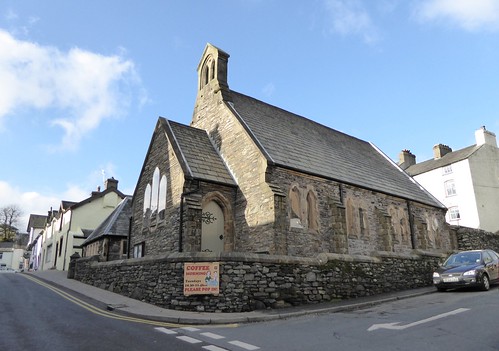
Methodist Church, Broughton
As we have just celebrated Easter it may be just the time to feature Methodist Chapels, so here is the one in Broughton in Furness, Cumbria.  If  passing by on a Tuesday then
the sign welcomes anyone to pop in for Morning Coffee.  The chapel has stood here on Princes Street since 1875 and was gifted by Nathaniel Caine (1808-1877) a Liverpool industrialist and co-owner of the nearby Hodbarrow Mines who considered the religious facilities in the area inadequate. He funded a number of nonconformist chapels in the 1860s and 1870s and although he himself was a baptist his faith was such he readily funded chapel buildings for those denominations that needed them. 

The reason there was a shortage of religious building here in the second half of the 19th Century was the large influx of workers and their families to work in the booming local industries.   The chapel cost £2,500 to build and is made of the very durable Kirkby Stone, still quarried locally.

In contrast the Marshside Methodist chapel, located in one of the hamlets that makes up the village of Kirkby
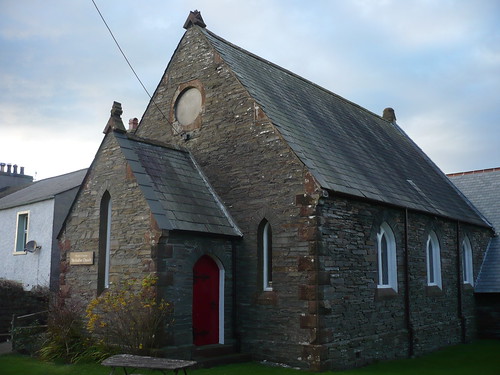
Kirkby Methodist Church
Marshside Methodist Chapel
was built in 1870 but with only the slate roof tiles from the local Burlington Quarry and the building is made of sandstone is from St Bees further up the coast. It was a similar story of workers emigrating into the area, mostly here from Wales and Cornwall.  They would come from different traditions of Methodism, the Welsh tending to be Calvanist Mehodist and those from Cornwall, Primitive Methodists but I guess they would all join together in worship here.

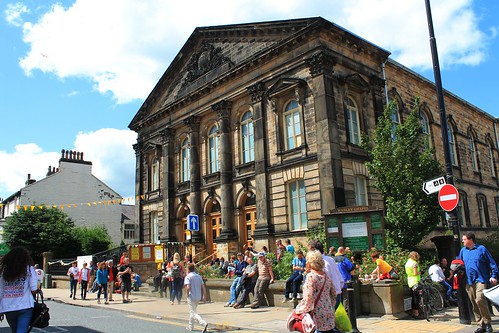
These simple chapels contrast with the one in Harrogate, Yorkshire,  built in 1862 and
Wesley Chapel, Harrogate
a much larger and ornate example.  The heartlands of Methodism were the north of England, Cornwall and Wales, its egalitarian message contrasting with the established church which it split from.  This like the first chapel I showed in Broughton both started life as Wesleyan Methodist Chapels.  In 1932 all the strands of Methodism reunited and today are simply called the Methodist Church of Great Britain.

The archives of the Methodist Church and  the papers of the founder of the religion John Wesley are held by the John Rylands Library of Manchester University which opened its doors in 1900 and also contains Wesley's statue alongside John Wycliff, William Shakespeare, John Dalton, William Caxton, Johannes Gutenberg and Francis Bacon. The choices of statues are explained here. This cathedral of  books has a magnificent reading room -
"The John Rylands Library" by Mdbeckwith - Licensed under CC BY 3.0 via Wikimedia Commons"
Year ago I was sent on a course to the Rylands Library and I can't for the life of me remember what it was about but vividly remember enjoying my meander around the library in the lunch break.

An entry to ABC Wednesday, a journey through the alphabet, this week sojourning at M here
 

Tuesday, 3 February 2015

Duttons and Dogs

Duttons for Buttons in Harrogate and their display window homage to the bicycle and the Tour which was about to race into the town. Kate Davies Designs calls the Dutton shops the spiritual home of the button on her blog here and the place to find that elusive button to make up a set here.  This family business have three haberdashery shops within a small area of Yorkshire, some of their stock can be browsed on-line here but as they have more than 12,000 designs in stock it is the tip of the iceberg.  Watched Pirates of the Caribbean? I'll pay more attention to the buttons rather than Johnny Depp next time as I read on their site that Duttons were the people who supplied the buttons for the costumes.

The companion cat was a popular choice for last week's ABC Wednesday contributors so of course we can't leave out the companion for this week's letter and
this 'cute as a button' little dog being taken for a walk along the Millom Embankment with the Lakeland fells in the distance.

An entry to ABC Wednesday, a journey through the alphabet, this week sojourning at D here

Tuesday, 30 December 2014

Yellow Bikes and Jerseys

When the Tour de France visited Yorkshire with two stages over two days Yorkshire folk got rather excited and painted yellow bicycles popped up all over the towns and countryside.  An appeal went out to knitters for 2,500 little jumpers portraying the famous tour jerseys, yellow for the race leader, polka dot for the best climber, green for the most consistent points finisher  and white for the best young rider.  The knitters went to work with gusto and eventually 23,453 were actually knitted and strung along the streets of towns and villages.
The bicycles appeared decorated and in various stages of repair or
disrepair
Come the day the 'Games Makers' were wearing their yellow t-shirts, here is one directing people traffic from Harrogate railway station.
and of course there was a good spread of spectators sporting Tour yellow t-shirts and French symbols such as French berets (above) blue and white stripped jerseys and even the occasional string of onions.
There was also a good smattering of punning local businesses signs such as this Indian restaurant featuring Bradley Wiggins (nickname Wiggo) the 2012 Yellow Jersey winner.
The banners were out as the race approached and this one says "Bonjour la France et Mémé" which of course is 'Hello France' but also "and Grandma", I wonder where she was?
Eventually all the build up was over and the race was on.  The true yellow jersey (briefly held by Marcel Kittel here) making the starting roll out from York before the proper racing began.  While watching the race where is the best place to leave your bike?
Well possibly chained to church fencing and this particular church is St Clements, not the famous London one whose bells said oranges and lemons but they have however chimed in with lemon yellow flags.

An entry to ABC Wednesday, a journey through the alphabet, this week sojourning at Y here