Showing posts with label Broughton in Furness. Show all posts

Tuesday, 23 May 2017

Timber Trees and Tractors

A beech tree felled because of its decayed core is neatly sliced and gives the passer by its last hurrah with a golden red glow, almost the colour of its autumn leaves.  I wonder if a local woodturner is going to be a lucky recipient of some of this timber.

The farmers are busy at this time of year
and this one in his tractor was spreading fertilizer while his dog burned up energy covering more distance than him racing up and down the field.  The white blossom of the hawthorn trees can be seen scattered over the Lickle Valley, although as the morning was full of heavy showers of rain they don't stand out as much as they do in reality.  If I had only taken my walk in what turned out to be a sunny afternoon
like this one was.  Tranquil Broughton Towers pond but I didn't sit on the seat for it was more interesting at the waters edge where the tadpoles were in perpetual motion unlike 
this piece of machinery which looks to be more greenhouse than tractor. 

An entry to ABC Wednesday, a journey through the alphabet, this week sojourning at T here
 

Tuesday, 14 March 2017

A trio of Js

I am sure these telegraph poles would be raised in a jiffy with the help of the JCB digger.  There was a strong smell of creosote on the air when I came close to take this photograph one Sunday when the workers were enjoying a justifiable rest.
Maybe they were enjoying their leisure in a garden although this photo of a jug on garden steps was taken in December, more the time of year to browse the seed catalogues.
Perhaps they walked to church in the spring sunshine, going through a door created by a joiner.  

An entry to ABC Wednesday, a journey through the alphabet, this week sojourning at J here

Tuesday, 24 May 2016

Church Tower

A carpet of crocus and a scattering of daffodils surround the tombs of St Mary Magdalene churchyard.  Here I stand on the west side of the church looking towards the tower. A church has stood here since the 12th century, although little remains of it after an extension in the 16th century, alterations in the 18th century and lastly a rebuilding in 1873.  The squat saddleback tower we see today is by Austin and Paley, a duo of much loved local architects, and replaced the old one in 1900-1.
It is difficult to get a photograph of the whole church as it is surrounded by trees and from this angle the tower saddleback cannot be seen but lets head out towards the gate for another angle, look up to check the time
and see a homily on the tower "Watch for ye know not the hour",  perhaps something to meditate on as I take a turn around the tombstones
while enjoying a day of spring sunshine and flowers.
Here can be seen how well the sturdy tower sits with the church as they nestle in the hollow of the valley south of the village of Broughton in Furness.

An entry to ABC Wednesday, a journey through the alphabet, this week sojourning at T here


Tuesday, 9 February 2016

Excavation

As the saying goes - I love work and could sit and watch it all day - or in my case take a photograph.  Highway Maintenance are on the corner of one of the narrow streets of Broughton in Furness and begin to dig off the surface to excavate the road. Of course there is the obligatory
huddle to discuss the job in hand or perhaps the latest gossip.  But no, roll of drums and dramatic music,
here comes an elephantine earthmover.

An entry to ABC Wednesday, a journey through the alphabet, this week sojourning at E here 

Tuesday, 7 April 2015

Mehodist Chapels

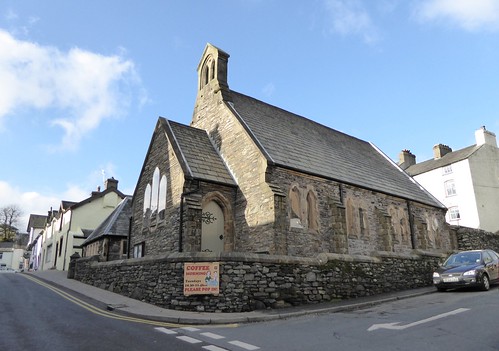
Methodist Church, Broughton
As we have just celebrated Easter it may be just the time to feature Methodist Chapels, so here is the one in Broughton in Furness, Cumbria.  If  passing by on a Tuesday then
the sign welcomes anyone to pop in for Morning Coffee.  The chapel has stood here on Princes Street since 1875 and was gifted by Nathaniel Caine (1808-1877) a Liverpool industrialist and co-owner of the nearby Hodbarrow Mines who considered the religious facilities in the area inadequate. He funded a number of nonconformist chapels in the 1860s and 1870s and although he himself was a baptist his faith was such he readily funded chapel buildings for those denominations that needed them. 

The reason there was a shortage of religious building here in the second half of the 19th Century was the large influx of workers and their families to work in the booming local industries.   The chapel cost £2,500 to build and is made of the very durable Kirkby Stone, still quarried locally.

In contrast the Marshside Methodist chapel, located in one of the hamlets that makes up the village of Kirkby
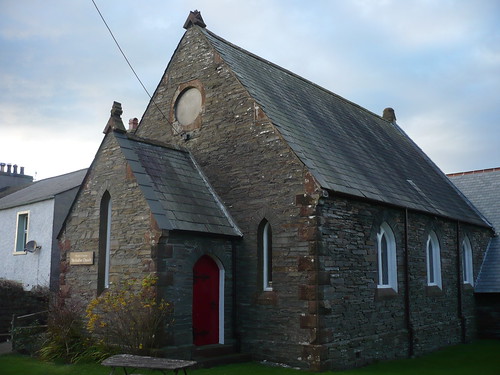
Kirkby Methodist Church
Marshside Methodist Chapel
was built in 1870 but with only the slate roof tiles from the local Burlington Quarry and the building is made of sandstone is from St Bees further up the coast. It was a similar story of workers emigrating into the area, mostly here from Wales and Cornwall.  They would come from different traditions of Methodism, the Welsh tending to be Calvanist Mehodist and those from Cornwall, Primitive Methodists but I guess they would all join together in worship here.

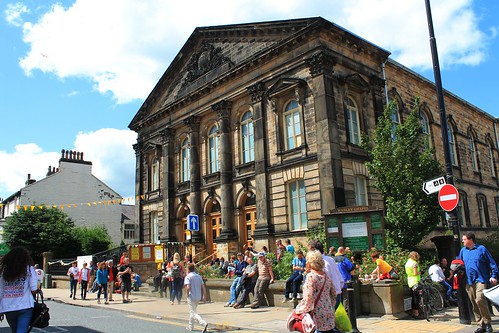
These simple chapels contrast with the one in Harrogate, Yorkshire,  built in 1862 and
Wesley Chapel, Harrogate
a much larger and ornate example.  The heartlands of Methodism were the north of England, Cornwall and Wales, its egalitarian message contrasting with the established church which it split from.  This like the first chapel I showed in Broughton both started life as Wesleyan Methodist Chapels.  In 1932 all the strands of Methodism reunited and today are simply called the Methodist Church of Great Britain.

The archives of the Methodist Church and  the papers of the founder of the religion John Wesley are held by the John Rylands Library of Manchester University which opened its doors in 1900 and also contains Wesley's statue alongside John Wycliff, William Shakespeare, John Dalton, William Caxton, Johannes Gutenberg and Francis Bacon. The choices of statues are explained here. This cathedral of  books has a magnificent reading room -
"The John Rylands Library" by Mdbeckwith - Licensed under CC BY 3.0 via Wikimedia Commons"
Year ago I was sent on a course to the Rylands Library and I can't for the life of me remember what it was about but vividly remember enjoying my meander around the library in the lunch break.

An entry to ABC Wednesday, a journey through the alphabet, this week sojourning at M here
 

Tuesday, 9 July 2013

Lets Zigzag

Smardale, Cumbria
Here is the letter Z in limestone gently zigzagging up the hill  or for our purposes zigzagging down also a good way for humans to come down a steep hill.   Now what else can I find, oh yes
Hodbarrow Point, Cumbria
a natural zigzag around a rock-pool.
Woodbridge Station, Suffolk
An ornate zigzagging awning on Woodbridge station, a pleasant place to wait for a train because one can watch the yachts bobbing about on the water to pass the time, a couple of these people are doing that very thing.  Getting dizzy with all this zigzagging perhaps I'll move to the zany
 A wall walking sheep.   The grass is always greener on the other side. 
Broughton-in-Furness, Cumbria
And lastly a zany clown, at least I think that is what it is supposed to be.  The stall in front of the obelisk is doing a plant swap although there seemed to be more chatting than swapping.  The clown may have had something to do with the candy floss stall hidden at the back. I can never resist candy floss.  Phew that is the tricky letter Z over for another round of ABC.   

An entry to ABC Wednesday where the end of the alphabet has been reached. 
Are you in for the next round? 


Wednesday, 29 May 2013

Anyone for Tennis?

Last Autumn I passed by the tennis courts.   They lay in silent shadow amongst the tall trees and turning colours, the winter lay in wait.  It took its time in going but now in the
sunshine of Spring  it looks like is time to toss up a few balls and look forward to a long summer of games.  Anyone for Tennis.?

An entry to ABC Wednesday - a journey through the alphabet.

Tuesday, 17 August 2010

ABC Wednesday - Elements

 Coniston Water
The elements as described in ancient and medieval philosophy were earth, air, fire and water from which they considered all other substances were composed. Later a fifth element was added called quintessence, or quinta essentia, supposed by Aristotle to permeate everything.  Well this is the quintessence of a  hot and sunny Sunday when people head for the water. They were 'in their element', sailing and swimming. although the boy at the bottom of the photo was not quite prepared for how icy cool a lake fed by mountain streams can be and was heading for shore. He shared his experience with us as he came ashore .
An aerial and elegant master of the elements, the golden ringed dragonfly (cordulegaster boltonii) who lives by mountain streams and heathland, I tried to get closer but the crunch on the rocky path alerted it and it resumed its patrol up and down the the bracken and stream .
Kikby Moor
Earth, air and water all in one picture. The spinning wind turbines on wet moorland and gathering clouds, we were 'braving the elements' on this walk last week.

That leaves one element left, fire,
 Broughton in Furness
no flames here though, because there are 10 retained fire-fighters to put them out, and on the left is their training tower. Retained fire-fighters are people who have full time jobs but are on call and when that call comes are ready to drop everything to become part of a team to fight the element of fire.
Time to take a canoe out of its element and natural environment where it glides through the water carrying its passengers, to four people carrying in onto the solid earth, dry land.  The end of an enjoyable day on the water.  Time for home.

Eager to see more of the participants of ABC Wednesday and what words they have envisaged beginning with E?  Then visit here.

Monday, 10 August 2009

The Prince Run In the Points

Sunday's local celebration of cricket that is the Jimmy Hull Trophy knock out. A short form of cricket which is 7 players a team and limited runs per player. The teams, as in the best of traditions, are from the local pubs. Here is my local the Prince of Wales, having reached the semi finals, fielding and the Old Kings Head trying to make a decent score. Black Combe, cloud coming in, is in the background.
The latest recruit to play for the Prince getting the score running in the right direction.
The score board ticking nicely away, while the crowd took full advantage of the bar and barbecue. The Prince win but the team to be met in the final is the favorite to win - The Blacksmiths Arms. Some good bowling and the Prince had 77 to beat, a gettable target.
4 runs to go and 5 wickets down. End result 81 for 5. Hurray. Much celebration, and the trophy won. Linda will enjoy polishing it to gleam in the trophy cupboard. It does however have a cricket ball shaped dent in it which it gained on this day. Everyone agreed this adds a touch of authenticity to the trophy.