Showing posts with label Leeds-Liverpool Canal. Show all posts

Tuesday, 7 March 2017

Ing, Inn and In

A late summer's day on the Leeds-Liverpool Canal with a narrow boat leaving St Ann's Ing Lock, which has the smallest rise on the canal of 4 foot and six inches so it must be one of the quickest locks to get through. Ing or ings means a meadow near a watercourse, the unsaid is that it is probably a very wet meadow.  This one is between canal and river.  I wondered about the St Ann connection but could find nothing but I know there many sacred spring wells named after her throughout the country. Perhaps she is associated with freshwater.
If you wanted more than freshwater then The Boathouse Inn might be just the place to imbibe something else.  I mentioned the nearby river.  What might be found there?
Well surprisingly a cat in a bath.  This is one of the sculptures on the River Aire Sculpture Trail.

An entry to ABC Wednesday, a journey through the alphabet, this week sojourning at I here


Tuesday, 8 November 2016

Five Rise Lock

Bingley Five Rise Locks, not the biggest in the UK but the steepest rising nearly 60 feet (16 metres) over a distance of 320 ft (97 metres).  The crowds turned out in 1774 when it opened to see this wonder of the waterways and people still come to see a piece of working history.
At the top the plaque not only mentions the Leeds to Liverpool Canal's first engineer who designed the locks, John Longbotham, but also credits the local stonemasons whose work can still be seen for the locks retain most of their original stonework
There have been modern additions such as the metal lock ladders so if anyone falls in they can get out easily (in the 18th century you would have had to haul yourself up the lock gates).  The lock gates of course haven't lasted

but their replacements are made of oak like the originals.
Here is a boat tying up at the bottom ready to make the journey up; no tripping up over an excitable dog because it has been tied up first
and was waiting patiently to get back on board.

 The boats coming down made their way out (the water can be seen gushing down in lock). The journey down takes 20-30 minutes now the locks are ready for those wanting to take the journey up however
this will take longer,  between 45 minutes and 1 hour.
but there will be company because they go up two by two
not to mention the many curious onlookers like me.

They reach the calm waters of the canal at the top to carry them on their way
but my destination was the tea room on the opposite bank which in past times was the stable block for horses.

An entry to ABC Wednesday, a journey through the alphabet, this week sojourning at R here


Tuesday, 27 September 2016

Leeds Link

Navigable water once determined the location and growth of towns and cities. The city of Leeds was no exception for it grew from a small market town on the Rive Aire trading wool in the West Riding of Yorkshire to expanding in the boom times of the mills of the Industrial Revolution and trading with the world. Today it is the UK's fourth largest urban economy.  Here at Granary Wharf near the city centre the whole area has undergone a massive regeneration since 2009 with residential building, restaurants, hotels, bars etc. The photograph above shows on the left the copper cladding and cedar panels of Waterman's Place apartments. The dome in the middle is the recently completed southern entrance to Leeds Railway station consisting of 2000 pieces of steel which sit on top of the Victorian viaduct of 1869. When you take the path towards the station entrance with its escalators before you get to it the first amazing sight is of the rushing waters of the River Aire cascade down to the left under the viaduct, or what is called locally the 'dark arches'.

But let me take you away from here
 past the yarn bombed boat
and away from modernity and continuing along the waterside.  This is the short canal that was built by the Aire and Calder Navigation Company to link the riverside industries to the Leeds-Liverpool canal. A lock separates the two waterways
but this is Lock Number 2 - Office Lock, so named because the bridge I am taking this photo from is where the Canal Offices are.
and the mile post tells one how far it will be before reaching Liverpool. A local wag saw me taking a photo of this and dryly said "there will be another one in a mile".
Millennium Milepost for Route 66 'The Fossil Tree'
But that is not the only way for we are also on Route 66, unfortunately not the one where one can
"take that California trip", to "get your kicks on Route 66" but a cycle route that crosses England from Manchester on the west side to Hull in the east (Spurn Head) and spends 13 of its 132 miles peddling alongside the canal.
 But I'm walking away from Leeds and looking back at the Italianate chimneys of what was the Tower Works whose Victorian owner was so fascinated by Renaissance Italy he built his chimneys in that style. The white modern building is Bridgewater Place, nicknamed locally 'The Dalek'
The canal towpath is also popular with runners so I could not resist a reflecting bridge and a red topped runner photograph, happily despite being a bit slow I got him in the picture.
St Anne's Ing Lock (Lock 3)
Canal boating in contrast to cycling and running is languid leisure interspersed with great activity when going through the lock systems (a total of 91 of varying flights on the full stretch of canal).
Oddy Two Rise Lock (Locks 4 and 5)
Being an urban area there are splashes of graffiti along the start of the canal, especially where concrete road bridges have been built over it but some are on a different scale altogether
like this funky frog enjoying his canal side view.

An entry to ABC Wednesday, a journey through the alphabet, this week sojourning at L here 


Tuesday, 13 September 2016

Junction

From a distance this is a typical canal view complete with a couple of boats and a bridge but lets stroll nearer
to Bridge Number 208 on the Leeds-Liverpool Canal, a modern building reflected beyond, but take a different perspective from the other side
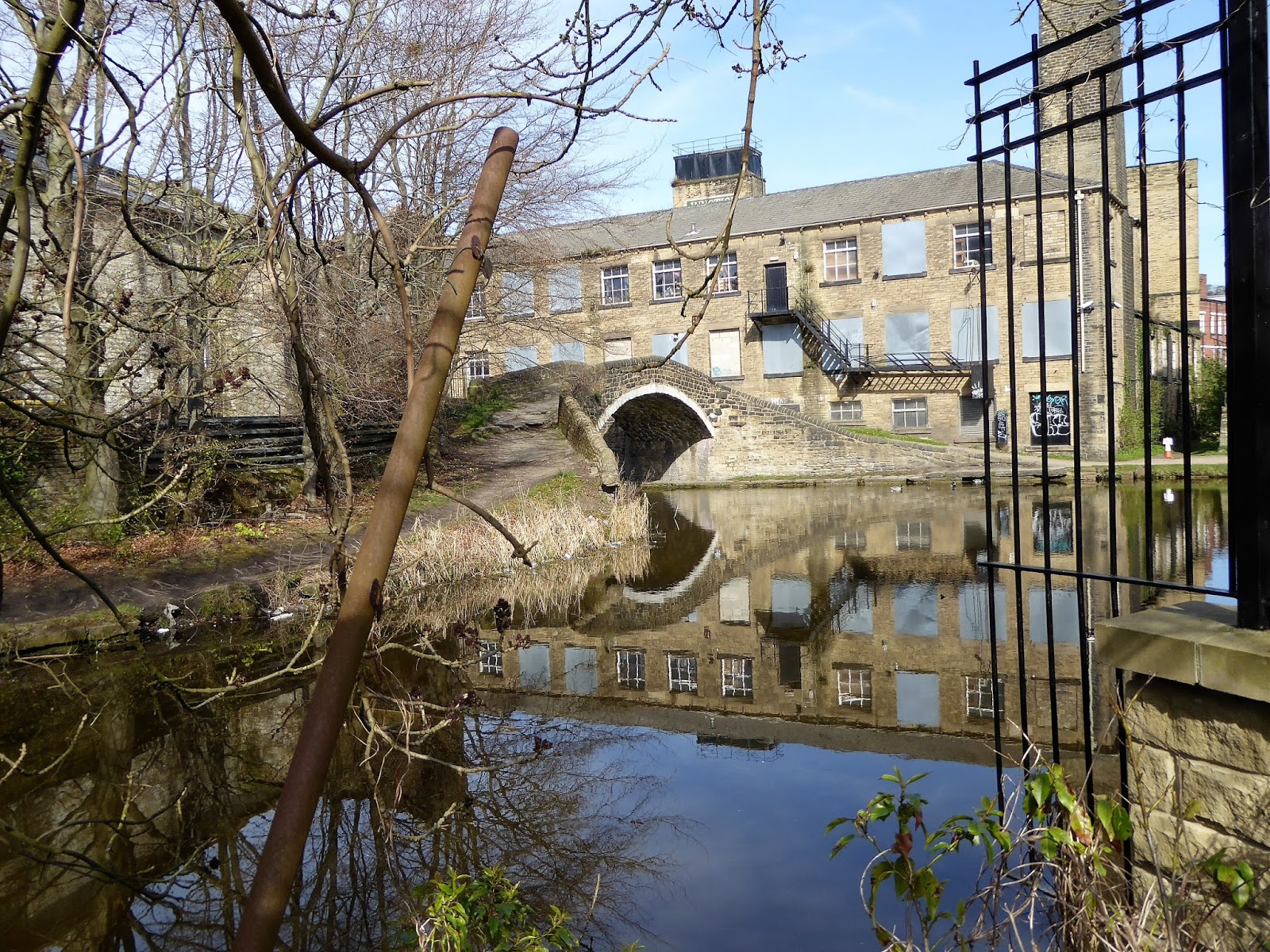
as it would have appeared in the 18th Century, although there would have been no trees and the house would not be falling into dereliction.  Both structures were built in 1774 but whereas Junction Bridge is a historically listed and protected, surprisingly Junction House is not.  In its time it has been a warehouse and home to millwrights and engineers and in the 19th Century one half was lodgings for old boatmen and the other half housed a canal toll office.
The bridge is structurally sound but in the 1970s rather than sympathetically restoring the sets they just slapped concrete on it. 
This stretch of water is the reason it gets the name Junction.  I managed to squeeze into a bit of banking to get the bridge into the photograph but the more pristine view without all the metal
would be this.  What at the time was the junction of the Leeds-Liverpool Canal with the Bradford Canal and at the height of the Industrial Revolution mills would have been spinning wool and this little corner would have been throbbing with the activity of industry and transport.  Problems with the water supply to the Bradford Canal closed it in 1867 but despite a stretch reopening it proved unprofitable and closed for good in 1922.  All that is left today is this 30 metres (98ft).  On the plus side there are 127 miles (204K) of the Leeds to Liverpool Canal to enjoy.  Even better with an unintended piece of synchronicity I'm spending a few days by the side of it this week.
   
An entry to ABC Wednesday, a journey through the alphabet, this week sojourning at J here