Tucked away on a hill in Hesketh Park, Southport is the Fernley Observatory. It fell into disrepair in the 1970s but this listed building was refurbished in 2007 and is once more operational with its 6" refracting telescope being used by the Southport Astronomical Society. The park it stands in is named after the Rev Charles Hesketh who donated the land, the observatory is named after a local Methodist and philanthropist who was involved with the setting up and operating Hesketh Park and donated the Meteorological and Astronomical Observatory in 1871.
I would have liked to take a trip up the stairs to have a look inside but alas it was not open. If I had been fortunate then I would have seen inscribed around the dome Psalm XX1X-1 "The Heavens declare the glory of God; And the firmament showeth his handwork".
Today observatories are more likely to be found on the tops of mountains rather than hills but the one glanced through the pillars on this hill on a hazy day is a more famous name than the one is Southport
Helpfully this woman is pointing at the name above the doorways.
The Royal Observatory, Greenwich which was founded in 1675 when the first Astronomer Royal was appointed. The building takes his name of Flamsteed House. Its original purpose was to improve navigation at sea so that an exact position of east and west could be found by astronomical means and to discover the "so much desired longitude of places" and is the home of Greenwich Mean Time.
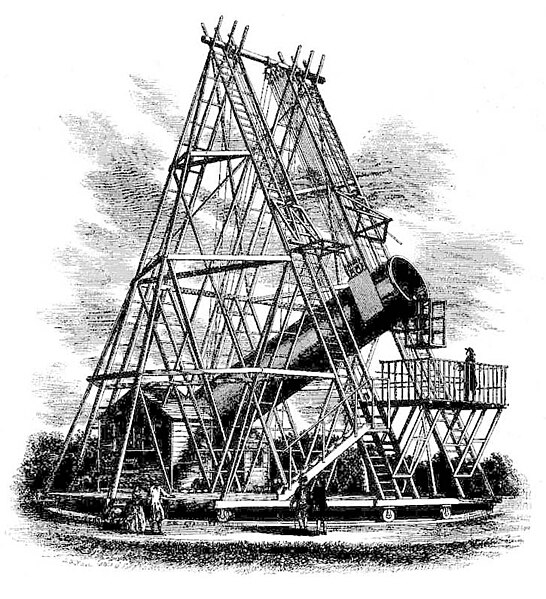
The scientific work of the Royal Observatory was relocated in the 20th Century and Greenwich itself is now a tourist attraction. There is a pleasant garden at the back here but the thing of most excitement to me was the remains of William Herschel's telescope seen in the foreground. This is the remaining section of the 40 ft (12m) reflecting telescope built for William Herschel who became famous for his discovery of the planet Uranus in 1781. At the time the telescope was the largest in the world and was paid for by King George III at a cost of £4000.

Completed in 1789 and erected at Herschel's home near Slough (30 miles east of Greenwich). It soon became a tourist attraction even being marked on the 1830 Ordnance Survey map. It was difficult to set up and maintain and his son dismantled it in 1840 then most of the Tube was destroyed when a tree fell on it 30 years later. I imagine that William Herschel's sister would have also looked through this telescope as she was also an accomplished astronomer discovering many comets.
Going inside the Observatory and up the stairs is this wonderful walnut panelled room with soaring windows, just the place to look at the sky.
Time to put our feet up outside the Astronomy Café at the Royal Observatory Here stands the Gagarin Statue and this part of Flamsteed House has now been renamed Gagarin Terrace. The zinc alloy
statue was unveiled by Yuri Gagarin's daughter Elena in March 2013. It
is an exhibition copy of the statue made by Anatoly Novikov installed at
Lyubertsy (just outside Moscow) which is where Gagarin trained as a
steel foundry worker aged 15-16.
 |
| Posters in the Astronomy Café |
After his flight into space Gagarin was invited to visit Manchester by the Foundry Worker's Union, which when he accepted was extended to a state visit to London and he made his two day visit in July 1961. These posters celebrate the occasion when the crowds came out to see the first man in space. an observer of the stars and the dream that one day we will travel there.


.jpg)