Showing posts with label Winchester. Show all posts

Tuesday, 1 April 2014

Libraries Through the Lens

Squeezed in between more modern structures this little building caught my attention while in London at the weekend.  I wondered what it was, but not for long,  because the sign above the left door says "Public Library".  Looks very inviting doesn't it?  The architect was Sir Alfred Brumwell Thomas (1868-1948) who was, as can be seen, a fan of the baroque revival style. Built at the beginning of the 20th Century it is one of the libraries funded by the great philanthropist Andrew Carnegie. He rarely turned down requests for a grant to build a library , the only stipulation was that the local authority would fund its upkeep.  Large parts of the English speaking world have Carnegie Libraries, including my own town. If he was around today doing the same thing these buildings would be very functional but most that were built under his inspired idea to give access to books to all were places you could both learn and dream.   What other purpose could that cupola have but be one to dream under especially when it looks like this inside
This interior view is from The Greenwich Phantom's blog who marvels at the three domes in one building here and appropriately calls it a Greenwich Secret.  If I had known there was such an interior I would have made my way through that public library door to marvel.
Built on a rather grander scale is Liverpool's Central Library, the largest of the cities 22 libraries. It is located in the rows of classical buildings on William Brown Street and has recently been reopened after extensive interior refurbishment last year. I think the rotunda is the reading room but the entrance is the one with the umbrella tables on the left. How very civilized, you could sit and read your book there in the sunshine. The refurbishment also introduced a roof terrace where views of the city can be gained and a literary pavement into the building which can be seen on the BBC's 'In Pictures' views of the £50M restoration here. Always a joy to hear about restoration rather than closure of a library.
 Lastly we have Winchester Library which has been re-branded as the Winchester Discovery Centre, the photo taken at sunset when the exterior floodlights were coming on.  Located in a building that is a former Corn Exchange from 1838, like the other libraries I have shown it is a listed building, but unlike the others its one I have actually been inside.  It is both a lending and reference library but they also have a small art gallery on the top floor with a interesting exhibition programme,
Demco Interiors photograph
up those stairs. It also has a performance hall, shop and café;  lots of discovering time could be spent in here. 

An entry to ABC Wednesday, a journey through the alphabet, this week sojourning at L here.
http://abcwednesday-mrsnesbitt.blogspot.co.uk/2014/04/l-is-for-lots.html


Tuesday, 16 August 2011

ABC Wednesday - Embroidery

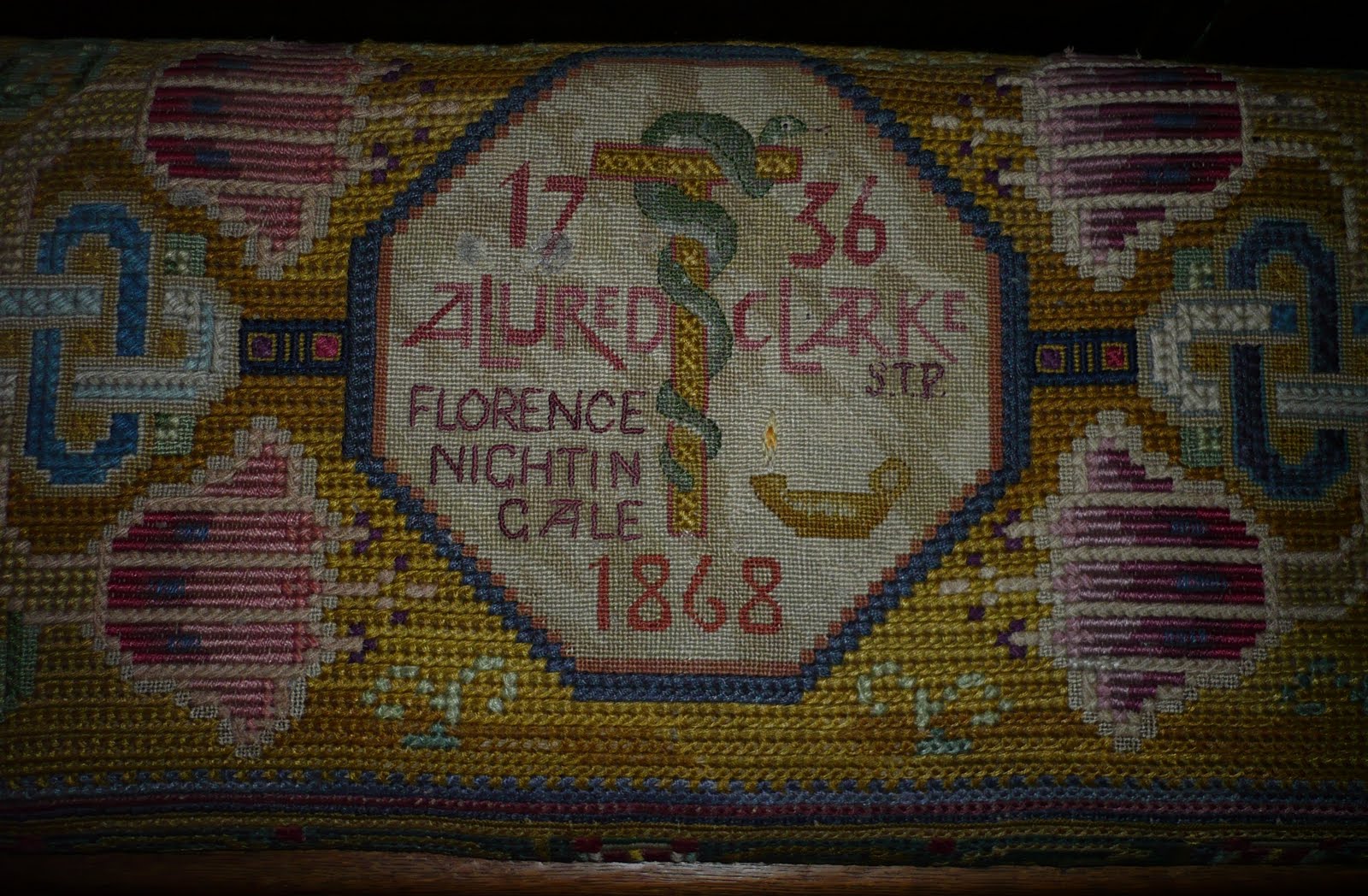
Embroidery is one of the oldest arts, and a perishable one, what remains from past ages are very precious. Heraldic and Ecclesiastical embroidery was full of the splendour of gold and silver thread but these cushions from the choir stalls of Winchester Cathedral are not luxurious but tell stories and show off the art of needlecraft. The Winchester Cathedral Broderers' Group was founded in 1931 and produced over 600 kneelers, canvas work, cushions and alms bags for the building.  When the cushions that I show were created in the 1930s they were originally laid out on the choir benches to tell a linear historic story, but to prevent wear today they are moved around.  It must be quite interesting for the choristers, as the cushions are moved, to see who they are sitting on today.  I don't think anyone would have be able to 'sit' upon Henry Beaufort (1375-1447), the embroidery shows his cardinal hat, unusually he was both a cardinal bishop and a Plantagenet (his half brother was Henry IV),  heavily involved in the politics of the time and also went into battle. He is possibly most famous for being the interrogator of Joan of Arc and instrumental in condemning  her to death.
It is interesting to see how each Borderer interpreted their story.  Here is Henry VIII, a Tudor and the red dragon of Wales.
The date on this cushion of 1642 is the start of the English Civil War


The first date of 1736 is the date the fund raising work of the Rev Alured Carke came to fruition with the admittance of the first patient into the first hospital founded in Winchester.  The second name will be more familiar, Florence Nightingale, the lady with the lamp, and one of the founders of modern nursing. I do not know the significance of the second date, 1868, but the 1880s was when Florence Nightingale introduced trained nurses into they hospital system so perhaps that is when they arrived at the Winchester Infirmary.

So there is a random selection of ecclesiastical cushions, unfortunately I did not take any pictures of the choir stalls because I was taken with the glitter of the eagle on the lectern in there

Enter ABC Wednesday to see more words starting with the letter E


Tuesday, 2 August 2011

ABC Wednesday - Clock

The Winchester clock, recently repaired,  restored and in place again on its gilded timber bracket. The building was originally the 'new' Guidhall built in 1713 now it is the Lloyds TSB bank and the present Guildhall is a much larger and grander building.

The statue is of Queen Anne, the last Stuart monarch  and says in Latin "Anna Regina, Anna Pacifica", which I think translates as "Ann queen, Ann peacefully".  Not that she had a peaceful life but the burgers of Winchester wished her this. Here is a sketch of the Guildhall
  as it originally appeared when the coat of arms of the City of Winchester looked like this
and in fact the city still continues to use the 16th Century arms in its original form without adding crests or motto. Winchester is the ancient capital of England  and the design features the Royal Lions or the Lions of England

Come over to ABC Wednesday where there are lots more words starting with C

Tuesday, 21 December 2010

ABC Wednesday - Winchester

As can be seen looking at the narrow main street there is a reason why Winchester has a park and ride system. Calling in here on the way back from the summer holidays we judged that three hours would be enough time to have a look round, wrong.  This city was the capital Wessex which became the dominant kingdom under King Alfred and was later the capital of England until the 12th century. So even if you ignore the shopping, coffee shops, pubs and restaurants history has left a lot to see. Go up this street and through an
arch of what used to be part of  the Norman castle entrance, now just a passing place to arrive at
the Great Hall which houses one of the treasures of Winchester, hanging high on a wall is the
Round Table. That of the Arthurian legend of knights, magic and the quest for the holy grail. It measures 18 feet across and would originally have had 12 legs and seats for 25 people (24 knights and 1 king).  It is not THE table and has been dated by dendrochronology as being made  some time between 1250-1280. The Round Table festivals of the Middle Ages were a celebration of the Arthurian legend and consisted of jousting, feasting and dancing, a good time was had by all. This table was probably produced for such an event.  They were lavish spectaculars, René of Anjou even erected an Arthurian Castle for his Round Table celebrations in 1446.  

In 1522 Henry VIII had the Winchester Table painted for the visit of Charles V with the names of the Arthurian knights and his own portrait with the Tudor Rose (his house) in the middle. Henry was rather paranoid about the plots against him (with some reason, they were not all in his imagination), and also the legitimacy of the  house of Tudor so this would be his statement of power.

As you may observe the table could resemble a dart board and was used as that as target practice by Cromwellian Troops in the English Civil War in 1645. The holes were filled and the table was repainted again in 1789.

Moving across the town to the other centre of power in the middle ages, the cathedral which was built from 1079 onwards, it is rather an understated perpendicular style on      
the outside.  But once inside
the detail is stunning.  It also is the burial place of many famous people, such as the writers Jane Austin and Isaac Walton (who has his own chapel), and

St Swithan, probably most famous for the 'fact' that the weather on his feast day of 15 July will continue for 40 days.
St Swithun's day if thou dost rain,
Forty days it will remain.
St Swithun's day if thou be fair
For forty days 'twill rain nae mair

He was bishop of Winchester from 852-862 and wished to be buried outside but when his body was dug up and taken to an indoor shrine it started to rain, it was very wet, and a legend was born. The remains originally were enshrined behind the high altar, later removed to a marble shrine on this site, destroyed in 1538.
To head deep under the cathedral to the crypt

which often floods, stands a statue by Antony Gormley called Sound II installed 1986, also down here is a bust to the diver William Walker who worked underwater from 1906-11 underpinning the the nave and shoring up the walls of the building. Winchester Cathedral is a treasure of objects and architecture, a long time
could be spent here, but the time for our park and ride was nearly expired so a run for the bus was our next move. Always leave something for a reason to return, perhaps at a more leisurely pace.

Wander over to ABC Wednesday where there will be more words starting with the letter W.