Tuesday, 3 December 2013

The Underground Overground

This year was the 150th Anniversary of the opening of the London Underground Metropolitan Line and the Royal Mail issued a set of stamps exactly 150th years to the day on 9th January.
I move forward some years to the Russell Square Station which for any lover of tiles or fonts is a great one to visit, that and the fact that it is near the British Museum.  One of many surviving stations designed by Leslie Green in an Arts and Craft style it opened in 1906 and although the upper ticketing areas have been altered some of the station level tiling survives
The last count was 1.2 billion passenger travelling on the various lines every year.
Although I'm not going to show you any of them because I had a bit of a camera glitch so here are the approaching train lights
Goodge Street station built in 1907 was closed for alterations when we were in London but it is one of the rare stations that has a different exit to the entrance. It is also one of eight London stations that had a deep level air raid shelter built underneath it.  Unlike this one
A postcard of a 1940s book cover with everybody carrying their gas masks in a sort of idealised blitz spirit kind of way, although perhaps reality was more like this
which looks rather more uncomfortable.  The Aldwych*  Station in 1940, one of 79 Tube stations used as air raid shelters

*UPDATE:  By one of those strange coincidences of life I just noticed that one of my favourite bloggers has written about his recent visit down to the long closed Aldwych Station (pictured above)  here (with pics and Doctor Who references).

An entry to ABC Wednesday, a journey through the alphabet this week sojourning at U


Tuesday, 26 November 2013

Tour of Britain Stage Two

Timing a rolling road block relies on communication and here is one of the police bikes waiting for the next team member to take over. This means that our wait is about over to see the Tour of Britain Riders 
 The first to arrive were the breakaway here led by the An Post rider Sean Downey.  The spectators are well wrapped against the weather which had been only showery until the riders approached and then it became a deluge and it looked as though they would have their own personal rain cloud throughout the day.
This next highlight of Stage Two of the Tour of Britain in September was indicated by a rather jolly Peleton Safety official bantering with the crowd jumping off the bike to run to the junction
to indicate the direction to the peleton powering up the hill out of Whitehaven 
Bernard Eisel leading the Sky Team and his expression and rhythmic determination to hunt down the breakaway did not alter throughout the stage. 
Mark Cavendish, the Manx Missile tucked away in the middle of the peleton. Hills are not his metier but give him a nice flat finish line to aim for and whoosh.

The events marshal rides up the A595 as the last of the bunch cross the road ahead turn left,  81 of the 186 miles done but lots to come on this trip from Carlisle to Kendal down the coast and across the Lake District.
The Australian rider Steele Von Hoff must have had some mechanical problem as he was the last rider and out of contact, he danced on the peddles trying to regain the peleton.  My camera was nicely steaming up at this point. The breakaway would lead for much of the stage until they hit Honister Pass which was a popular place to watch the tour, but one that produced the worst of the Lakeland weather so its 1 in 4 gradient was also part stream.  I watched that part of the race on the TV, not outside on the big screen in Workington but gradually drying out in the comfort of a pub.

An entry to ABC Wednesday, a journey through the alphabet, this week sojourning at T


Tuesday, 19 November 2013

Saints, Sailors and Seabirds

Here is St Bega as imagined by Chris Telfer in one of his iron ore dust and resin statues. The village of St Bees is named after her and the statue was installed for the millennium, the tower of  12th Century St Bees Priory stands in the background. Legend has Bega as an Irish princess who was promised in marriage to a Viking Prince but she fled across the Irish Sea to escape her fate. The legend continues that she went to Lord Egremont to ask for land to build a priory, he joked that she could have any land that was covered in snow the following day (it was midsummer at the time).  The next day the land between the sea and the castle was covered in snow. After founding the priory pirate raids meant that the little community of nuns later moved to Northumberland. History has a Benedictine nunnery established in c650 destroyed by the Danes.
The many interesting gravestones in the churchyard include this one which is known locally as "The Sailors Grave" and commemorates the souls of the seamen from wreck of the 'Luigi Olivari', only one which could be identified, the pilot Henry Legg, and this from his pilot certificate which was kept safe enclosed in a tin in his pocket. The cross is dedicated to him and the other 11 unknown sailors.  The three shells seen on the left complement many on the back and have been there as long as anyone can remember.  The old people in the village remember them being there as children but no-one knows who put them there.
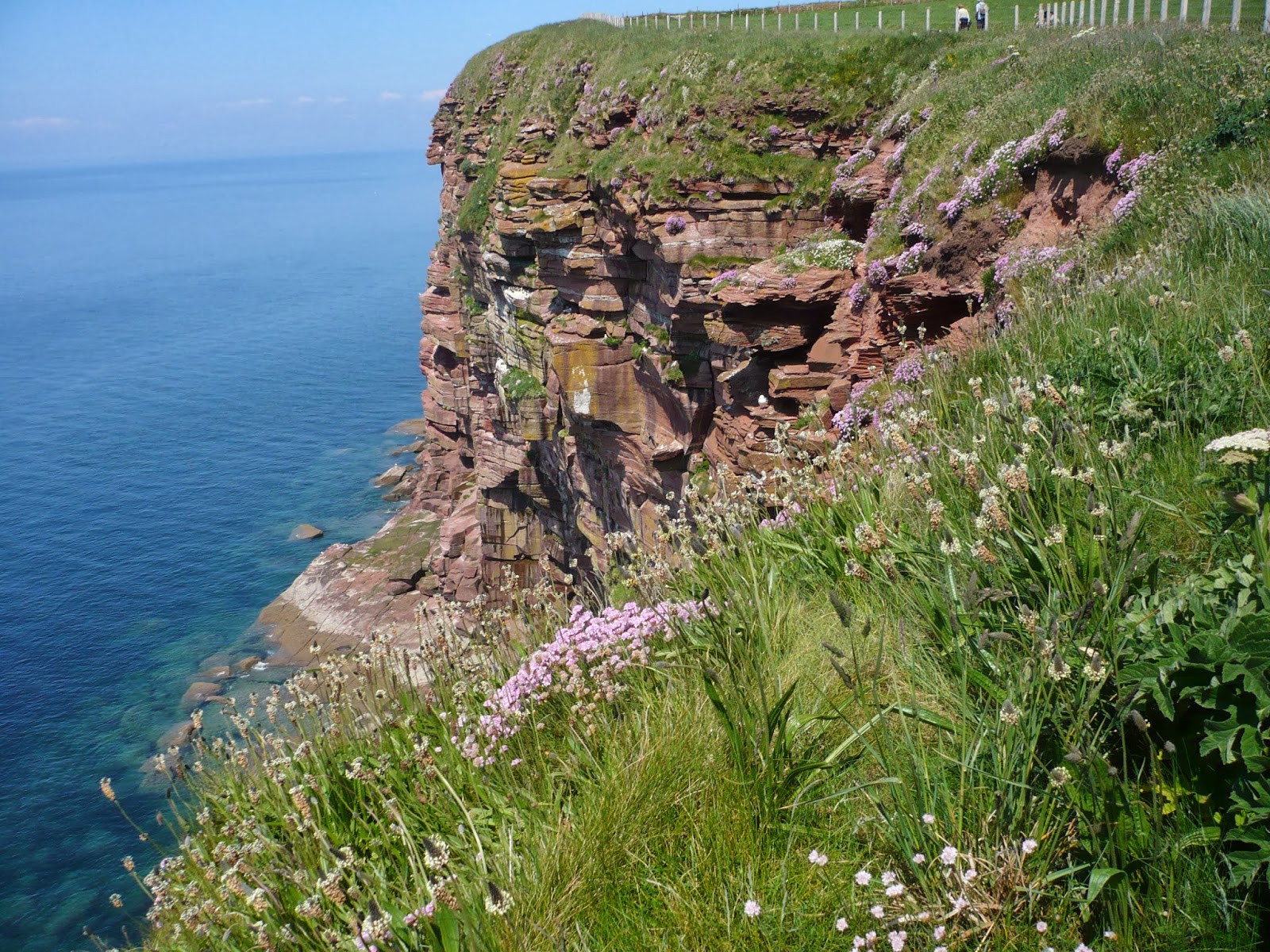
Walking out of the village to the sea and the most westerly part of Cumbria are the sandstone cliffs of St Bees Head. This is also the start of the 182 mile coast to coast walk across northern England where tradition has it to dip your feet in the Irish Sea here (or bike wheel if doing the C2C), and after passing through three contrasting national parks reaching the end at Robin Hoods Bay to do the same in the North Sea. The preferred route is usually west to east because, as the Irish blessing goes, the wind is ever at your back. I however am heading north.
along the coastal path on a warm June day, and a summer that abounded in buttercups. The views were hazy but in the distance can be seen the St Bees Lighthouse
and the path crosses inbetween that and the 
coastguard lookout.  The sea here merging with the sky it was so calm.
which the occupants of these cliffs were enjoying for turning around the corner there were
thousands of black guillemots. They almost look like dark pieces of rock from a distance but crop
a photo and here they all are. Over the last fifty years their numbers have increased but many sea-birds stop here including Razorbills which come to breed from March to July.  If lucky there are also a few Puffins,(not on this day) but there is no shortage of many other species to be seen whirling over the sea and sky.

An entry to ABC Wednesday, a journey through the alphabet, this week sojourning at S


Tuesday, 12 November 2013

Railway Reflection

The Oxford Road Railway Station reflecting its surrounding in the late afternoon sun.  The original station on this site was opened in 1849 but became dilapidated and was demolished when the line was electrified and modernised, being rebuilt in 1960 (and  recently refurbished in 2004).  I have not been able to find a photograph of the 19th Century station but it was lucky to be rebuilt before the mid 60s and concrete brutalism. The architect Max Clendinning was joined by the structural engineer Hugh Tottenham of the Timber Development Association whose timber shell roof and this laminated timber façade make it so distinctive.  Rather than reverse the time in ones head from the reflection, turn around and see

the clock tower and the correct time.
Express Sprinter waiting at Oxford Road
The curved wooden beams inside the station support the canopy and there have been later additions of waiting shelters in the same theme
who occupants may be reflecting on when their train might arrive. 
To see what the clock tower is attached to one must walk away from the station and see it soaring above what was the Refuge Assurance Building built by Alfred Waterhouse in the 1890s and then later in 1910-12 a 217 ft (66m) clock tower and extension along Oxford Road was built by his son John. Refuge Assurance occupied the building for nearly a century but today it is the Palace Hotel a short walk from the ornate
entrance (still with the Refuge name on the stonework), to the railway station or vice-versa.

An entry to ABC Wednesday, a journey through the alphabet sojourning this week at R 

Tuesday, 5 November 2013

Queens and Quids

The Queen's School, Chester When I spot a letter my first thought is "where is my camera", especially if it is one of those tricky ones towards the end of the alphabet. These big Qs were irresistible especially as behind the gates was a lovely building in Tudor Gothic style and a berried Rowan tree. Founded as the Chester School for Girls in 1878 it changed its name in 1882 when Queen Victoria became its patron and they moved here and became, the Queens School. The building stands by City Walls Rd (on the site of what was the old City Gaol and House of Correction) and was built between 1881-1883. The architect, EA Ould (1852-1909), was a pupil of John Douglas whose style influenced Ould's early buildings like these. He would become an expert on half timbered houses and indeed jointly authored a book on the subject. The building is constructed of Ruabon brick when that area of Wales was at the hight of production employing thousands of people.  With the high quality Etruria Marl clay the area also made Ruabon quarry tiles (and still does).  I wonder if there any of those inside?

The Queens School is an fee-paying independent school for girls of 4-18 and  its most recognisable ex pupil is the Gymnastic World Champion gold medallist and Olympian Beth Tweddle.

Opposite the school is the Chester Racecourse
where I hung over the low wall and took this picture of people waiting for the last race of the day.  Under the umbrellas are the bookies and small queues of people placing their last bet. some may have even made a profit on the day but one thing I can guarantee is that the bookies will be quids in.

An entry to ABC Wednesday, a journey through the alphabet sojourning this week at Q

Tuesday, 29 October 2013

Peripatetic Pianist and a Plot

2013_07_07_0675


As can be seen by the clothing this is not an October scene but the middle of summer and a warm day in York (tourist central by York Minster). I can't remember what the peripatetic pianist was playing but he was in prime position as this is a joining of many pathways.  When he gets thirsty for a pint it is possible to call into the pub on the far right  which was built on the site of where a notorious plotter was born, and takes his name -
Guy Fawkes, 
And as the rhyme goes:-   
"Remember, remember the Fifth of November,
The Gunpowder Treason and Plot,
I know of no reason
Why the Gunpowder Treason
Should ever be forgot.
Guy Fawkes, Guy Fawkes, ’twas his intent
To blow up the King and Parli’ment.
Three-score barrels of powder below
To prove old England’s overthrow;
By God’s mercy he was catch’d
With a dark lantern and burning match."
 That was way back in  1605 and everybody still enjoys the bonfires and fireworks that November 5th brings every year.  Fast forward a couple of centuries and a overheated chimney flue meant the whole edifice burnt to the ground anyway (wonderfully captured by JMW Turner who painted the blaze in watercolour sketches from a barge on the Thames). 
Westminster Bridge and Houses of Parliament, London
Look there is still a barge there today ready to prop up an easel if anything catches alight in the Parliament buildings, but that would be to deprive us of Augustus Pugin's wonderful Gothic towers and spires.
So I'll  just keep it to a virtual disaster with a heat map.

An entry to ABC Wednesday, a journey through the alphabet sojourning this week at P

Tuesday, 22 October 2013

Oystercatchers

Oystercatchers in their favourite place between mud, sand,  rocks and sea. Does it ever open an oyster?  I don't know, but it cleverly forces back the valves of mussels and small bivalves.  It will knock a limpet from rock with ease.  Walking on the Cumbria coast in July they were at their most flighty.  Gathering together at the edge of the sea, pic-pic-pic they chatter,  but come too close and
away they fly skimming the waves,
Showing off the distinctive V shape feathers. Present all around the British coast it is also increasingly found in the summer inland on the moors. I am always a surprise when I hear a slow call, pleee-ah, plee-ah and see a lone oystercatcher roller-coasting low over the land.  Happily when sometimes all one hears are about declining numbers of species the Oystercatcher bucks the trend and numbers have increased in the last fifty years.  Where once there were 30,000 breeding pairs there are now estimated to be 98,000 in the summer, (probably why some move inland to breed) but in the winter they all gather around the coast and estuaries
to be joined by visitors from Norway when the numbers swell to about 320,000.  Watch out bivalves, they're  coming. 

An entry to ABC Wednesday, a journey through the alphabet -  this week sojourning at O