Tuesday, 20 May 2014

Sign of Sheep by the Sea

Trotting along by the side of a tidal channel on Morecambe Bay this line of  sheep attracted my attention as I walked the coastal path.  They seemed to have purpose in mind. The sign says 'Beware", not of sheep, but of 'fast incoming tides. Quicksand close inshore'.  These woolly locals intuitively know that because they are sticking to the rocky outcrop and perhaps are going  in search of sweet green grass.
Heading into western slopes of the Pennines, a duo of signs, one for the farm and one saying "No HGV" although the only reason they would be on this rough road,
which I would be more inclined to call a path, would be the driver paying more attention to his Sat Nav than the road.  Perhaps these two sheep are the farmer's look out, although one of them has more interest in grass nibbling. The stripy legs are one of the indicators they are Rough Fell sheep, a descendant of a breed found in northern Britain in the middle ages.
It is a docile breed, sometimes cross bred, but is very hardy, it needs to be to survive the harsh conditions of the Pennine and Cumbrian fells.
Rough Fell with the Cumbrian fells in the background in the low November sun
The regulations for ear tags seems to change all the time and as I no longer work with my farming colleague who ran a herd and had a wealth of amusing incidents I'm not sure of the significance.  I believe that sheep born after 1 January 2010 have a yellow electronic tag in one ear and either a matching tag on the other or a tattoo.
And just as a change from Rough Fell sheep here is Cheviot; my that coat does look cosy.  This is a wool that is sometimes used by hand spinners.  These white faced sheep have been run in the borders for hundreds of years.  They can be found  up to 3,000 ft above sea level however this one is actually at sea level in the Duddon estuary.The last three photos were all taken in November last year and unlike the previous year the winter turned out to be mild but the waterproof nature of sheep wool might have come into its own.

An entry to ABC Wednesday, a journey through the alphabet, this week sojourning at S here
 

Tuesday, 13 May 2014

Right Royal Rain

Hoods up against the rain as this little group cross Lancaster Square in Conwy. The building in the background is the local police station and the painted statue on the left is of Llwelyn ap Lorwerth, also known as Llwelyn the Great (c1172-1240) who united and ruled Wales for forty years. The statue and the ornamental fountain it stands on was unveiled in 1898 to commemorate a water supply to the town.  The square (which expands behind me) is also home to the annual Honey Fair in September which dates back more than 700 years when local bee-keepers were given the right to sell their honey within the walls of the town by the Royal Charter of Edward I.
Here is a close up of the statue of Llwelyn the Great from Wikipedia with blue sky background. The statue was created by E O Griffith and is in Llwelyn's royal colours.
More rain as we take a turn around the town and pass the traffic lights. The building is Aberconwy House a medieval merchants house and warehouse.
Tourists ignoring the rain while photographing the smallest house in Great Britain with its traditionally costumed curator.
Meanwhile down by the harbour no day sailors can be seen out on the water in the misty rain
But part of the mural by the car park underpass shows sunnier sailing days by the coast and a sunbathing crab.

An entry to ABC Wednesday, a journey through the alphabet, this week sojourning at R here
 

Tuesday, 6 May 2014

Queen Victoria

Here is the Birkenhead's Queen Victoria Monument in Hamilton Square gardens. It is made of sandstone but for the steps something more resilient has been used, granite. Designed by Edmund Kirby in the form of an Eleanor Cross it was unveiled in 1905.   The origin of  the Eleanor Cross shape are from the 13th Century when King Edward I commemorated the sites the coffin of his Queen, Eleanor of Castile, had rested on its journey from where she died in Hertfordshire to her final resting place in Westminster Abbey.
The Queen Victoria monument has the coat of arms of Birkenhead, Cheshire, Wales, Ireland, Scotland, England and the Royal Arms around the bottom. The clock tower in the background is that of the Birkenhead Town Hall.
The monument is 75 ft (23 metres) high and its light and airy construction contrasts to the robust War Memorial built after World War I nearby.

An entry to ABC Wednesday, a journey through the alphabet, this week sojourning at Q here
      

Tuesday, 29 April 2014

Port Sunlight

One of the finest surviving industrial garden villages in the UK is that of Port Sunlight. Founded in 1888 by William Hesketh Lever, the "soap king"  its location the result of him looking for somewhere to build a new soap works and house his employees. At that time this area on the Wirral was marshy farmland and tidal creeks but Lever saw its both as a potential source of labour and also good connections by road and rail.
Although Lever made his fortune by manufacturing soap he would have loved to be an architect so he wanted his workers village to be a pleasant place to live and be of the finest of the architecture of the time. In this pursuit he employed over a dozen different architectural practices.
One of which was his godson James Lomax-Simpson who built the houses along the long and extensive  King George's Dive here.  The timber frame house on the left of this photograph is now a holiday home.
At the end of the drive is the Art Gallery which houses Lever's huge collection of pottery, paintings and furniture. He collected so much he ran out of room in all his houses.  The gallery was built in memory of his adored wife, Elizabeth,  Lady Lever (who died in 1913) who he called his "better three-quarters".
They lie together in the churchyard of the church which was built for all denominations. The signpost outside the mausoleum is just a simple sign that says "The Founder".  When Lever was knighted he became Lord Leverhulme, which was the combination of their two surnames (Lever and Hulme).
Lever's social and romantic ideals makes the village an unique place.  The health and education of the workers at the time was far superior to those in the nearby cities. The external look of the village has been preserved since the death of Lever in 1925. Set in 130 acres of parkland there are over 900 houses and 12 public buildings now looked after by the Port Sunlight Trust.
The present home of the NatWest Bank was the Girls' Hostel (built 1896) originally built as a a hostel for the female employees travelling from Liverpool.
What I liked about the village was the variety of architecture, as can be seen at the time it was built there was much influence from of the Arts and Crafts Movement.
Alas although I can show some of the housing styles I can't show the Port Sunlight Swimming Pool which was an open-air pool and, like the majority of them in the UK, it does not survive.  I am told by someone who was born, married and lives in the village it was wonderfully place to swim as it was heated by underground pipes from the Glycerine Works in the factory .

So there you have it, a village built on soap.  Lever was famous for his use of advertising and spent millions. His famous quote is as true today as it was in the 19th century "I know half my advertising isn't working, I just don't know which half"

An entry to ABC Wednesday, a journey through the alphabet this week sojourning at P here

Tuesday, 22 April 2014

Observing Observatories

Tucked away on a hill in Hesketh Park, Southport is the Fernley Observatory. It fell into disrepair in the 1970s but this listed building was refurbished in 2007 and is once more operational with its 6" refracting telescope being used by the Southport Astronomical Society.  The park it stands in is named after the Rev Charles Hesketh who donated the land, the observatory is named after a local Methodist and philanthropist who was involved with the setting up and operating Hesketh Park and donated the Meteorological and Astronomical Observatory in 1871.
I would have liked to take a trip up the stairs to have a look inside but alas it was not open.  If I had been fortunate then I would have seen inscribed around the dome Psalm XX1X-1 "The Heavens declare the glory of God; And the firmament showeth his handwork". 
Today observatories are more likely to be found on the tops of mountains rather than hills but the one glanced through the pillars on this hill on a hazy day is a more famous name than the one is Southport
 Helpfully this woman is pointing at the name above the doorways.
 The Royal Observatory, Greenwich which was founded in 1675 when the first Astronomer Royal was appointed.  The building takes his name of Flamsteed House. Its original purpose was to improve navigation at sea so that an exact position of east and west could be found by astronomical means and to discover the "so much desired longitude of places" and is the home of Greenwich Mean Time.
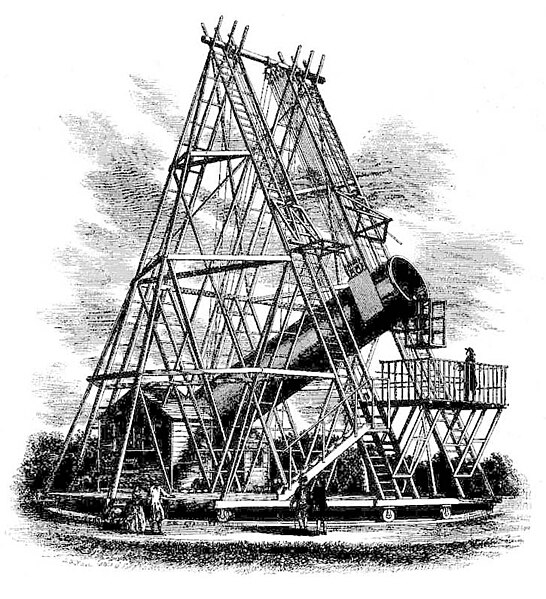
The scientific work of the Royal Observatory was relocated in the 20th Century and Greenwich itself is now a tourist attraction.  There is a pleasant garden at the back here but the thing of most excitement to me was the remains of William Herschel's telescope seen in the foreground.  This is the remaining section of the 40 ft (12m) reflecting telescope built for William Herschel who became famous for his discovery of the planet Uranus in 1781.  At the time the telescope was the largest in the world and was paid for by King George III at a cost of £4000.


Completed in 1789 and erected at Herschel's home near Slough (30 miles east of Greenwich).  It soon became a tourist attraction even being marked on the 1830 Ordnance Survey map.  It was difficult to set up and maintain and his son dismantled it in 1840 then most of the Tube was destroyed when a tree fell on it 30 years later.  I imagine that William Herschel's sister would have also looked through this telescope as she was also an accomplished astronomer discovering many comets.
Going inside the Observatory and up the stairs is this wonderful walnut panelled room with soaring windows, just the place to look at the sky.
 Time to put our feet up outside the Astronomy Café at the Royal Observatory   Here stands the Gagarin Statue and this part of Flamsteed House has now been renamed Gagarin Terrace. The zinc alloy statue was unveiled by Yuri Gagarin's daughter Elena in March 2013. It is an exhibition copy of the statue made by Anatoly Novikov installed at Lyubertsy (just outside Moscow) which is where Gagarin trained as a steel foundry worker aged 15-16.
Posters in the Astronomy Café
After his flight into space Gagarin was invited to visit Manchester by the Foundry Worker's Union, which when he accepted  was extended to a state visit to London and he made his two day visit in July 1961.  These posters celebrate the occasion when the crowds came out to see the first man in space. an observer of the stars and the dream that one day we will travel there.

An entry to ABC Wednesday, a journey through the alphabet, this week sojourning at O here 

Tuesday, 15 April 2014

Naval College

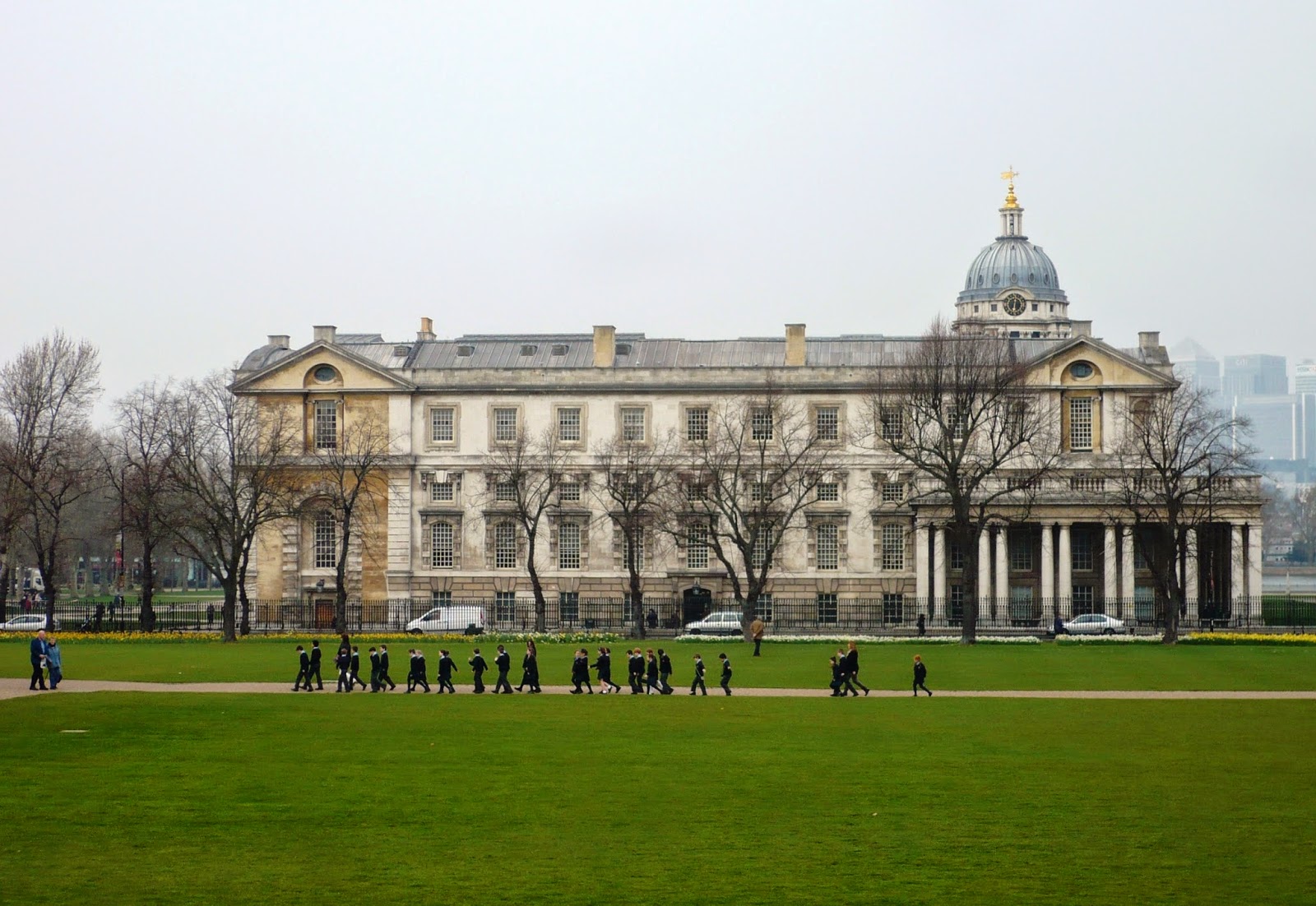
Part of the complex of buildings that is the Old Royal Naval College, Greenwich, London which I passed when heading towards the riverside.  Designed and built by Christopher Wren it was also added to by later architects, its most iconic view of its buildings and domes is from the across the river
Described by UNESCO as the "finest and dramatically sited architectural landscape ensemble in the British Isles" unfortunately this is the clearest view I took when departing by river boat.  The reason.  It was just a few days before the Saharan Sand/Dust was going to give London its first smog of the year on the 31st March.
The preceding days (before the full impact of the dust storm) resulted in hazy views such as this taken from Observatory Hill in Greenwich Park of the Naval College and London skyline.
But here is one half of the building domes taken from the Greenwich Park side and as a school crocodile passed on its way to the National Maritime Museum
Where, as threatened in my post for F for Fourth Plinth in this round of ABC Wednesday, here is a photo of where Yinka Shonibare's Nelson's Ship in a Bottle found its permanent home.
As can be imagined Greenwich's naval past is everywhere but the site was originally a palace of the Tudor monarchs (which fell into ruins after the English Civil War). 
An appropriate place to find a statue of Sir Walter Raleigh who was a favourite of Queen Elizabeth and schoolchildren everywhere who enjoy swashbuckling history so no wonder he featured in the BBC's poll of the 100 Greatest Britons. Originally this statue was in Whitehall and was relocated here outside Pepys House.

All the Christopher Wren designed buildings were constructed from 1696-1702 to serve as a Royal Hospital for Seamen, this closed in 1865 and between 1873 to 1998 the buildings were used as the Royal Naval College for training in the naval sciences. Today some buildings are occupied by the University of Greenwich, the National Maritime Museum and are owned by a charitable trust for all to enjoy their architecture.
An entry to ABC Wednesday, a journey through the alphabet, this week sojourning at N here