 I've tested out my new boots and done a few miles of easy walking, and now they are not as prisine as this any more. Having had a good experience with Brasher's cross trainers thought I would try their boots. I'm heading for the Welsh hills, and perhaps some Welsh beer. I may be out in the wilds so no posts for a week.
Friday, 29 May 2009
Boots, Boots, Boots
I've tested out my new boots and done a few miles of easy walking, and now they are not as prisine as this any more. Having had a good experience with Brasher's cross trainers thought I would try their boots. I'm heading for the Welsh hills, and perhaps some Welsh beer. I may be out in the wilds so no posts for a week.

Tuesday, 26 May 2009
ABC Wednesday - S
 S is for Seat
Are you sitting comfortably? Then I'll begin. Sometimes when walking through forests, you come across quirky little carvings done by the foresters. The forestier who did this near Geishouse was obviously of a more practical nature. But only room for one, whereas these two trees near the old Hincaster canal can accommodate four, and are very comfortable.
 Purpose built with artistic flair, an unusual wooden seat near Wye.
 Sometimes seats provide both rest and shelter as this one does on top of Pendle Hill
 Certainly well built to withstand any storm, although the day this picture was taken was warm and sunny.
 A bit of Scottish stone nicely placed so Ron can gaze at
 Sueno's Stone. A 9th Century Pictish sculpture stone which has its own little (21 ft) glass case.
 When you are waiting for a train at the Station a seat is always nice. These are the old Furness railway (1846-1923) seats, refurbished and still in use on Ulverston station.
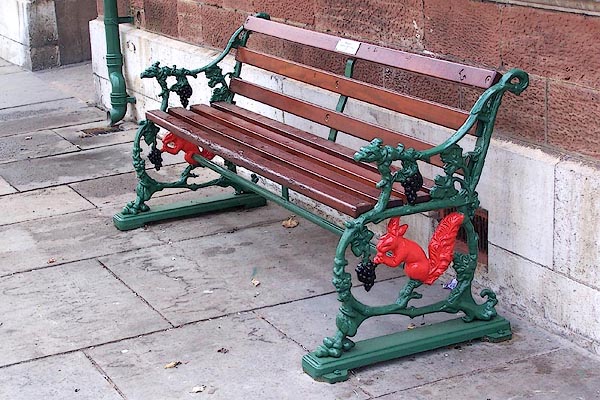 I will be having ABC withdrawal next week as I am away, but wish you all you ABCers a terrific T day.
To see more SSSSSs go to Mrs Nesbitt's ABC Wednesday
Friday, 22 May 2009
Star Trek - 2009
Heard the hype, read the good reviews so off we went to the new Star Trek movie with high hopes.
The story is a prequel on how the crew of the first Enterprise get together, with the twist that a Romulan wants revenge, and has travelled back through time to destroy Spock, his planet, and the Earth.
The special effects CGI are excellent, planets, interiors and exteriors of spaceships its all there in spades. The plot sort of holds together but has gaping holes in it of the "and with one bound they were free" type. The monster/reptiles scene where they chase after James T Kirk seems tacked on for no reason, only to irritate. How would a reptile exist on an ice planet? OK might have adapted in some alien way. Both seemed to travel at speed, and a human being is notoriously slow, even hens can outrace us.
The cast was good. I wondered if Zachary Quinto's previous role as Sylar in Heroes would overshadow his performance, but he was excellent as Spock, coming to terms with is half human/half Vulcan nature. Chris Pine as James T Kirk was a whole lot less irritating than Shatner in the original, but that may be because of some of the moralising in the original series scrips. He played the part in a different way but then threw in some of Shatners mannerisms and speech patterns at certain times which added to the enjoyment. The stand out performance was Simon Pegg as Scotty who brought some energy to the film.
Nerd alert. The Romulan space mining ship was a puzzle. I am sure the idea was lifted from a similar ship I've seen somewhere like Babylon 5.
Overall the verdict would be, good as an action SF film, and if they follow it up with another film the cast should develop well. The downside was it was rather a Spielbergian type schmaltzy version of Star Trek so I hope they choose another director next time rather than JJ Abrams. Abrams also seemed to accentuate the military nature of the Federation rather than the Roddenberry version of the future. I suppose that just reflects the times we live in.
Tuesday, 19 May 2009
ABC Wednesday - R
.JPG) R is for Rain and Rivers
R is for Rain and RiversWe British like rain, it gives us something to moan about. I once went on a cycle-camping trip to France, freewheeling off the ferry into warm sunshine. By the afternoon it was raining and it continued to rain off and on for the fortnight. Some days it was showery, for two days it was a deluge. Wet tent packed, wet tent pitched. Two days before we were due to return the sun came out and we dried out. It was one of the most enjoyable holidays I have had. Though that may be the wine talking.
The rain falls and trickles into Rivers. Early on in the year this river is quite full and the stepping stones on the River Esk are under water. Traps for the unwary, nice and slippy. This is cool clear running water.
 But here at the estuary, Kirkby Pool river is making a sluggish journey to the sea.
 Living on a small island we do not have the vast rivers such as the Amazon, or rivers that travel great distances, but here is the river that travels through London, The Thames. This is taken from the North Kent Marshes where Charles Dickens set his book 'Great Expectations', The oil terminal is across on the other side but the marshes are just the same as he describes them.
.JPG) All rivers start in a small way, usually unnoticed, but this little dribble is the start of the Thur in Alsace, which gets a notice attached, and there is a rather nice seat by the side where you can gaze at the dribble, and the view down the valley.
All rivers start in a small way, usually unnoticed, but this little dribble is the start of the Thur in Alsace, which gets a notice attached, and there is a rather nice seat by the side where you can gaze at the dribble, and the view down the valley. When it reaches the town of Thann it has become rather more noticeable
 In the summer when the water is low, a paddle is nice and refreshing, although I think the objective of these paddlers was another type of refreshment, at a riverside pub (The Aspinall Arms on the River Ribble).
.JPG) Walking by river is always relaxing especially if you have brought a picnic, or you can use them as a guide to travel through valleys. At the end of a walk it is always nice to sit on a river bank. Here I am watching a Heron looking for tea. On my pocket camera you would just get an indistinct grey shape, so no picture of that bird, you get my feet instead. As usual I have got a little bit muddy.
Walking by river is always relaxing especially if you have brought a picnic, or you can use them as a guide to travel through valleys. At the end of a walk it is always nice to sit on a river bank. Here I am watching a Heron looking for tea. On my pocket camera you would just get an indistinct grey shape, so no picture of that bird, you get my feet instead. As usual I have got a little bit muddy. Go to ABC Wednesday for lots more interpretations of the letter R
Monday, 18 May 2009
Wash This Blood Clean From My Hand by Fred Vargas
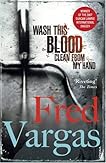 Murders from 1943 to 2003 that all have murder wounds in common, three punctures like a trident. Commissair Jean Baptiste Adamsberg thinks it is the same killer, Judge Fulgence, but he has been dead for over 15 years. Whoever he tries to convince tells him to stop wasting their time. Each murder has been solved and someone has been convicted, despite the accused not remembering anything. Commissaire Adamsberg has a personal interest - his brother's girlfriend was killed, and his brother would have been convicted, if Adamsberg had not got rid of some of the evidence.
The first few chapters are rather contrived, as Vargas sets up the characters and a fresh murder, but once we fly from Paris and arrive in Canada the plot and prose start to flow. Before long Adamsburg is on the run, accused of a murder with three puncture wounds! He cannot bear to think he has committed this crime, but there are hours he cannot remember after a drinking binge, and he found blood on his hands. The key is to return to France and solve the murder of The Trident.
Commissair Adamsberg is a detective who relies on intuition and imagination whereas his subordinate, and friend, Captaine Danglard is intellectual and logical. A nice yin/yang balance in a detective novel. As a man on the run he is help in his quest by a handful of people and a different type of computer hacker.
Vargas's characterisation of the main and secondary characters is deft and she can capture the essence of a place in a few sentences. An enjoyable, lyrical and page turning read, admirably translated by Sian Reynolds. I look forward to reading more Vargas. Apparently this is number five in the Adamsberg series but the first I have read.
Additional Info
The book won the Duncan Lawrie International Dagger Award.
The French title is 'Sous Les Vents De Neptune' (Under Neptune's Winds) and the origin of the English title is from Macbeth "Will all great Neptune's ocean wash this blood from my hands". Love whoever came up with that.
The book has recently been made into a film "Sous Les Vents De Neptune" which I think is a made for TV movie. It has an interesting cast...
more
Friday, 15 May 2009
My Brother Is An Only Child
The film clubs Thursday film 'Mio fratello e figlio unico' (2007) directed by Daniele Luchetti
"Luchettis sweeping saga, divisions within working class family encompasses 15 years of political turmoil in a nation's history"
Set in the 60s and 70s this film is based on the novel by Antionio Pennacchi called 'Il Fasciocomunista'. The story follows the lives of two working class brothers living in Latina, a small model town built by Mussolini near Rome in the Pauline Marshes.
The film opens with a young 13 year old Antonio Benassi, whose nickname is Accio (bully) due to his belligerence, training in a seminary to be a priest. He questions the institution and leaves suddenly to return to his family. They don't exactly welcome him with open arms as the apartment is overcrowded and rundown. His sister has taken his bed so he has to sleep in the corridor.
Accio wants to continue his studies in Latin but his father thinks this is pointless and sends him to the technical college so he can get a trade. Disaffected, he forms a friendship with a father figure, Nastri, who is a fascist and influences Accio with his ideas. Accio joins the movement.
In contrast Accio's older brother Manrico (Riccardo Scamerico) is a handsome, charming leftist. He meets Francesco (Diane Fleri), a student with similar ideas and they become lovers, when Accio meets her he too falls in love.
Manrico starts to work at the factory where his father is employed and begins to organise the workers. The fascists plot to burn his car and Accio tries to stop them, to no avail. Now disillusioned with the violence of his fellow fascists he breaks with them but Nastri's wife Bella's (Bonaiuto) interest in him is beyond politics. They go to bed together under the Mussolini bed sheets. She is besotted and buys him that quintessential Italian small car of the 60s the Fiat 600 (Love those doors that open backwards).
The brothers are now both on the communist side as the sit ins spread across the Europe of 1968.
Francesca has moved to Turin and Manrico visits at weekends and if he doesn't then Accio does. The brothers are growing closer but Manrico is becoming more extreme whereas Accio just wants to see things change. The need for change is symbolised by the Bonassi's house where cracks appear, walls crumble and they are promised new housing. The keys to the houses are available but corruption prevents them occupying them. The posturing of the right and left give no practical help.
This is an engaging film with its squabbling but loving family, a coming of age of a boy, a love story and a country and people desperate for change. The term bittersweet would encapsulate the feeling of this film and Luchetti has a light touch while dealing with some dark times but not without humour.
The soundtrack is superb taking you, with music, to that period and the end tune 'Amore Disperato' by Nada sends you humming out of the cinema although not all has gone well. The handheld camera in one of the fight scenes put you right in the way of harm! The acting is first-rate of all the participants. Vittorio Emanuele Propizio who plays the young Accio is suitably belligerent and I believe that Elio Germano who takes the role of the older Accio won a best actor award.
Tuesday, 12 May 2009
ABC Wednesday - Q
 Q is for Quicksand
This is the Leven Estuary where the River Crake feeds into Morecambe Bay, a 120 square mile intertidal area. Five rivers in total run into the bay creating shifting channels and water logged sand. It is also rich in wading birds who also use it as a wintering and passage area.
 The point which is on the far side near hear was one of the places we used to go to the beach. It was reached via a railway viaduct. One of my vivid memories is of the heat of the wooden planks on our feet as we walked by the railway line which we took us over the channel and from where we would walk on the sea turf and round to the point. Each summer the area would be different, sometimes flat, sometimes with channels but quite magical. The viaduct has long gone now, no more trains, and has been replaced by a footbridge.
But back to the quicksand
 One of the things to do as a child was to stamp up and down on the spot to make the sand go all wobbly, great fun. Some of the areas further out in the bay are far more dangerous.
 In past times the stage coaches would come across the sands because this saved miles and miles of travel going round the bay, however, not all made it some sinking or being overtaken by tides when stuck. Legend has it that part of the Roman Army crossed the sands, never to be seen again. My grandmother told the story, to all her grandchildren, of standing as a young girl on Arnside Knot and seeing a horse and cart coming back from gathering cockles and then the man, horse and cart disappear within minutes.
 There was such loss of life in earlier times that a guide was employed by the Duchy of Lancaster in 1536 to take people across the bay and the latest in this long line is Cedric Robinson who still guides groups of people across, but just for fun nowadays. The times of the crossing depend on the tide because as it says on the above notice they are fast rising and come in, as the local expression goes, "faster than a horse can run".
For lots more Qs go to Mrs Nesbitt's ABC Wednesday
Subscribe to:
Posts (Atom)


