Saturday, 11 February 2012

Bookish

 An entry to Sepia Saturday, "Using old images as prompts for new reflections"

I have always loved books, perhaps too much
 because I obviously couldn't be without one on this day out on Hoad Hill, Ulverston.  I remember these little books, they were a set that fitted into a box sleeve. I have no idea who the legs with summer skirts belong to, one would have been my mother. I can remember as a child seeing pictures of people reading in different positions and experimented to see if one would replace curling up on a chair, such as lying on my stomach (too uncomfortable for long periods of time),  but never tried sitting on a branch
 which does look rather spiffing to use the word that could have been used in this book full of stories full of adventure such as "Betty's Besetment" "The Detectives" and "Out of the Storm.  Even if I did not know that this book was published in the 1930s I would know it was my mothers rather than mine because no book illustration would be left uncoloured in a book owned by me as a child.  I wonder which section I would have started on first, possibly the tree flowers, although the dress flowers would be tempting, then again the broad sweeps of the branch would be relaxing.  Although I have never sat on a high branch to read I did used to 
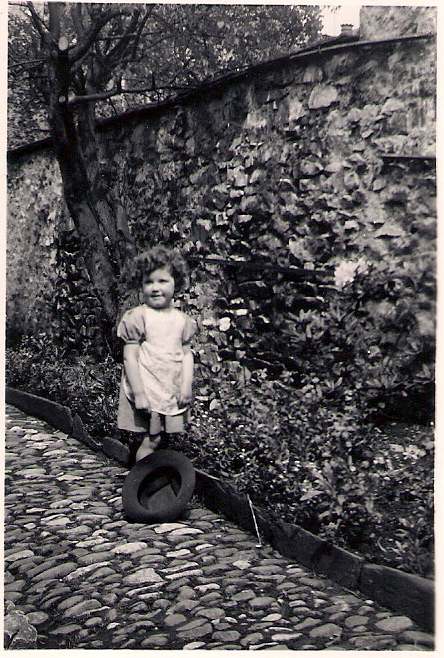
use the lilac tree in the background of this photo to gain access to the wall (not when this picture was taken, those 3 year old legs would never have made it).   On the other side of the wall was a builders yard, which had interesting stacks of wood, copper tubes for plumbing and the coming and goings of the builders. On warm summer days it was my favourite place to sit drying my hair after having it washed.   We left this house when I was 12 years old but I think I gained my love of walled gardens from this time, not to mention hats. But here is a much more elaborate hat

 From the North Yorkshire Library Collection
in an idyllic spot for a quiet moment with a book on the River Greta at Ingleton in 1912, (woman and photographer unknown).

Tuesday, 7 February 2012

ABC Wednesday - Paul DAY

 Paul Day's "The Meeting Place" was one of the statues commissioned for the recently refurbished Victorian railway station of St Pancras in London.  Day shows himself and his half-French wife Catherine representing a French woman reunited with her English lover, symbolising the meeting of two cultures and the romance of travel.  This is a station that the French and English do meet because the Eurostar trains departs and finishes here, travelling back and forward from the two countries under the Channel Tunnel.  The statue is huge 20 tonnes and 9 metres high,  it needs to be because the William Barlow's St Pancras shed of 1868 is on a monumental scale.  The statue is one that is both loved and hated.  I'm now going to leave the luscious St Pancras architecture, glimpsed in the background, for later in this round of ABC Wednesday but instead show some of the reliefs around the frieze at the bottom of the statue, all continuing the theme of people meeting in a public spaces  
 The men who built the railways
 I think this is supposed to be a railway driver and two people waiting on a station
 The underground rush hour commute, and lastly
meetings on stairways.

An entry to ABC Wednesday, Round 10, a journey from A to Z...


Saturday, 4 February 2012

Walkies

I couldn't find any dog orientated postcards for this week's Sepia Saturday theme so I'm migrated to this blog, although if it had been beards, as humorously mentioned,  I'd have been quids in because my Victorian family ancestors sported a fine array.
Unlike my father who was always clean shaven. Here he is on a Sunday in May 1970 taking a break by sitting on a cairn above Easdale Tarn with Shandy the dog.  Sunday walks were often taken with his and my mother's friends Chris and Hilda whose pet was Shandy. Even if they did not know what day it was the dog always did for on Sunday mornings at their home he would pull down his lead and sit by the door, patiently waiting but underneath eager to go on the fells.  How did he know which day it was?

I think this photo shows well how this tarn is right in the middle of the Lake District, the hills spread out all around. The walk up to Easdale Tarn  is a popular one from the village of Grasmere, once the home of William Wordsworth, who no doubt also walked this path. It became so popular in Victorian times that there was a refreshment hut on the tarn for thirsty walkers.

This little group of walkers however had done that walk and were on their way to Codale Tarn which rests in a hollow so typical of Lakeland tarns.
      Photo courtesy of Ann Bowker at Mad About Mountains

and is the perfect place to laze by on a hot summers day.  Not by the looks of it on the June day of this photo, the misty peaks are the Langdale Pikes

Tuesday, 31 January 2012

ABC Wednesday - Centenary

 The city of Preston at one time had 64 cotton mills and Centenary Mill was one of them.  The power house chimney
 today is a city landmark.  Centenary Mill was built by the Horrockses Company in 1891 to mark 100 years of its cotton manufacture in Preston (where they had originally started in the Yellow Factory).  In the second half of the 19th Century takeovers and mergers instigated the construction of enormous spinning mills and this was one of four monumental giants erected in the final years.  Horrockses had merged with companies of Crewdson and Hollins to become the Horrockses and Crewdson Company  Could my pocket camera get the building into one photograph?
 Well I managed to get the side entrance and a portion of the building so I tried again
 and just squeezed it in while cutting off the top of the tower. Outwardly the brick façade is in the style of the day, inwardly there was a revolutionary steel frame, allowing greater weight to be supported inside and permitting large and numerous window.

 In 1981 Courtaulds Textiles closed their mill and Horrockses moved work from Centenary Mill to the Courtaulds site. In 1986 Centenary Mill was taken over for blue jean manufacture and 50% of UK jean manufacturing was done here employing 3000.  That finished and  it was used as warehousing eventually it lay empty until in recent years the building was converted into apartments.

Horrockses was a vast enterprise but its founder John Horrocks was a small spinner who by building a mill was one of the pioneers of the Lancashire 'factory system' by which the cotton industry was revolutionised.  The company used the slogan "The Greatest Name in Cotton" and at the time the Centenary Mill was built they were expanding their business both at home and abroad. Labels were tailor made for each different market, they were rarely understated....
An entry to the ABC Wednesday meme, a journey  from A to Z

Tuesday, 24 January 2012

ABC Wednesday - Bridge Inn

 The Bridge Inn, Boughton on the Chester stretch of the Shropshire Union Canal.  I was fascinated by the chimneys of this pub which as you get closer
 enclose the sign that proclaims the the date 1899.  It was not the only ornate sign because going round to the front
 two putti celebrate the name and
the pub sign celebrates the chimneys.

I could find no other information of the history of the pub but it is near a canal mooring point and canal bridge number 123. You can always depend on lots of pubs on a canal.  I find it interesting that it was built at this late date when most canals were in decline (the railways were taking the trade) but perhaps the reason this canal was different because of rivalry.  The canal was leased to the LNWR (London and North Western Railways) and operated energetically because a large portion of the canal ran through the area of their great rival the Great Western Railway.  In 1895 there were about 400 boats operating on this stretch. By the 1920s the days of bulk water transport were ended.    But to bring up to date more of interest to me is that it was in last years Good Beer Guide and has a wide selection of real ale.  How did I miss that?  Next time we are down in this area I will have to shepherd my companions through the door and find out what is inside, apart from a Pub Quiz which I notice is on Sundays.

UPDATE:Thanks to the Landlord commenting here is the story of the Bridge Inn:
 "There are 6 fire places throughout the building, I think two more have been covered up in two of the bedrooms.The original Bridge Inn was one hundred meters up the road where a hump back bridge once crossed the canal, but was lost when the bridge was replaced with a bridge that trams could cross,that is the reason the pub was built when it was. I think the original pub was built a 50 or 60 years earlier".

Well that has certainly satisfied by historical curiosity and next time I am down in Chester I will have to satisfy my liquid curiosity and call in. The outside is to be painted in the spring so I suspect there is also another photo opportunity with canal to be taken.  

An entry to ABC Wednesday, a journey from A to Z now at the beginning of Round 10 

Tuesday, 17 January 2012

ABC Wednesday - Anderton

The Anderton Boat Lift, sometimes called the "Cathedral of Canals".  This was the elegant solution to connecting the Trent and Mersey Canal to the River Weaver which  run roughly parallel at this point with a horizontal gap of about 400 ft (121m).   In the photo (top right) can be seen the route on to the lift from the Trent and Mersey Canal.  The canal barge floats into a huge water tank, or caisson, with watertight sealable doors
which is counterbalance by another on the other side. It makes its way slowly down to the other waterway.  Here you can just see at the bottom the sightseeing boat which takes the trip down the lift
and emerges out onto the River Weaver, it is named after Edwin Clark who was the designer of this boat lift opened  in 1875.  He went on to construct more lifts in Belgium and other parts of the continent. Anderton was originally built as a hydraulic lift but in 1904 it was converted to electric, after operating for a hundred years it was eventually closed due to corrosion and the fact that its original purpose of transporting large quantities of salt from the Cheshire mines and also clay for the midland potteries was no longer required.  This was as can be seen not the end for  restored, returned to hydraulic operation it reopened again in 2002.  (The full history and technology can be found on Wikipedia here).  Today the Anderton Boat lift has a visitor and exhibition centre, of course the structure is the real attraction, still used by leisure craft.   A link to the salt that used to be transported through the boat lift still exists nearby in the
chemical plant producing sodium carbonate and sodium bicarbonate located on the opposite bank just where boats turn from the lift into the River Weaver. On the side of the river I'm taking the photo, nature trails. A contrasting part of Cheshire.

Here we are at the start of another round of ABC Wednesday, we are into double figures, or even binary, have a happy Round 10 everyone.

Saturday, 14 January 2012

Trafalgar Square

Just back from a short break in London so here is perhaps one photograph that would sum up the trip (apart from the fact I can never resist a fountain in sunshine).  Part of Trafalgar Square, in the centre of the city surrounded by galleries, theatres, restaurants and pubs and in the photo, lots of people, the art of display, interesting buildings and just in the picture a bit of construction.  Its a long time since I have visited the city and it never disappoints, the only problem is fitting all one wants to do (impossible) into a short time.